

Cold Adaptation and Stenothermy in Antarctic Notothenioid Fishes
105
055 ~
050 1I?
I
045 ~
I
i
I
I
I
040
AntarctiC
I
1
NolothenlOids
I
~
(j
.s
035
,,j
"
E
030
1
1
::s::: o 25 l
.
Q)
1
- ~ 020
2
~ 015
1
010
-0 Gllichthys mrabills
1
005
•
GlllChthys seta
000
0
5
10
15
20
25
30
35
40
45
Temperature rC)
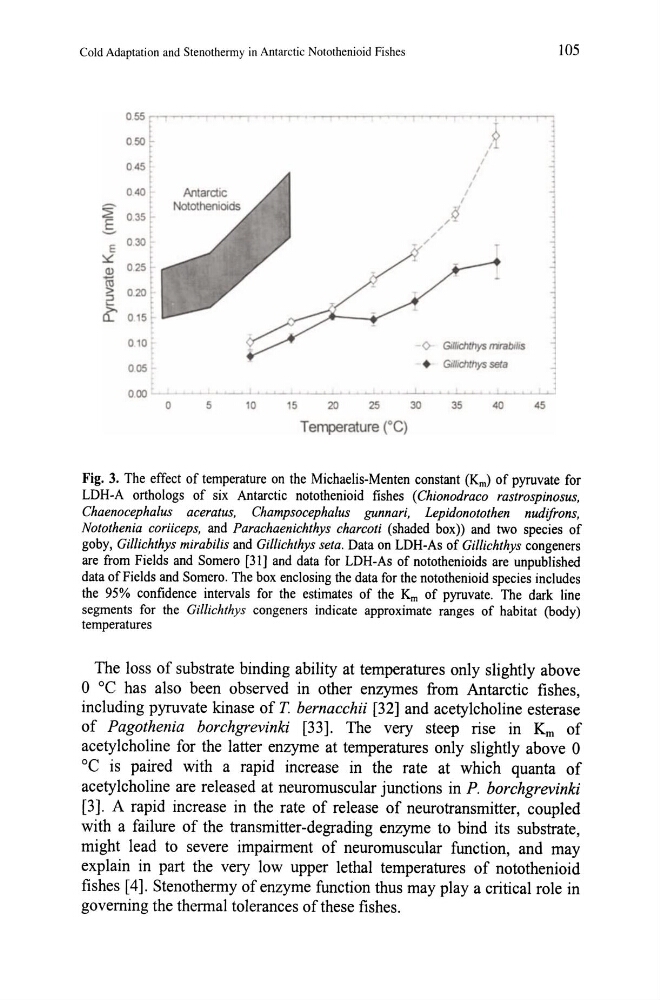
Fig. 3. The effect of temperature on the Michaelis-Menten constant (Km) of pyruvate for
LDH-A orthologs of six Antarctic notothenioid fishes (Chionodraco rastrospinosus,
Chaenocephalus aceratus, Champsocephalus gunnari, Lepidonotothen nudifrons,
Notothenia coriiceps, and Parachaenichthys charcoti (shaded box)) and two species of
goby, Gillichthys mirabilis and Gillichthys seta. Data on LDH-As of Gillichthys congeners
are from Fields and Somero [31] and data for LDH-As of notothenioids are unpublished
data of Fields and Somero. The box enclosing the data for the notothenioid species includes
the 95% confidence intervals for the estimates of the Km of pyruvate. The dark line
segments for the Gillichthys congeners indicate approximate ranges of habitat (body)
temperatures
The loss of substrate binding ability at temperatures only slightly above
o °C has also been observed in other enzymes from Antarctic fishes,
including pyruvate kinase of T bernacchii [32] and acetylcholine esterase
of Pagothenia borchgrevinki [33]. The very steep rise in Km of
acetylcholine for the latter enzyme at temperatures only slightly above 0
°C is paired with a rapid increase in the rate at which quanta of
acetylcholine are released at neuromuscular junctions in P. borchgrevinki
[3]. A rapid increase in the rate of release of neurotransmitter, coupled
with a failure of the transmitter-degrading enzyme to bind its substrate,
might lead to severe impairment of neuromuscular function, and may
explain in part the very low upper lethal temperatures of notothenioid
fishes [4]. Stenothermy of enzyme function thus may playa critical role in
governing the thermal tolerances of these fishes.
105
055 ~
050 1I?
I
045 ~
I
i
I
I
I
040
AntarctiC
I
1
NolothenlOids
I
~
(j
.s
035
,,j
"
E
030
1
1
::s::: o 25 l
.
Q)
1
- ~ 020
2
~ 015
1
010
-0 Gllichthys mrabills
1
005
•
GlllChthys seta
000
0
5
10
15
20
25
30
35
40
45
Temperature rC)
Fig. 3. The effect of temperature on the Michaelis-Menten constant (Km) of pyruvate for
LDH-A orthologs of six Antarctic notothenioid fishes (Chionodraco rastrospinosus,
Chaenocephalus aceratus, Champsocephalus gunnari, Lepidonotothen nudifrons,
Notothenia coriiceps, and Parachaenichthys charcoti (shaded box)) and two species of
goby, Gillichthys mirabilis and Gillichthys seta. Data on LDH-As of Gillichthys congeners
are from Fields and Somero [31] and data for LDH-As of notothenioids are unpublished
data of Fields and Somero. The box enclosing the data for the notothenioid species includes
the 95% confidence intervals for the estimates of the Km of pyruvate. The dark line
segments for the Gillichthys congeners indicate approximate ranges of habitat (body)
temperatures
The loss of substrate binding ability at temperatures only slightly above
o °C has also been observed in other enzymes from Antarctic fishes,
including pyruvate kinase of T bernacchii [32] and acetylcholine esterase
of Pagothenia borchgrevinki [33]. The very steep rise in Km of
acetylcholine for the latter enzyme at temperatures only slightly above 0
°C is paired with a rapid increase in the rate at which quanta of
acetylcholine are released at neuromuscular junctions in P. borchgrevinki
[3]. A rapid increase in the rate of release of neurotransmitter, coupled
with a failure of the transmitter-degrading enzyme to bind its substrate,
might lead to severe impairment of neuromuscular function, and may
explain in part the very low upper lethal temperatures of notothenioid
fishes [4]. Stenothermy of enzyme function thus may playa critical role in
governing the thermal tolerances of these fishes.