

Cold Adaptation and Stenothermy in Antarctic Notothenioid Fishes
H
ontrol
H
T. berllaccltii
G. mirabili
' +- 90kDa
+- 70kDa
103
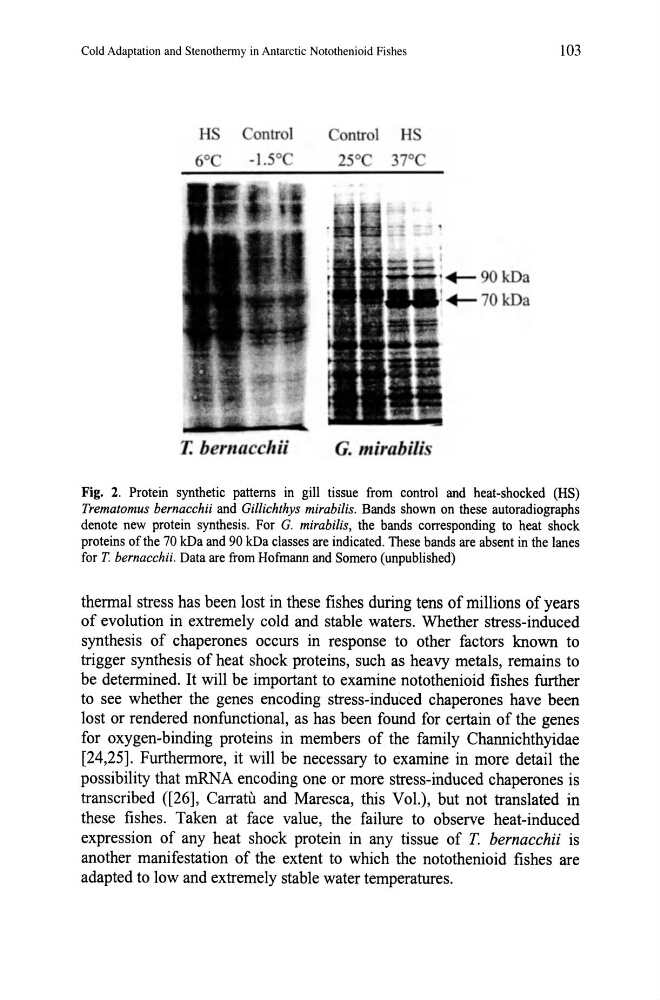
Fig. 2. Protein synthetic patterns in gill tissue from control and heat-shocked (HS)
Trematomus bernacchii and Gillichthys mirabilis. Bands shown on these autoradiographs
denote new protein synthesis. For G. mirabilis, the bands corresponding to heat shock
proteins of the 70 kDa and 90 kDa classes are indicated. These bands are absent in the lanes
for T bernacchii. Data are from Hofmann and Somero (unpublished)
thermal stress has been lost in these fishes during tens of millions of years
of evolution in extremely cold and stable waters. Whether stress-induced
synthesis of chaperones occurs in response to other factors known to
trigger synthesis of heat shock proteins, such as heavy metals, remains to
be determined. It will be important to examine notothenioid fishes further
to see whether the genes encoding stress-induced chaperones have been
lost or rendered nonfunctional, as has been found for certain of the genes
for oxygen-binding proteins in members of the family Channichthyidae
[24,25]. Furthermore, it will be necessary to examine in more detail the
possibility that mRNA encoding one or more stress-induced chaperones is
transcribed ([26], Carraru and Maresca, this Vol.), but not translated in
these fishes. Taken at face value, the failure to observe heat-induced
expression of any heat shock protein in any tissue of T bernacchii is
another manifestation of the extent to which the notothenioid fishes are
adapted to low and extremely stable water temperatures.
H
ontrol
H
T. berllaccltii
G. mirabili
' +- 90kDa
+- 70kDa
103
Fig. 2. Protein synthetic patterns in gill tissue from control and heat-shocked (HS)
Trematomus bernacchii and Gillichthys mirabilis. Bands shown on these autoradiographs
denote new protein synthesis. For G. mirabilis, the bands corresponding to heat shock
proteins of the 70 kDa and 90 kDa classes are indicated. These bands are absent in the lanes
for T bernacchii. Data are from Hofmann and Somero (unpublished)
thermal stress has been lost in these fishes during tens of millions of years
of evolution in extremely cold and stable waters. Whether stress-induced
synthesis of chaperones occurs in response to other factors known to
trigger synthesis of heat shock proteins, such as heavy metals, remains to
be determined. It will be important to examine notothenioid fishes further
to see whether the genes encoding stress-induced chaperones have been
lost or rendered nonfunctional, as has been found for certain of the genes
for oxygen-binding proteins in members of the family Channichthyidae
[24,25]. Furthermore, it will be necessary to examine in more detail the
possibility that mRNA encoding one or more stress-induced chaperones is
transcribed ([26], Carraru and Maresca, this Vol.), but not translated in
these fishes. Taken at face value, the failure to observe heat-induced
expression of any heat shock protein in any tissue of T bernacchii is
another manifestation of the extent to which the notothenioid fishes are
adapted to low and extremely stable water temperatures.