

Cold Adaptation and Stenothenny in Antarctic Notothenioid Fishes
101
,--..,
55
u 0 '-' 50
Q)
I-<
B 45
ro I-<
Q)
0..
40
8 Q)
E-< 35
~ Q) 30
I-<
a:l
rJ:J
25
;:::s
.....
s:: Q) 20
"§
-< 15
-10
0
10
20
30
40
50
Maximum Habitat Temperature CC)
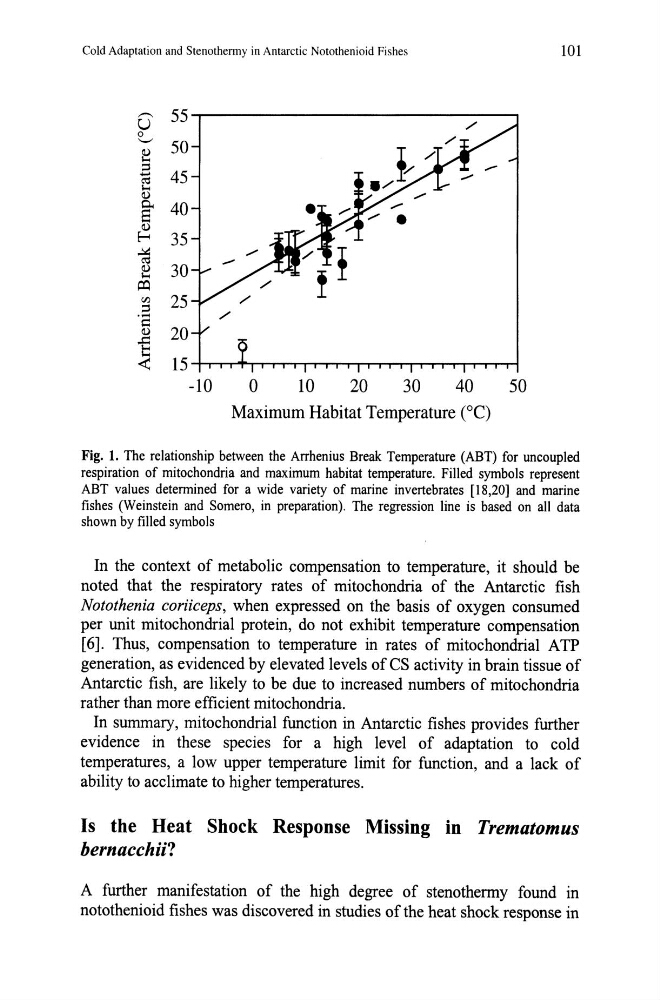
Fig. 1. The relationship between the Arrhenius Break Temperature (ABT) for uncoupled
respiration of mitochondria and maximum habitat temperature. Filled symbols represent
ABT values determined for a wide variety of marine invertebrates [18,20] and marine
fishes (Weinstein and Somero, in preparation). The regression line is based on all data
shown by filled symbols
In the context of metabolic compensation to temperature, it should be
noted that the respiratory rates of mitochondria of the Antarctic fish
Notothenia coriiceps, when expressed on the basis of oxygen consumed
per unit mitochondrial protein, do not exhibit temperature compensation
[6]. Thus, compensation to temperature in rates of mitochondrial ATP
generation, as evidenced by elevated levels of CS activity in brain tissue of
Antarctic fish, are likely to be due to increased numbers of mitochondria
rather than more efficient mitochondria.
In summary, mitochondrial function in Antarctic fishes provides further
evidence in these species for a high level of adaptation to cold
temperatures, a low upper temperature limit for function, and a lack of
ability to acclimate to higher temperatures.
Is the Heat Shock Response Missing in Trematomus
bernacchii?
A further manifestation of the high degree of stenothermy found in
notothenioid fishes was discovered in studies of the heat shock response in
101
,--..,
55
u 0 '-' 50
Q)
I-<
B 45
ro I-<
Q)
0..
40
8 Q)
E-< 35
~ Q) 30
I-<
a:l
rJ:J
25
;:::s
.....
s:: Q) 20
"§
-< 15
-10
0
10
20
30
40
50
Maximum Habitat Temperature CC)
Fig. 1. The relationship between the Arrhenius Break Temperature (ABT) for uncoupled
respiration of mitochondria and maximum habitat temperature. Filled symbols represent
ABT values determined for a wide variety of marine invertebrates [18,20] and marine
fishes (Weinstein and Somero, in preparation). The regression line is based on all data
shown by filled symbols
In the context of metabolic compensation to temperature, it should be
noted that the respiratory rates of mitochondria of the Antarctic fish
Notothenia coriiceps, when expressed on the basis of oxygen consumed
per unit mitochondrial protein, do not exhibit temperature compensation
[6]. Thus, compensation to temperature in rates of mitochondrial ATP
generation, as evidenced by elevated levels of CS activity in brain tissue of
Antarctic fish, are likely to be due to increased numbers of mitochondria
rather than more efficient mitochondria.
In summary, mitochondrial function in Antarctic fishes provides further
evidence in these species for a high level of adaptation to cold
temperatures, a low upper temperature limit for function, and a lack of
ability to acclimate to higher temperatures.
Is the Heat Shock Response Missing in Trematomus
bernacchii?
A further manifestation of the high degree of stenothermy found in
notothenioid fishes was discovered in studies of the heat shock response in