

60
Cyclestheriidae
Limnadiinae
8
t
(~)
Cyzicus gynecia
&
Leptestheria sp.
t
t
8
, C(: . . . ~
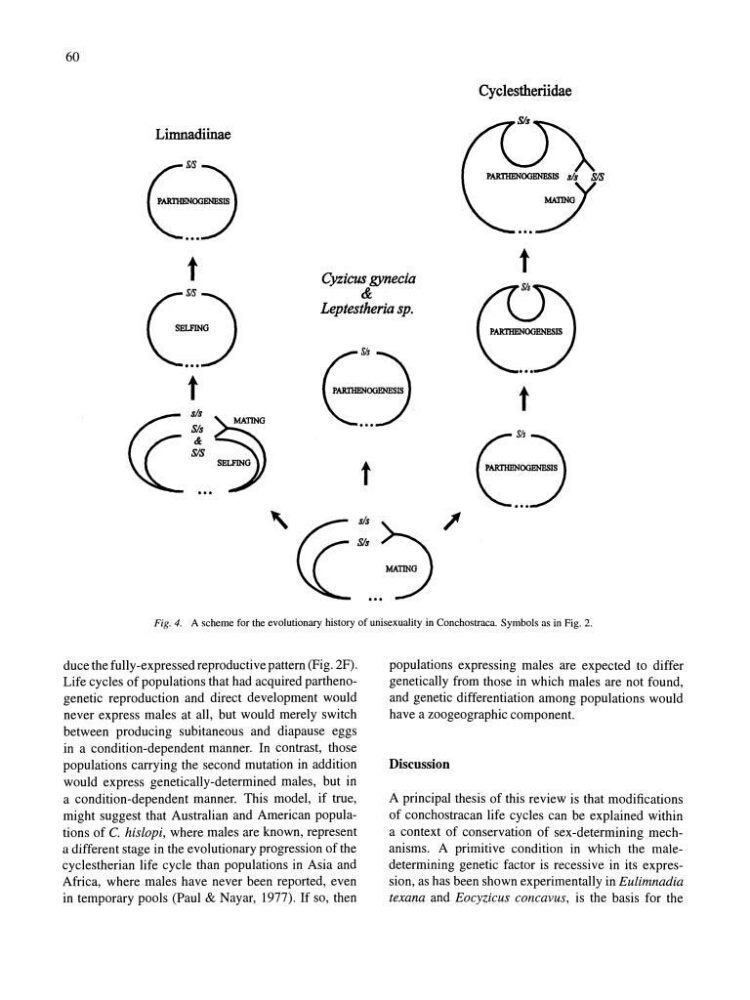
Fig. 4. A scheme for the evolutionary history of unisexuality in Conchostraca. Symbols as in Fig. 2.
duce the fully-expressed reproductive pattern (Fig. 2F).
Life cycles of populations that had acquired parthenogenetic reproduction and direct development would
never express males at all, but would merely switch
between producing subitaneous and diapause eggs
in a condition-dependent manner. In contrast, those
populations carrying the second mutation in addition
would express genetically-determined males, but in
a condition-dependent manner. This model, if true,
might suggest that Australian and American populations of C. his/opi, where males are known, represent
a different stage in the evolutionary progression of the
cyclestherian life cycle than populations in Asia and
Africa, where males have never been reported, even
in temporary pools (Paul & Nayar, 1977). If so, then
populations expressing males are expected to differ
genetically from those in which males are not found,
and genetic differentiation among popUlations would
have a zoogeographic component.
Discussion
A principal thesis of this review is that modifications
of conchostracan life cycles can be explained within
a context of conservation of sex-determining mechanisms. A primitive condition in which the maledetermining genetic factor is recessive in its expression, as has been shown experimentally in Eulimnadia
texana and Eocyzicus concavus, is the basis for the
Cyclestheriidae
Limnadiinae
8
t
(~)
Cyzicus gynecia
&
Leptestheria sp.
t
t
8
, C(: . . . ~
Fig. 4. A scheme for the evolutionary history of unisexuality in Conchostraca. Symbols as in Fig. 2.
duce the fully-expressed reproductive pattern (Fig. 2F).
Life cycles of populations that had acquired parthenogenetic reproduction and direct development would
never express males at all, but would merely switch
between producing subitaneous and diapause eggs
in a condition-dependent manner. In contrast, those
populations carrying the second mutation in addition
would express genetically-determined males, but in
a condition-dependent manner. This model, if true,
might suggest that Australian and American populations of C. his/opi, where males are known, represent
a different stage in the evolutionary progression of the
cyclestherian life cycle than populations in Asia and
Africa, where males have never been reported, even
in temporary pools (Paul & Nayar, 1977). If so, then
populations expressing males are expected to differ
genetically from those in which males are not found,
and genetic differentiation among popUlations would
have a zoogeographic component.
Discussion
A principal thesis of this review is that modifications
of conchostracan life cycles can be explained within
a context of conservation of sex-determining mechanisms. A primitive condition in which the maledetermining genetic factor is recessive in its expression, as has been shown experimentally in Eulimnadia
texana and Eocyzicus concavus, is the basis for the