

55
BISEXUAL LIFE CYCLES
GONOCHORIC
sis
Sis
•••
A
B
ANDRODIOECIOUS
sis
Sis
&
SIS
• ••
UNISEXUAL LIFE CYCLES
PARTHENOGENETIC
Sis
•••
c
D
SIS
• ••
E
SELFING
SIS
• ••
CYCLICAL PARTHENOGENESIS
F
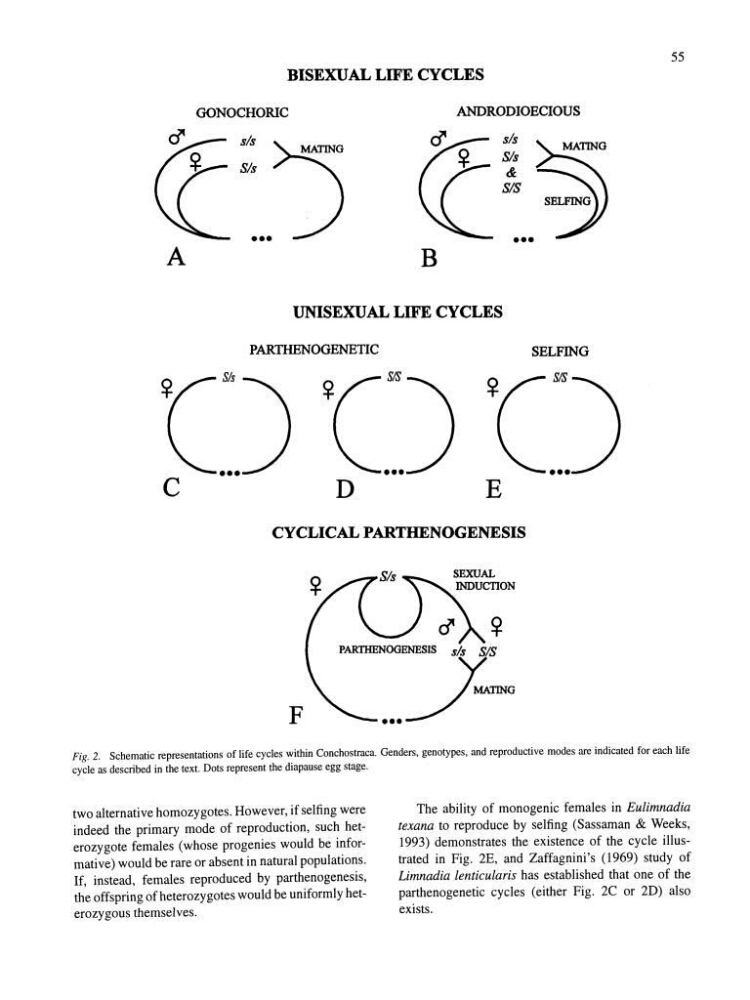
Fig. 2. Schematic representations of life cycles within Conchostraca. Genders, genotypes, and reproductive modes are indicated for each life
cycle as described in the text. Dots represent the diapause egg stage.
two alternative homozygotes. However, if selfing were
indeed the primary mode of reproduction, such heterozygote females (whose progenies would be informative) would be rare or absent in natural populations.
If, instead, females reproduced by parthenogenesis,
the offspring of heterozygotes would be uniformly heterozygous themselves.
The ability of monogenic females in Eulimnadia
texana to reproduce by selfing (Sassaman & Weeks,
1993) demonstrates the existence of the cycle illustrated in Fig. 2E, and Zaffagnini's (1969) study of
Limnadia lenticularis has established that one of the
parthenogenetic cycles (either Fig. 2C or 2D) also
exists.
BISEXUAL LIFE CYCLES
GONOCHORIC
sis
Sis
•••
A
B
ANDRODIOECIOUS
sis
Sis
&
SIS
• ••
UNISEXUAL LIFE CYCLES
PARTHENOGENETIC
Sis
•••
c
D
SIS
• ••
E
SELFING
SIS
• ••
CYCLICAL PARTHENOGENESIS
F
Fig. 2. Schematic representations of life cycles within Conchostraca. Genders, genotypes, and reproductive modes are indicated for each life
cycle as described in the text. Dots represent the diapause egg stage.
two alternative homozygotes. However, if selfing were
indeed the primary mode of reproduction, such heterozygote females (whose progenies would be informative) would be rare or absent in natural populations.
If, instead, females reproduced by parthenogenesis,
the offspring of heterozygotes would be uniformly heterozygous themselves.
The ability of monogenic females in Eulimnadia
texana to reproduce by selfing (Sassaman & Weeks,
1993) demonstrates the existence of the cycle illustrated in Fig. 2E, and Zaffagnini's (1969) study of
Limnadia lenticularis has established that one of the
parthenogenetic cycles (either Fig. 2C or 2D) also
exists.