

40
.,
I •
.,
.,
C
II
I .
I .
II
.,
C
I .
I .
., II
I .
I .
0 ~ C C
~
C C I .
.,
.,
0 II
I .
I .
I! I . II
II
Gl
I .
I .
oIJ
., I. C oIJ .II: - I.
=
I .
-
oIJ
oIJ
E 0 II II 0 U - 0
-
I .
0 oIJ
' C
I .
I.
II E
II N oIJ
~
I.
II oIJ 0
II II I . 0 E
~
0 C II 0 E
c E
.II:
., ,.
• =
C.
I .
oIJ
'C
II
-
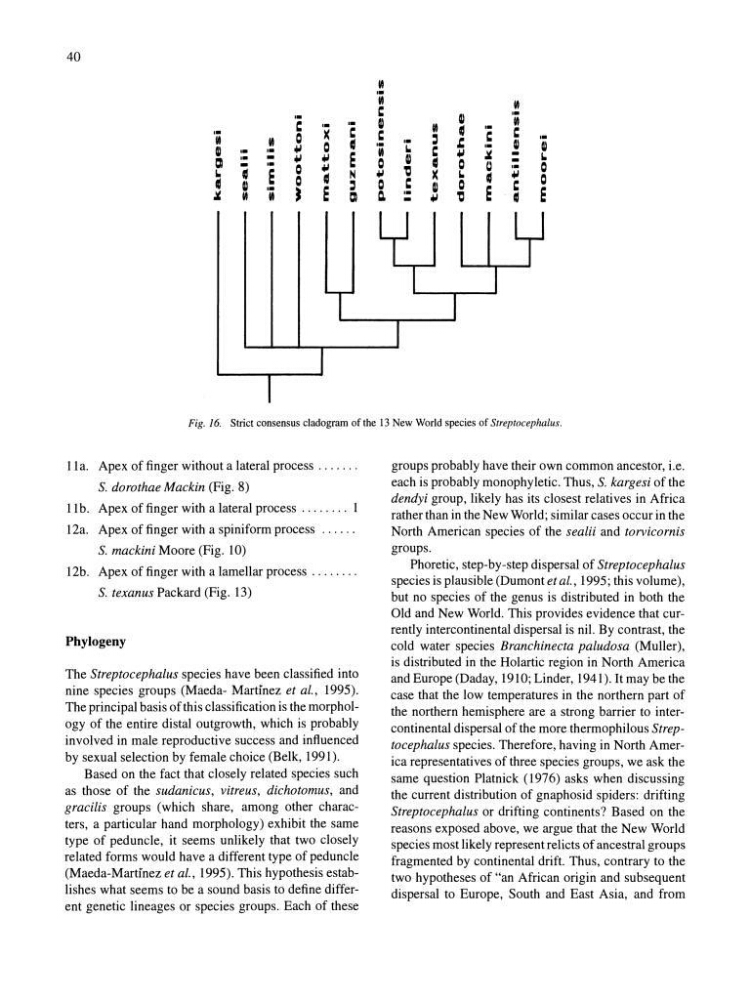
Fig. 16. Strict consensus cladogram of the 13 New World species of Streptocephalus.
11a. Apex of finger without a lateral process ...... .
S. dorothae Mackin (Fig. 8)
11 b. Apex of finger with a lateral process ... . . . .. 1
12a. Apex of finger with a spiniform process ..... .
S. mackini Moore (Fig. 10)
12b. Apex of finger with a lamellar process ....... .
S. texan us Packard (Fig. 13)
Phylogeny
The Streptocephalus species have been classified into
nine species groups (Maeda- Martinez et aI., 1995).
The principal basis of this classification is the morphology of the entire distal outgrowth, which is probably
involved in male reproductive success and influenced
by sexual selection by female choice (Belk, 1991).
Based on the fact that closely related species such
as those of the sudanicus, vitreus, dichotomus, and
gracilis groups (which share, among other characters, a particular hand morphology) exhibit the same
type of peduncle, it seems unlikely that two closely
related forms would have a different type of peduncle
(Maeda-Martinez et al., 1995). This hypothesis establishes what seems to be a sound basis to define different genetic lineages or species groups. Each of these
groups probably have their own common ancestor, i.e.
each is probably monophyletic. Thus, S. kargesi ofthe
dendyi group, likely has its closest relatives in Africa
rather than in the New World; similar cases occur in the
North American species of the sealii and torvicornis
groups.
Phoretic, step-by-step dispersal of Streptocephalus
species is plausible (Dumont et at., 1995; this volume),
but no species of the genus is distributed in both the
Old and New World. This provides evidence that currently intercontinental dispersal is nil. By contrast, the
cold water species Branchinecta paludosa (Muller),
is distributed in the Holartic region in North America
and Europe (Daday, 1910; Linder, 1941). It may be the
case that the low temperatures in the northern part of
the northern hemisphere are a strong barrier to intercontinental dispersal of the more thermophilous Streptocephalus species. Therefore, having in North America representatives of three species groups, we ask the
same question Platnick (1976) asks when discussing
the current distribution of gnaphosid spiders: drifting
Streptocephalus or drifting continents? Based on the
reasons exposed above, we argue that the New World
species most likely represent relicts of ancestral groups
fragmented by continental drift. Thus, contrary to the
two hypotheses of "an African origin and subsequent
dispersal to Europe, South and East Asia, and from
.,
I •
.,
.,
C
II
I .
I .
II
.,
C
I .
I .
., II
I .
I .
0 ~ C C
~
C C I .
.,
.,
0 II
I .
I .
I! I . II
II
Gl
I .
I .
oIJ
., I. C oIJ .II: - I.
=
I .
-
oIJ
oIJ
E 0 II II 0 U - 0
-
I .
0 oIJ
' C
I .
I.
II E
II N oIJ
~
I.
II oIJ 0
II II I . 0 E
~
0 C II 0 E
c E
.II:
., ,.
• =
C.
I .
oIJ
'C
II
-
Fig. 16. Strict consensus cladogram of the 13 New World species of Streptocephalus.
11a. Apex of finger without a lateral process ...... .
S. dorothae Mackin (Fig. 8)
11 b. Apex of finger with a lateral process ... . . . .. 1
12a. Apex of finger with a spiniform process ..... .
S. mackini Moore (Fig. 10)
12b. Apex of finger with a lamellar process ....... .
S. texan us Packard (Fig. 13)
Phylogeny
The Streptocephalus species have been classified into
nine species groups (Maeda- Martinez et aI., 1995).
The principal basis of this classification is the morphology of the entire distal outgrowth, which is probably
involved in male reproductive success and influenced
by sexual selection by female choice (Belk, 1991).
Based on the fact that closely related species such
as those of the sudanicus, vitreus, dichotomus, and
gracilis groups (which share, among other characters, a particular hand morphology) exhibit the same
type of peduncle, it seems unlikely that two closely
related forms would have a different type of peduncle
(Maeda-Martinez et al., 1995). This hypothesis establishes what seems to be a sound basis to define different genetic lineages or species groups. Each of these
groups probably have their own common ancestor, i.e.
each is probably monophyletic. Thus, S. kargesi ofthe
dendyi group, likely has its closest relatives in Africa
rather than in the New World; similar cases occur in the
North American species of the sealii and torvicornis
groups.
Phoretic, step-by-step dispersal of Streptocephalus
species is plausible (Dumont et at., 1995; this volume),
but no species of the genus is distributed in both the
Old and New World. This provides evidence that currently intercontinental dispersal is nil. By contrast, the
cold water species Branchinecta paludosa (Muller),
is distributed in the Holartic region in North America
and Europe (Daday, 1910; Linder, 1941). It may be the
case that the low temperatures in the northern part of
the northern hemisphere are a strong barrier to intercontinental dispersal of the more thermophilous Streptocephalus species. Therefore, having in North America representatives of three species groups, we ask the
same question Platnick (1976) asks when discussing
the current distribution of gnaphosid spiders: drifting
Streptocephalus or drifting continents? Based on the
reasons exposed above, we argue that the New World
species most likely represent relicts of ancestral groups
fragmented by continental drift. Thus, contrary to the
two hypotheses of "an African origin and subsequent
dispersal to Europe, South and East Asia, and from