

. ?
(L.~··
.\\;::..
?
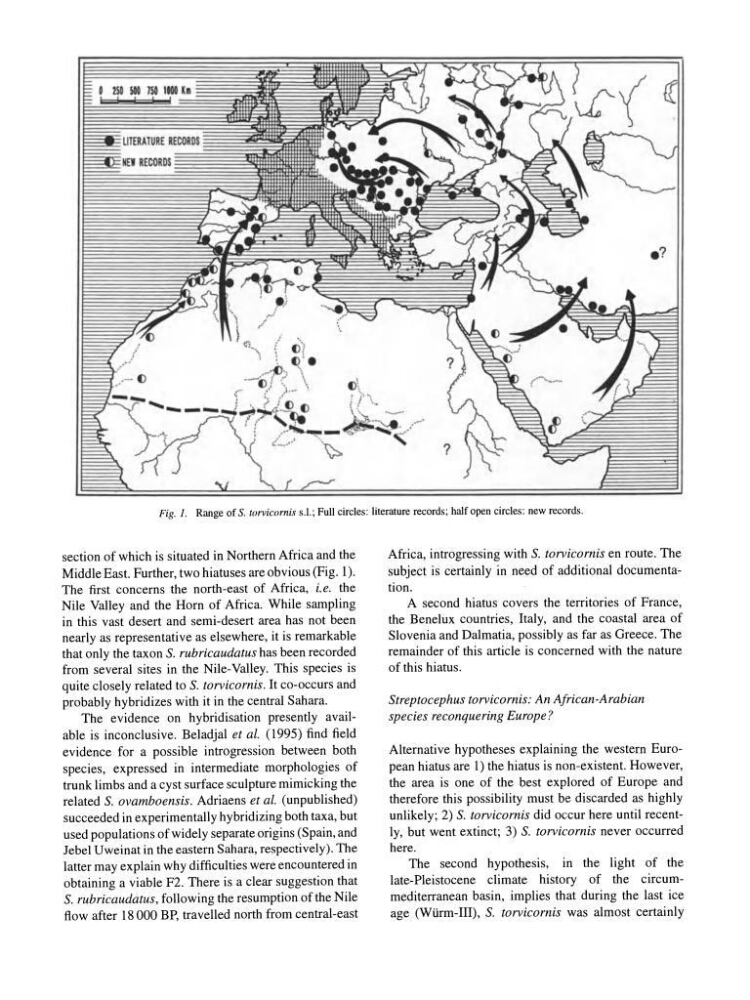
Fig. I. Range of S. torvicornis s.l.; Full circles: literature records; half open circles: new records.
section of which is situated in Northern Africa and the
Middle East. Further, two hiatuses are obvious (Fig. 1).
The first concerns the north-east of Africa, i.e. the
Nile Valley and the Horn of Africa. While sampling
in this vast desert and semi-desert area has not been
nearly as representative as elsewhere, it is remarkable
that only the taxon S. rubricaudatus has been recorded
from several sites in the Nile-Valley. This species is
quite closely related to S. torvicornis. It co-occurs and
probably hybridizes with it in the central Sahara.
The evidence on hybridisation presently available is inconclusive. Beladjal et al. (1995) find field
evidence for a possible introgression between both
species, expressed in intermediate morphologies of
trunk limbs and a cyst surface sculpture mimicking the
related S. ovamboensis. Adriaens et al. (unpublished)
succeeded in experimentally hybridizing both taxa, but
used populations of widely separate origins (Spain, and
Jebel Uweinat in the eastern Sahara, respectively). The
latter may explain why difficulties were encountered in
obtaining a viable F2. There is a clear suggestion that
S. rubricaudatus, following the resumption of the Nile
flow after 18000 BP, travelled north from central-east
Africa, introgressing with S. torvicornis en route. The
subject is certainly in need of additional documentation.
A second hiatus covers the territories of France,
the Benelux countries, Italy, and the coastal area of
Slovenia and Dalmatia, possibly as far as Greece. The
remainder of this article is concerned with the nature
of this hiatus.
Streptocephus torvicornis: An African-Arabian
species reconquering Europe?
Alternative hypotheses explaining the western European hiatus are I) the hiatus is non-existent. However,
the area is one of the best explored of Europe and
therefore this possibility must be discarded as highly
unlikely; 2) S. torvicornis did occur here until recently, but went extinct; 3) S. torvicornis never occurred
here.
The second hypothesis, in the light of the
late-Pleistocene climate history of the circummediterranean basin, implies that during the last ice
age (Wiirm-III), S. torvicornis was almost certainly
(L.~··
.\\;::..
?
Fig. I. Range of S. torvicornis s.l.; Full circles: literature records; half open circles: new records.
section of which is situated in Northern Africa and the
Middle East. Further, two hiatuses are obvious (Fig. 1).
The first concerns the north-east of Africa, i.e. the
Nile Valley and the Horn of Africa. While sampling
in this vast desert and semi-desert area has not been
nearly as representative as elsewhere, it is remarkable
that only the taxon S. rubricaudatus has been recorded
from several sites in the Nile-Valley. This species is
quite closely related to S. torvicornis. It co-occurs and
probably hybridizes with it in the central Sahara.
The evidence on hybridisation presently available is inconclusive. Beladjal et al. (1995) find field
evidence for a possible introgression between both
species, expressed in intermediate morphologies of
trunk limbs and a cyst surface sculpture mimicking the
related S. ovamboensis. Adriaens et al. (unpublished)
succeeded in experimentally hybridizing both taxa, but
used populations of widely separate origins (Spain, and
Jebel Uweinat in the eastern Sahara, respectively). The
latter may explain why difficulties were encountered in
obtaining a viable F2. There is a clear suggestion that
S. rubricaudatus, following the resumption of the Nile
flow after 18000 BP, travelled north from central-east
Africa, introgressing with S. torvicornis en route. The
subject is certainly in need of additional documentation.
A second hiatus covers the territories of France,
the Benelux countries, Italy, and the coastal area of
Slovenia and Dalmatia, possibly as far as Greece. The
remainder of this article is concerned with the nature
of this hiatus.
Streptocephus torvicornis: An African-Arabian
species reconquering Europe?
Alternative hypotheses explaining the western European hiatus are I) the hiatus is non-existent. However,
the area is one of the best explored of Europe and
therefore this possibility must be discarded as highly
unlikely; 2) S. torvicornis did occur here until recently, but went extinct; 3) S. torvicornis never occurred
here.
The second hypothesis, in the light of the
late-Pleistocene climate history of the circummediterranean basin, implies that during the last ice
age (Wiirm-III), S. torvicornis was almost certainly