

254
logical studies special fixatives were used, primarily
Bouin's solution. With the exception of histological
slides, no permanent mountings were made.
Taxonomic aspects
The conchostracan fauna of Colombia presently
includes 12 species in five families belonging to the
two known orders - Spinicaudata and Laevicaudata.
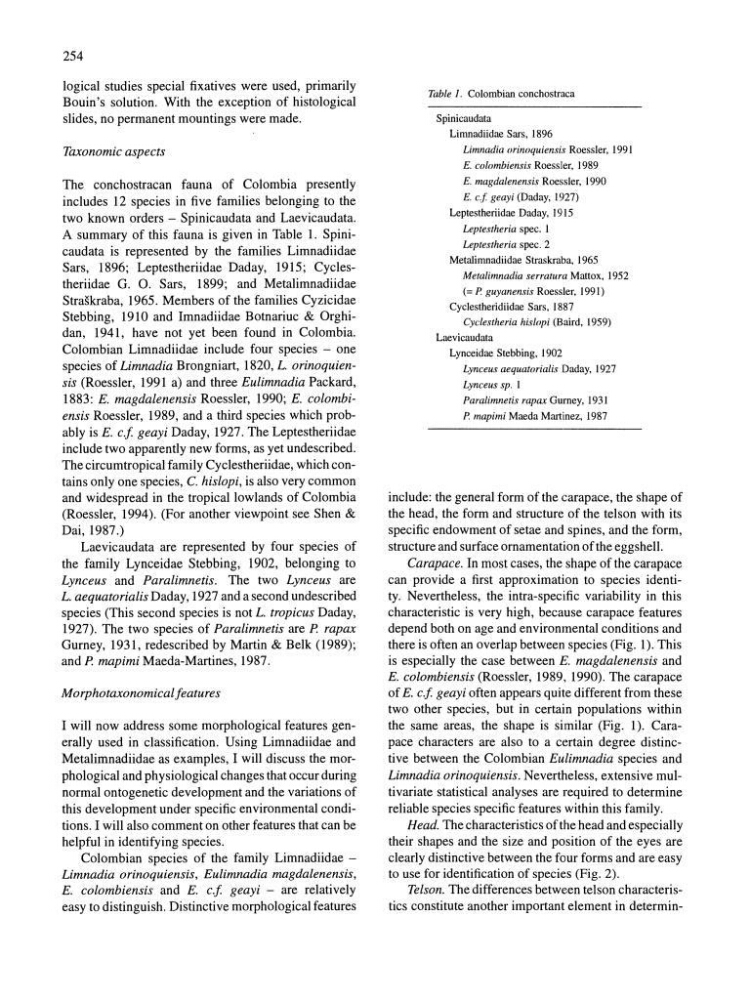
A summary of this fauna is given in Table 1. Spinicaudata is represented by the families Limnadiidae
Sars, 1896; Leptestheriidae Daday, 1915; Cyclestheriidae G. O. Sars, 1899; and Metalimnadiidae
Straskraba, 1965. Members of the families Cyzicidae
Stebbing, 1910 and Imnadiidae Botnariuc & Orghidan, 1941, have not yet been found in Colombia.
Colombian Limnadiidae include four species - one
species of Limnadia Brongniart, 1820, L. orinoquiensis (Roessler, 1991 a) and three Eulimnadia Packard,
1883: E. magdalenensis Roessler, 1990; E. colombiensis Roessler, 1989, and a third species which probably is E. c.f geayi Daday, 1927. The Leptestheriidae
include two apparently new forms, as yet undescribed.
The circumtropical family Cyclestheriidae, which contains only one species, C. hislopi, is also very common
and widespread in the tropical lowlands of Colombia
(Roessler, 1994). (For another viewpoint see Shen &
Dai, 1987.)
Laevicaudata are represented by four species of
the family Lynceidae Stebbing, 1902, belonging to
Lynceus and Paralimnetis. The two Lynceus are
L. aequatorialis Daday, 1927 and a second undescribed
species (This second species is not L. tropicus Daday,
1927). The two species of Paralimnetis are P. rapax
Gurney, 1931, redescribed by Martin & Belk (1989);
and P. mapimi Maeda-Martines, 1987.
Morphotaxonomical features
I will now address some morphological features generally used in classification. Using Limnadiidae and
Metalimnadiidae as examples, I will discuss the morphological and physiological changes that occur during
normal ontogenetic development and the variations of
this development under specific environmental conditions. I will also comment on other features that can be
helpful in identifying species.
Colombian species of the family Limnadiidae -
Limnadia orinoquiensis, Eulimnadia magdaienensis,
E. colombiensis and E. c.! geayi - are relatively
easy to distinguish. Distinctive morphological features
Table 1. Colombian conchostraca
Spinicaudata
Limnadiidae Sars, 1896
Limnadia orinoquiensis Roessler, 1991
E. colombiensis Roessler, 1989
E. magdalenensis Roessler, 1990
E. cf geayi (Daday, 1927)
Leptestheriidae Daday, 1915
Leptestheria spec. 1
Leptestheria spec. 2
Metalimnadiidae Straskraba, 1965
Metalimnadia serratura Mattox, 1952
(= P. guyanensis Roessler, 1991)
Cyclestheridiidae Sars, 1887
Cycles theria hislopi (Baird, 1959)
Laevicaudata
Lynceidae Stebbing, 1902
Lynceus aequatorialis Daday, 1927
Lynceus sp. 1
Paralimnetis rapax Gurney, 1931
P. mapimi Maeda Martinez, 1987
include: the general form of the carapace, the shape of
the head, the form and structure of the telson with its
specific endowment of setae and spines, and the form,
structure and surface ornamentation of the eggshell.
Carapace. In most cases, the shape of the carapace
can provide a first approximation to species identity. Nevertheless, the intra-specific variability in this
characteristic is very high, because carapace features
depend both on age and environmental conditions and
there is often an overlap between species (Fig. 1). This
is especially the case between E. magdalenensis and
E. colombiensis (Roessler, 1989, 1990). The carapace
of E. c.! geayi often appears quite different from these
two other species, but in certain populations within
the same areas, the shape is similar (Fig. 1). Carapace characters are also to a certain degree distinctive between the Colombian Eulimnadia species and
Limnadia orinoquiensis. Nevertheless, extensive multivariate statistical analyses are required to determine
reliable species specific features within this family.
Head. The characteristics of the head and especially
their shapes and the size and position of the eyes are
clearly distinctive between the four forms and are easy
to use for identification of species (Fig. 2).
Telson. The differences between telson characteristics constitute another important element in determin-
logical studies special fixatives were used, primarily
Bouin's solution. With the exception of histological
slides, no permanent mountings were made.
Taxonomic aspects
The conchostracan fauna of Colombia presently
includes 12 species in five families belonging to the
two known orders - Spinicaudata and Laevicaudata.
A summary of this fauna is given in Table 1. Spinicaudata is represented by the families Limnadiidae
Sars, 1896; Leptestheriidae Daday, 1915; Cyclestheriidae G. O. Sars, 1899; and Metalimnadiidae
Straskraba, 1965. Members of the families Cyzicidae
Stebbing, 1910 and Imnadiidae Botnariuc & Orghidan, 1941, have not yet been found in Colombia.
Colombian Limnadiidae include four species - one
species of Limnadia Brongniart, 1820, L. orinoquiensis (Roessler, 1991 a) and three Eulimnadia Packard,
1883: E. magdalenensis Roessler, 1990; E. colombiensis Roessler, 1989, and a third species which probably is E. c.f geayi Daday, 1927. The Leptestheriidae
include two apparently new forms, as yet undescribed.
The circumtropical family Cyclestheriidae, which contains only one species, C. hislopi, is also very common
and widespread in the tropical lowlands of Colombia
(Roessler, 1994). (For another viewpoint see Shen &
Dai, 1987.)
Laevicaudata are represented by four species of
the family Lynceidae Stebbing, 1902, belonging to
Lynceus and Paralimnetis. The two Lynceus are
L. aequatorialis Daday, 1927 and a second undescribed
species (This second species is not L. tropicus Daday,
1927). The two species of Paralimnetis are P. rapax
Gurney, 1931, redescribed by Martin & Belk (1989);
and P. mapimi Maeda-Martines, 1987.
Morphotaxonomical features
I will now address some morphological features generally used in classification. Using Limnadiidae and
Metalimnadiidae as examples, I will discuss the morphological and physiological changes that occur during
normal ontogenetic development and the variations of
this development under specific environmental conditions. I will also comment on other features that can be
helpful in identifying species.
Colombian species of the family Limnadiidae -
Limnadia orinoquiensis, Eulimnadia magdaienensis,
E. colombiensis and E. c.! geayi - are relatively
easy to distinguish. Distinctive morphological features
Table 1. Colombian conchostraca
Spinicaudata
Limnadiidae Sars, 1896
Limnadia orinoquiensis Roessler, 1991
E. colombiensis Roessler, 1989
E. magdalenensis Roessler, 1990
E. cf geayi (Daday, 1927)
Leptestheriidae Daday, 1915
Leptestheria spec. 1
Leptestheria spec. 2
Metalimnadiidae Straskraba, 1965
Metalimnadia serratura Mattox, 1952
(= P. guyanensis Roessler, 1991)
Cyclestheridiidae Sars, 1887
Cycles theria hislopi (Baird, 1959)
Laevicaudata
Lynceidae Stebbing, 1902
Lynceus aequatorialis Daday, 1927
Lynceus sp. 1
Paralimnetis rapax Gurney, 1931
P. mapimi Maeda Martinez, 1987
include: the general form of the carapace, the shape of
the head, the form and structure of the telson with its
specific endowment of setae and spines, and the form,
structure and surface ornamentation of the eggshell.
Carapace. In most cases, the shape of the carapace
can provide a first approximation to species identity. Nevertheless, the intra-specific variability in this
characteristic is very high, because carapace features
depend both on age and environmental conditions and
there is often an overlap between species (Fig. 1). This
is especially the case between E. magdalenensis and
E. colombiensis (Roessler, 1989, 1990). The carapace
of E. c.! geayi often appears quite different from these
two other species, but in certain populations within
the same areas, the shape is similar (Fig. 1). Carapace characters are also to a certain degree distinctive between the Colombian Eulimnadia species and
Limnadia orinoquiensis. Nevertheless, extensive multivariate statistical analyses are required to determine
reliable species specific features within this family.
Head. The characteristics of the head and especially
their shapes and the size and position of the eyes are
clearly distinctive between the four forms and are easy
to use for identification of species (Fig. 2).
Telson. The differences between telson characteristics constitute another important element in determin-