

237
A
B
c
O,5mm
O,5mm
O,5mm
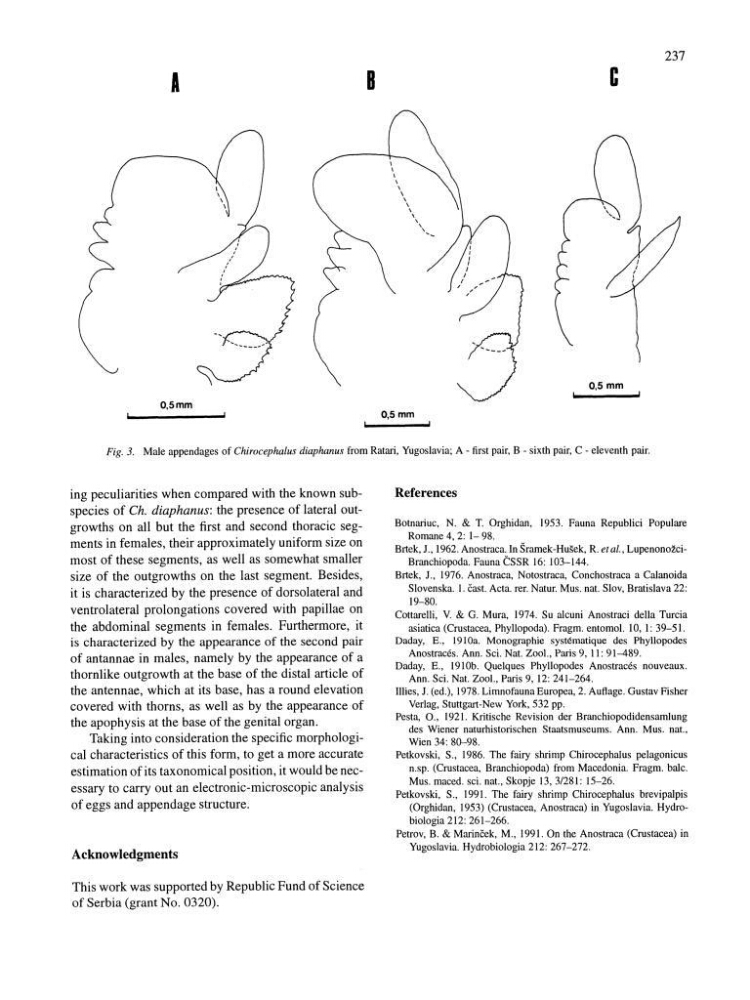
Fig. 3. Male appendages of Chirocephalus diaphanus from Ratari, Yugoslavia; A - first pair, B - sixth pair, C - eleventh pair.
ing peculiarities when compared with the known subspecies of Ch. diaphanus: the presence of lateral outgrowths on all but the first and second thoracic segments in females, their approximately uniform size on
most of these segments, as well as somewhat smaller
size of the outgrowths on the last segment. Besides,
it is characterized by the presence of dorsolateral and
ventrolateral prolongations covered with papillae on
the abdominal segments in females. Furthermore, it
is characterized by the appearance of the second pair
of antannae in males, namely by the appearance of a
thornlike outgrowth at the base of the distal article of
the antennae, which at its base, has a round elevation
covered with thorns, as well as by the appearance of
the apophysis at the base of the genital organ.
Taking into consideration the specific morphological characteristics of this form, to get a more accurate
estimation of its taxonomical position, it would be necessary to carry out an electronic-microscopic analysis
of eggs and appendage structure.
Acknowledgments
This work was supported by Republic Fund of Science
of Serbia (grant No. 0320).
References
Botnariuc, N. & T. Orghidan, 1953. Fauna Republici Populare
Romane 4, 2: 1- 98.
Brtek, J., 1962. Anostraca. In Sramek-Husek, R. eta!., LupenonozciBranchiopoda. Fauna CSSR 16: 103-144.
Brtek, J., 1976. Anostraca, Notostraca, Conchostraca a Calanoida
Siovenska. I. cast. Acta. rer. Natur. Mus. nat. Slov, Bratislava 22:
19-80.
Cottarelli, V. & G. Mura, 1974. Su alcuni Anostraci della Turcia
asiatica (Crustacea, Phyllopoda). Fragm. entomo!. 10, 1: 39-51.
Daday, E., 1910a. Monographie systematique des Phyllopodes
Anostraces. Ann. Sci. Nat. Zool., Paris 9,11: 91--489.
Daday, E., 19 lOb. Quelques Phyllopodes Anostraces nouveaux.
Ann. Sci. Nat. Zool., Paris 9, 12: 241-264.
Illies, J. (ed.), 1978. Limnofauna Europea, 2. Autlage. Gustav Fisher
Verlag, Stuttgart-New York, 532 pp.
Pesta, 0., 1921. Kritische Revision der Branchiopodidensamlung
des Wiener naturhistorischen Staatsmuseums. Ann. Mus. nat.,
Wien 34: 80-98.
Petkovski, S., 1986. The fairy shrimp Chirocephalus pelagonicus
n.sp. (Crustacea, Branchiopoda) from Macedonia. Fragm. balc.
Mus. maced. sci. nat., Skopje 13,3/281: 15-26.
Petkovski, S., 1991. The fairy shrimp Chirocephalus brevipalpis
(Orghidan, 1953) (Crustacea, Anostraca) in Yugoslavia. Hydrobiologia 212: 261-266.
Petrov, B. & Marincek, M., 1991. On the Anostraca (Crustacea) in
Yugoslavia. Hydrobiologia 212: 267-272.
A
B
c
O,5mm
O,5mm
O,5mm
Fig. 3. Male appendages of Chirocephalus diaphanus from Ratari, Yugoslavia; A - first pair, B - sixth pair, C - eleventh pair.
ing peculiarities when compared with the known subspecies of Ch. diaphanus: the presence of lateral outgrowths on all but the first and second thoracic segments in females, their approximately uniform size on
most of these segments, as well as somewhat smaller
size of the outgrowths on the last segment. Besides,
it is characterized by the presence of dorsolateral and
ventrolateral prolongations covered with papillae on
the abdominal segments in females. Furthermore, it
is characterized by the appearance of the second pair
of antannae in males, namely by the appearance of a
thornlike outgrowth at the base of the distal article of
the antennae, which at its base, has a round elevation
covered with thorns, as well as by the appearance of
the apophysis at the base of the genital organ.
Taking into consideration the specific morphological characteristics of this form, to get a more accurate
estimation of its taxonomical position, it would be necessary to carry out an electronic-microscopic analysis
of eggs and appendage structure.
Acknowledgments
This work was supported by Republic Fund of Science
of Serbia (grant No. 0320).
References
Botnariuc, N. & T. Orghidan, 1953. Fauna Republici Populare
Romane 4, 2: 1- 98.
Brtek, J., 1962. Anostraca. In Sramek-Husek, R. eta!., LupenonozciBranchiopoda. Fauna CSSR 16: 103-144.
Brtek, J., 1976. Anostraca, Notostraca, Conchostraca a Calanoida
Siovenska. I. cast. Acta. rer. Natur. Mus. nat. Slov, Bratislava 22:
19-80.
Cottarelli, V. & G. Mura, 1974. Su alcuni Anostraci della Turcia
asiatica (Crustacea, Phyllopoda). Fragm. entomo!. 10, 1: 39-51.
Daday, E., 1910a. Monographie systematique des Phyllopodes
Anostraces. Ann. Sci. Nat. Zool., Paris 9,11: 91--489.
Daday, E., 19 lOb. Quelques Phyllopodes Anostraces nouveaux.
Ann. Sci. Nat. Zool., Paris 9, 12: 241-264.
Illies, J. (ed.), 1978. Limnofauna Europea, 2. Autlage. Gustav Fisher
Verlag, Stuttgart-New York, 532 pp.
Pesta, 0., 1921. Kritische Revision der Branchiopodidensamlung
des Wiener naturhistorischen Staatsmuseums. Ann. Mus. nat.,
Wien 34: 80-98.
Petkovski, S., 1986. The fairy shrimp Chirocephalus pelagonicus
n.sp. (Crustacea, Branchiopoda) from Macedonia. Fragm. balc.
Mus. maced. sci. nat., Skopje 13,3/281: 15-26.
Petkovski, S., 1991. The fairy shrimp Chirocephalus brevipalpis
(Orghidan, 1953) (Crustacea, Anostraca) in Yugoslavia. Hydrobiologia 212: 261-266.
Petrov, B. & Marincek, M., 1991. On the Anostraca (Crustacea) in
Yugoslavia. Hydrobiologia 212: 267-272.