

234
Mura (1974). It is of theoretical interest for the taxonomy of the diaphanus group to establish the importance
of these morphological differences.
Material and methods
The material was collected from ephemeral ponds after
rains. Specimens were preserved in 70% ethyl-alcohol
and stored at the Institute of Zoology, Faculty of Biology, Belgrade.
Results and discussion
Comparative morphological analysis of different populations of Ch. diaphanus discovered in Yugoslavia has
shown that the population from the village of Ratari
near Mladenovac exhibits some peculiarities making
it different from all known subspecies. These differences are especially outstanding in females. They are,
first of all, in the appearance and structure of the body
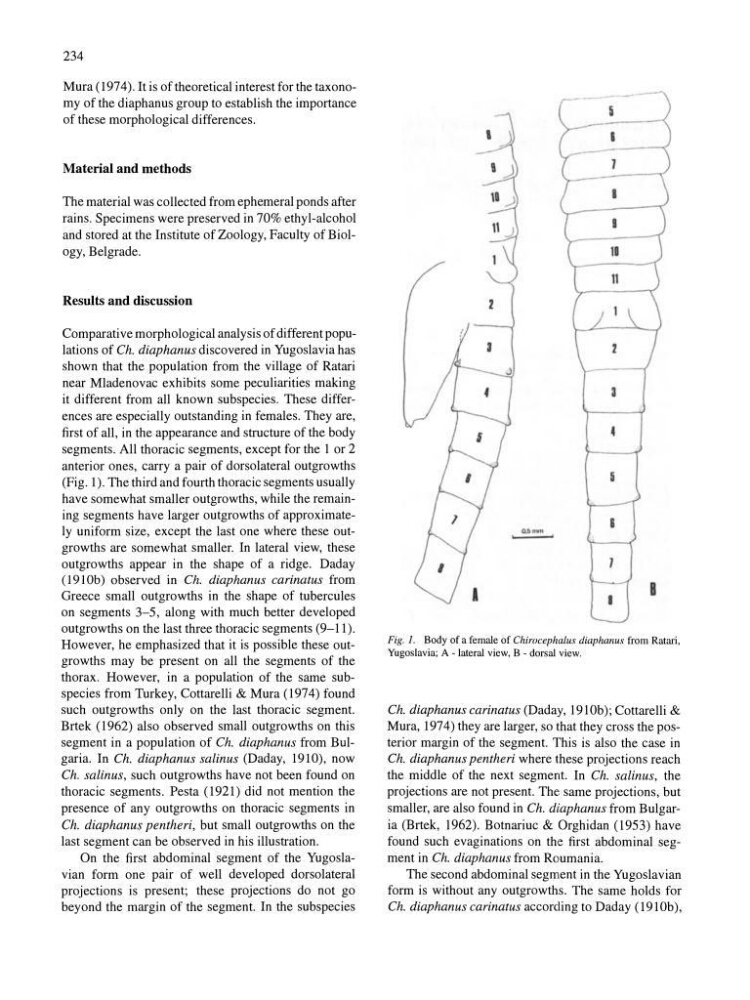
segments. All thoracic segments, except for the 1 or 2
anterior ones, carry a pair of dorsolateral outgrowths
(Fig. 1). The third and fourth thoracic segments usually
have somewhat smaller outgrowths, while the remaining segments have larger outgrowths of approximately uniform size, except the last one where these outgrowths are somewhat smaller. In lateral view, these
outgrowths appear in the shape of a ridge. Daday
(191 Ob) observed in Ch. diaphanus carinatus from
Greece small outgrowths in the shape of tubercules
on segments 3-5, along with much better developed
outgrowths on the last three thoracic segments (9-1l).
However, he emphasized that it is possible these outgrowths may be present on all the segments of the
thorax. However, in a population of the same subspecies from Turkey, Cottarelli & Mura (1974) found
such outgrowths only on the last thoracic segment.
Brtek (1962) also observed small outgrowths on this
segment in a population of Ch. diaphanus from Bulgaria. In Ch. diaphanus salinus (Daday, 1910), now
Ch. salinus, such outgrowths have not been found on
thoracic segments. Pesta (1921) did not mention the
presence of any outgrowths on thoracic segments in
Ch. diaphanus pentheri, but small outgrowths on the
last segment can be observed in his illustration.
On the first abdominal segment of the Yugoslavian form one pair of well developed dorsolateral
projections is present; these projections do not go
beyond the margin of the segment. In the subspecies
2
3
5
&
I
B
Fig. 1. Body of a female of Chirocephalus diaphanus from Ratari,
Yugoslavia; A - lateral view, B - dorsal view.
Ch. diaphanus carinatus (Daday, 19IOb); Cottarelli &
Mura, 1974) they are larger, so that they cross the posterior margin of the segment. This is also the case in
Ch. diaphanus pentheri where these projections reach
the middle of the next segment. In Ch. salinus, the
projections are not present. The same projections, but
smaller, are also found in Ch. diaphanus from Bulgaria (Brtek, 1962). Botnariuc & Orghidan (1953) have
found such evaginations on the first abdominal segment in Ch. diaphanus from Roumania.
The second abdominal segment in the Yugoslavian
form is without any outgrowths. The same holds for
Ch. diaphanus carinatus according to Daday (191 Ob),
Mura (1974). It is of theoretical interest for the taxonomy of the diaphanus group to establish the importance
of these morphological differences.
Material and methods
The material was collected from ephemeral ponds after
rains. Specimens were preserved in 70% ethyl-alcohol
and stored at the Institute of Zoology, Faculty of Biology, Belgrade.
Results and discussion
Comparative morphological analysis of different populations of Ch. diaphanus discovered in Yugoslavia has
shown that the population from the village of Ratari
near Mladenovac exhibits some peculiarities making
it different from all known subspecies. These differences are especially outstanding in females. They are,
first of all, in the appearance and structure of the body
segments. All thoracic segments, except for the 1 or 2
anterior ones, carry a pair of dorsolateral outgrowths
(Fig. 1). The third and fourth thoracic segments usually
have somewhat smaller outgrowths, while the remaining segments have larger outgrowths of approximately uniform size, except the last one where these outgrowths are somewhat smaller. In lateral view, these
outgrowths appear in the shape of a ridge. Daday
(191 Ob) observed in Ch. diaphanus carinatus from
Greece small outgrowths in the shape of tubercules
on segments 3-5, along with much better developed
outgrowths on the last three thoracic segments (9-1l).
However, he emphasized that it is possible these outgrowths may be present on all the segments of the
thorax. However, in a population of the same subspecies from Turkey, Cottarelli & Mura (1974) found
such outgrowths only on the last thoracic segment.
Brtek (1962) also observed small outgrowths on this
segment in a population of Ch. diaphanus from Bulgaria. In Ch. diaphanus salinus (Daday, 1910), now
Ch. salinus, such outgrowths have not been found on
thoracic segments. Pesta (1921) did not mention the
presence of any outgrowths on thoracic segments in
Ch. diaphanus pentheri, but small outgrowths on the
last segment can be observed in his illustration.
On the first abdominal segment of the Yugoslavian form one pair of well developed dorsolateral
projections is present; these projections do not go
beyond the margin of the segment. In the subspecies
2
3
5
&
I
B
Fig. 1. Body of a female of Chirocephalus diaphanus from Ratari,
Yugoslavia; A - lateral view, B - dorsal view.
Ch. diaphanus carinatus (Daday, 19IOb); Cottarelli &
Mura, 1974) they are larger, so that they cross the posterior margin of the segment. This is also the case in
Ch. diaphanus pentheri where these projections reach
the middle of the next segment. In Ch. salinus, the
projections are not present. The same projections, but
smaller, are also found in Ch. diaphanus from Bulgaria (Brtek, 1962). Botnariuc & Orghidan (1953) have
found such evaginations on the first abdominal segment in Ch. diaphanus from Roumania.
The second abdominal segment in the Yugoslavian
form is without any outgrowths. The same holds for
Ch. diaphanus carinatus according to Daday (191 Ob),