

15
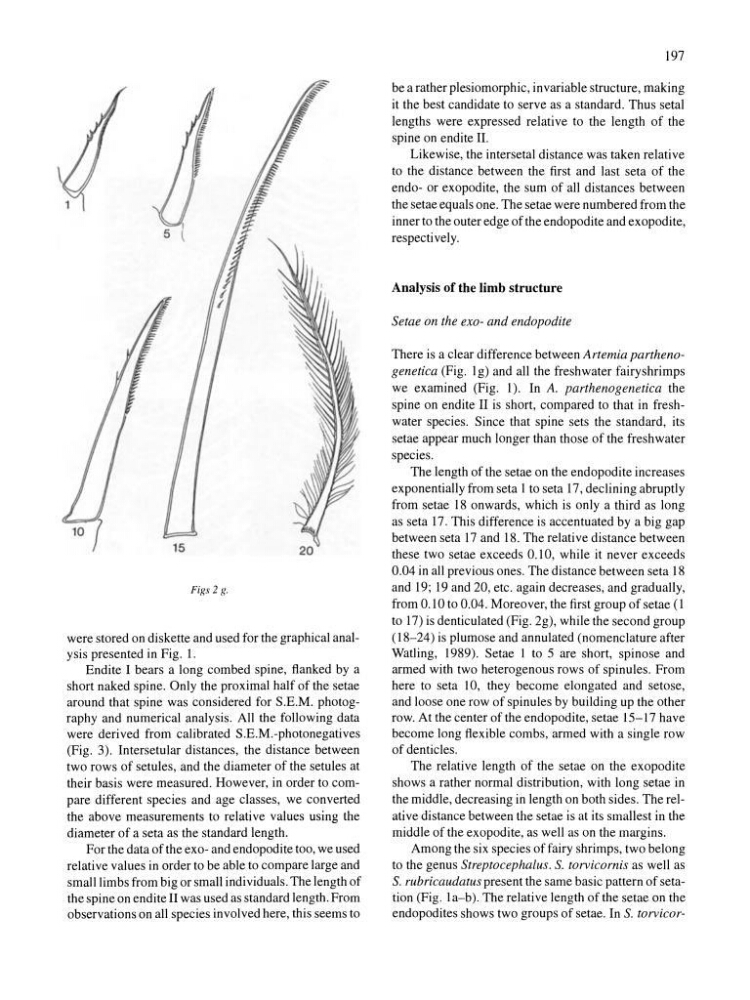
Figs 2 g.
were stored on diskette and used for the graphical analysis presented in Fig. 1.
Endite I bears a long combed spine, flanked by a
short naked spine. Only the proximal half of the setae
around that spine was considered for S.E.M. photography and numerical analysis. All the following data
were derived from calibrated S.E.M.-photonegatives
(Fig. 3). Intersetular distances, the distance between
two rows of setules, and the diameter of the setules at
their basis were measured. However, in order to compare different species and age classes, we converted
the above measurements to relative values using the
diameter of a seta as the standard length.
For the data of the exo- and endopodite too, we used
relative values in order to be able to compare large and
small limbs from big or small individuals. The length of
the spine on endite II was used as standard length. From
observations on all species involved here, this seems to
197
be a rather plesiomorphic, invariable structure, making
it the best candidate to serve as a standard. Thus setal
lengths were expressed relative to the length of the
spine on endite II.
Likewise, the intersetal distance was taken relative
to the distance between the first and last seta of the
endo- or exopodite, the sum of all distances between
the setae equals one. The setae were numbered from the
inner to the outer edge of the endopodite and exopodite,
respectively.
Analysis of the limb structure
Setae on the exo- and endopodite
There is a clear difference between Artemia parthenogenetica (Fig. I g) and all the freshwater fairy shrimps
we examined (Fig. I). In A. parthenogenetica the
spine on endite II is short, compared to that in freshwater species. Since that spine sets the standard, its
setae appear much longer than those of the freshwater
species.
The length of the setae on the endopodite increases
exponentially from seta 1 to seta 17, declining abruptly
from setae 18 onwards, which is only a third as long
as seta 17. This difference is accentuated by a big gap
between seta 17 and 18. The relati ve distance between
these two setae exceeds 0.10, while it never exceeds
0.04 in all previous ones. The distance between seta 18
and 19; 19 and 20, etc. again decreases, and gradually,
from 0.10 to 0.04. Moreover, the first group of setae (1
to 17) is denticulated (Fig. 2g), while the second group
(18-24) is plumose and annulated (nomenclature after
Watling, 1989). Setae 1 to 5 are short, spinose and
armed with two heterogenous rows of spinules. From
here to seta 10, they become elongated and setose,
and loose one row of spinules by building up the other
row. At the center of the endopodite, setae 15-17 have
become long flexible combs, armed with a single row
of denticles.
The relative length of the setae on the exopodite
shows a rather normal distribution, with long setae in
the middle, decreasing in length on both sides. The relative distance between the setae is at its smallest in the
middle of the exopodite, as well as on the margins.
Among the six species of fairy shrimps, two belong
to the genus Streptocephalus. S. torvicornis as well as
S. rubricaudatus present the same basic pattern of setation (Fig. la-b). The relative length of the setae on the
endopodites shows two groups of setae. In S. torvicor-
Figs 2 g.
were stored on diskette and used for the graphical analysis presented in Fig. 1.
Endite I bears a long combed spine, flanked by a
short naked spine. Only the proximal half of the setae
around that spine was considered for S.E.M. photography and numerical analysis. All the following data
were derived from calibrated S.E.M.-photonegatives
(Fig. 3). Intersetular distances, the distance between
two rows of setules, and the diameter of the setules at
their basis were measured. However, in order to compare different species and age classes, we converted
the above measurements to relative values using the
diameter of a seta as the standard length.
For the data of the exo- and endopodite too, we used
relative values in order to be able to compare large and
small limbs from big or small individuals. The length of
the spine on endite II was used as standard length. From
observations on all species involved here, this seems to
197
be a rather plesiomorphic, invariable structure, making
it the best candidate to serve as a standard. Thus setal
lengths were expressed relative to the length of the
spine on endite II.
Likewise, the intersetal distance was taken relative
to the distance between the first and last seta of the
endo- or exopodite, the sum of all distances between
the setae equals one. The setae were numbered from the
inner to the outer edge of the endopodite and exopodite,
respectively.
Analysis of the limb structure
Setae on the exo- and endopodite
There is a clear difference between Artemia parthenogenetica (Fig. I g) and all the freshwater fairy shrimps
we examined (Fig. I). In A. parthenogenetica the
spine on endite II is short, compared to that in freshwater species. Since that spine sets the standard, its
setae appear much longer than those of the freshwater
species.
The length of the setae on the endopodite increases
exponentially from seta 1 to seta 17, declining abruptly
from setae 18 onwards, which is only a third as long
as seta 17. This difference is accentuated by a big gap
between seta 17 and 18. The relati ve distance between
these two setae exceeds 0.10, while it never exceeds
0.04 in all previous ones. The distance between seta 18
and 19; 19 and 20, etc. again decreases, and gradually,
from 0.10 to 0.04. Moreover, the first group of setae (1
to 17) is denticulated (Fig. 2g), while the second group
(18-24) is plumose and annulated (nomenclature after
Watling, 1989). Setae 1 to 5 are short, spinose and
armed with two heterogenous rows of spinules. From
here to seta 10, they become elongated and setose,
and loose one row of spinules by building up the other
row. At the center of the endopodite, setae 15-17 have
become long flexible combs, armed with a single row
of denticles.
The relative length of the setae on the exopodite
shows a rather normal distribution, with long setae in
the middle, decreasing in length on both sides. The relative distance between the setae is at its smallest in the
middle of the exopodite, as well as on the margins.
Among the six species of fairy shrimps, two belong
to the genus Streptocephalus. S. torvicornis as well as
S. rubricaudatus present the same basic pattern of setation (Fig. la-b). The relative length of the setae on the
endopodites shows two groups of setae. In S. torvicor-