

180
Table 1. Hatching results for cysts of
Branchinecta lindahli. A. Results for cysts
placed directly at 15°C (Ohr) and those
incubated at 30 ° C for 6 or 12 hours before
being transferred to 15°C. B. Total hatch:
includes four cycles of drying, rewetting,
and incubating at 15 ° C plus the hatching
results in A.
Replicate
Ohr 6hr 12hr
A.
91
84
9
2
69
57
2
3
87
21
4
4
94
93
B.
91
84
49
2
71
60
60
3
89
44
69
4
94
93
55
rewetting produced no additional hatching. This cycle
of drying, rewetting, and incubating for 2-14 days was
included to establish the total hatchability of the cysts
and determine if the 30°C incubation had only inhibited hatching or had killed the encysted embryos.
For the T. Platyurus study, Nelson weighed
0.0142 mg (±0.0002 mg) of dry cysts with an analytical balance and placed each batch of cysts into 16
50-ml test tubes. The cysts came from a California
population cultured at Scientific Hatcheries, Huntington Beach, California, USA by Dallas E. Weaver who
gave them to Denton Belk in 1989. They were stored
in a dry state in a household refrigerator at about 4 dc.
Nelson filled each tube with aerated, deionized water
and placed four at 28°C and the other 12 at 10 DC.
In sets of four, the replicates in the 10 °C water bath
were moved to the 28°C water bath after 48 hours,
72 hours, and 96 hours. Nelson removed and counted
all larvae at approximately 0800, 1500, and 2000 each
day from 16-26 March 1993.
For statistical analyses, we used Version 2.0 of
InStat Instant Biostatistics from GraphPad Software,
San Diego, California, USA.
Results
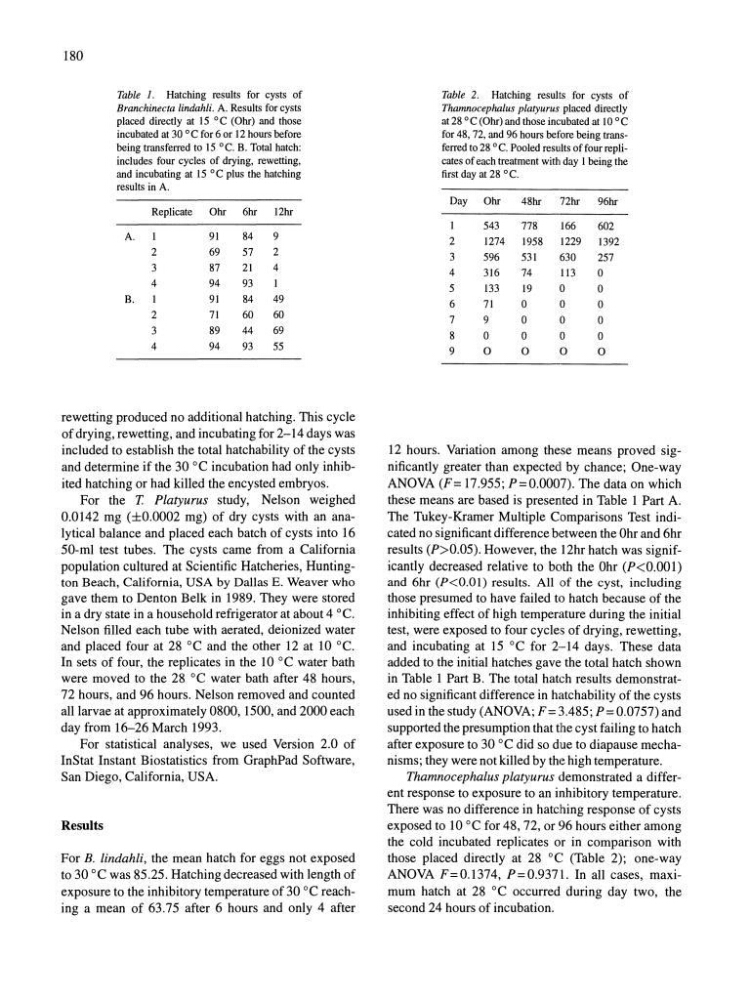
For B. lindahli, the mean hatch for eggs not exposed
to 30°C was 85.25. Hatching decreased with length of
exposure to the inhibitory temperature of 30 °C reaching a mean of 63.75 after 6 hours and only 4 after
Table 2. Hatching results for cysts of
Thamnocephalus platyurus placed directly
at 28 ° C (Ohr) and those incubated at 10 ° C
for 48, 12, and 96 hours before being transferred to 28 ° C. Pooled results of four replicates of each treatment with day 1 being the
first day at 28 ° C.
Day
Ohr
48hr 12hr 96hr
543
778
166
602
2
1274 1958 1229 1392
3
596
531
630
257
4
316
74
113
0
5
133
19
0
0
6
71
0
0
0
7
9
0
0
0
8
0
0
0
0
9
0
0
0
0
12 hours. Variation among these means proved significantly greater than expected by chance; One-way
ANOVA (F= 17.955; P=0.0007). The data on which
these means are based is presented in Table 1 Part A.
The Tukey-Kramer Multiple Comparisons Test indicated no significant difference between the Ohr and 6hr
results (P>0.05). However, the 12hr hatch was significantly decreased relative to both the Ohr (P
inhibiting effect of high temperature during the initial
test, were exposed to four cycles of drying, rewetting,
and incubating at 15°C for 2·-14 days. These data
added to the initial hatches gave the total hatch shown
in Table 1 Part B. The total hatch results demonstrated no significant difference in hatchability of the cysts
used in the study (ANOVA; F=3.485; P=0.0757) and
supported the presumption that the cyst failing to hatch
after exposure to 30°C did so dille to diapause mechanisms; they were not killed by the high temperature.
Thamnocephalus platyurus demonstrated a different response to exposure to an inhibitory temperature.
There was no difference in hatching response of cysts
exposed to 10 °C for 48, 72, or 96 hours either among
the cold incubated replicates or in comparison with
those placed directly at 28°C (Table 2); one-way
ANOVA F=0.1374, P=0.9371. In all cases, maximum hatch at 28°C occurred during day two, the
second 24 hours of incubation.
Table 1. Hatching results for cysts of
Branchinecta lindahli. A. Results for cysts
placed directly at 15°C (Ohr) and those
incubated at 30 ° C for 6 or 12 hours before
being transferred to 15°C. B. Total hatch:
includes four cycles of drying, rewetting,
and incubating at 15 ° C plus the hatching
results in A.
Replicate
Ohr 6hr 12hr
A.
91
84
9
2
69
57
2
3
87
21
4
4
94
93
B.
91
84
49
2
71
60
60
3
89
44
69
4
94
93
55
rewetting produced no additional hatching. This cycle
of drying, rewetting, and incubating for 2-14 days was
included to establish the total hatchability of the cysts
and determine if the 30°C incubation had only inhibited hatching or had killed the encysted embryos.
For the T. Platyurus study, Nelson weighed
0.0142 mg (±0.0002 mg) of dry cysts with an analytical balance and placed each batch of cysts into 16
50-ml test tubes. The cysts came from a California
population cultured at Scientific Hatcheries, Huntington Beach, California, USA by Dallas E. Weaver who
gave them to Denton Belk in 1989. They were stored
in a dry state in a household refrigerator at about 4 dc.
Nelson filled each tube with aerated, deionized water
and placed four at 28°C and the other 12 at 10 DC.
In sets of four, the replicates in the 10 °C water bath
were moved to the 28°C water bath after 48 hours,
72 hours, and 96 hours. Nelson removed and counted
all larvae at approximately 0800, 1500, and 2000 each
day from 16-26 March 1993.
For statistical analyses, we used Version 2.0 of
InStat Instant Biostatistics from GraphPad Software,
San Diego, California, USA.
Results
For B. lindahli, the mean hatch for eggs not exposed
to 30°C was 85.25. Hatching decreased with length of
exposure to the inhibitory temperature of 30 °C reaching a mean of 63.75 after 6 hours and only 4 after
Table 2. Hatching results for cysts of
Thamnocephalus platyurus placed directly
at 28 ° C (Ohr) and those incubated at 10 ° C
for 48, 12, and 96 hours before being transferred to 28 ° C. Pooled results of four replicates of each treatment with day 1 being the
first day at 28 ° C.
Day
Ohr
48hr 12hr 96hr
543
778
166
602
2
1274 1958 1229 1392
3
596
531
630
257
4
316
74
113
0
5
133
19
0
0
6
71
0
0
0
7
9
0
0
0
8
0
0
0
0
9
0
0
0
0
12 hours. Variation among these means proved significantly greater than expected by chance; One-way
ANOVA (F= 17.955; P=0.0007). The data on which
these means are based is presented in Table 1 Part A.
The Tukey-Kramer Multiple Comparisons Test indicated no significant difference between the Ohr and 6hr
results (P>0.05). However, the 12hr hatch was significantly decreased relative to both the Ohr (P
inhibiting effect of high temperature during the initial
test, were exposed to four cycles of drying, rewetting,
and incubating at 15°C for 2·-14 days. These data
added to the initial hatches gave the total hatch shown
in Table 1 Part B. The total hatch results demonstrated no significant difference in hatchability of the cysts
used in the study (ANOVA; F=3.485; P=0.0757) and
supported the presumption that the cyst failing to hatch
after exposure to 30°C did so dille to diapause mechanisms; they were not killed by the high temperature.
Thamnocephalus platyurus demonstrated a different response to exposure to an inhibitory temperature.
There was no difference in hatching response of cysts
exposed to 10 °C for 48, 72, or 96 hours either among
the cold incubated replicates or in comparison with
those placed directly at 28°C (Table 2); one-way
ANOVA F=0.1374, P=0.9371. In all cases, maximum hatch at 28°C occurred during day two, the
second 24 hours of incubation.