

",.clPlI.G~n (mIn)
000
- - --- - - - - - - - - -. - - - - - -1987-1993
1100
b
300
200
a 11 4
81011
12
129
VALOAES TOTALES MENSUALES
PRECIPITACION
o e 1 e
Me •••
Villavicencio
Pr.clpltaG~n (mm)
OOO~~----------------------1100
a
1987-1991
a 3 4 II e 1 • 0 10 11 ~
Me,es
Hulla
.. pr~K=Ip~~~e~lo~n~(m~m~) ________________________ __
800.1987-1993
c
1100
400
300
aoo
100
O~"""-'---.
a 3 4 II e 1 • 8 10 11 12
Mel.s
Puerto Carreno
VALORES PROMEDIO DE PRECIPITACION
1987-1993
Praclphacltn f/r.1n)
5000
4000
3000
2000
looo r
oL
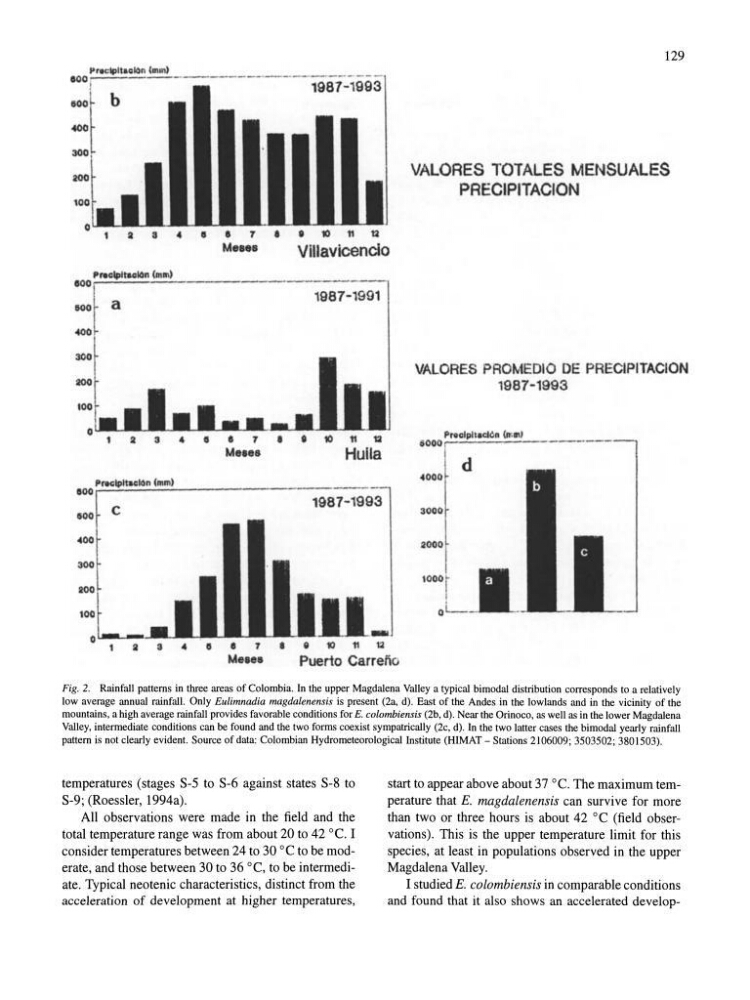
Fig. 2. Rainfall patterns in three areas of Colombia. In the upper Magdalena Valley a typical bimodal distribution corresponds to a relatively
low average annual rainfall. Only Eulimnadia magdalenensis is present (2a, d). East of the Andes in the lowlands and in the vicinity of the
mountains, a high average rainfall provides favorable conditions for E. colombiensis (2b, d). Near the Orinoco, as well as in the lower Magdalena
Valley, intermediate conditions can be found and the two forms coexist sympatrically (2c, d). In the two latter cases the bimodal yearly rainfall
pattern is not clearly evident. Source of data: Colombian Hydrometeorological Institute (HIMAT - Stations 2106009; 3503502; 3801503).
temperatures (stages S-5 to S-6 against states S-8 to
S-9; (Roessler, 1994a).
All observations were made in the field and the
total temperature range was from about 20 to 42°C. I
consider temperatures between 24 to 30 °e to be moderate, and those between 30 to 36 °e, to be intermediate. Typical neotenic characteristics, distinct from the
acceleration of development at higher temperatures,
start to appear above about 37°C. The maximum temperature that E. magdalenensis can survive for more
than two or three hours is about 42 °e (field observations). This is the upper temperature limit for this
species, at least in populations observed in the upper
Magdalena Valley.
I studied E. colombiensis in comparable conditions
and found that it also shows an accelerated develop-
000
- - --- - - - - - - - - -. - - - - - -1987-1993
1100
b
300
200
a 11 4
81011
12
129
VALOAES TOTALES MENSUALES
PRECIPITACION
o e 1 e
Me •••
Villavicencio
Pr.clpltaG~n (mm)
OOO~~----------------------1100
a
1987-1991
a 3 4 II e 1 • 0 10 11 ~
Me,es
Hulla
.. pr~K=Ip~~~e~lo~n~(m~m~) ________________________ __
800.1987-1993
c
1100
400
300
aoo
100
O~"""-'---.
a 3 4 II e 1 • 8 10 11 12
Mel.s
Puerto Carreno
VALORES PROMEDIO DE PRECIPITACION
1987-1993
Praclphacltn f/r.1n)
5000
4000
3000
2000
looo r
oL
Fig. 2. Rainfall patterns in three areas of Colombia. In the upper Magdalena Valley a typical bimodal distribution corresponds to a relatively
low average annual rainfall. Only Eulimnadia magdalenensis is present (2a, d). East of the Andes in the lowlands and in the vicinity of the
mountains, a high average rainfall provides favorable conditions for E. colombiensis (2b, d). Near the Orinoco, as well as in the lower Magdalena
Valley, intermediate conditions can be found and the two forms coexist sympatrically (2c, d). In the two latter cases the bimodal yearly rainfall
pattern is not clearly evident. Source of data: Colombian Hydrometeorological Institute (HIMAT - Stations 2106009; 3503502; 3801503).
temperatures (stages S-5 to S-6 against states S-8 to
S-9; (Roessler, 1994a).
All observations were made in the field and the
total temperature range was from about 20 to 42°C. I
consider temperatures between 24 to 30 °e to be moderate, and those between 30 to 36 °e, to be intermediate. Typical neotenic characteristics, distinct from the
acceleration of development at higher temperatures,
start to appear above about 37°C. The maximum temperature that E. magdalenensis can survive for more
than two or three hours is about 42 °e (field observations). This is the upper temperature limit for this
species, at least in populations observed in the upper
Magdalena Valley.
I studied E. colombiensis in comparable conditions
and found that it also shows an accelerated develop-