

2
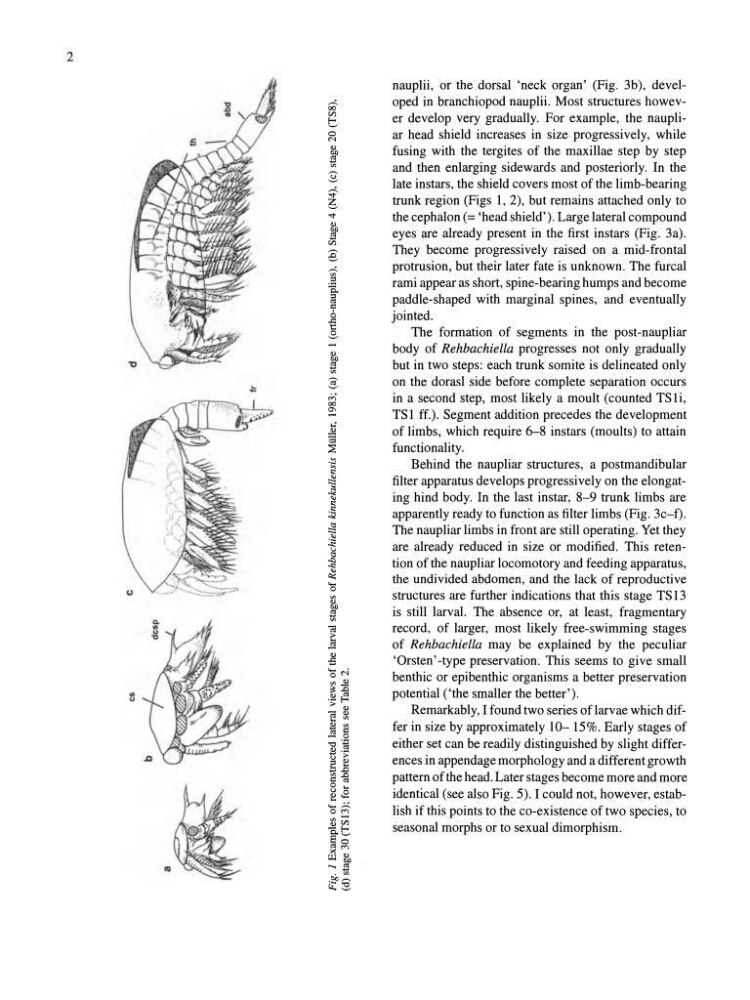
nauplii, or the dorsal 'neck organ' (Fig. 3b), devel00
oped in branchiopod nauplii. Most structures howevtil
t:o
ar head shield increases in size progressively, while
N
~
fusing with the tergites of the maxillae step by step
~
and then enlarging sidewards and posteriorly. In the
~
~
late instars, the shield covers most of the limb-bearing
~
b
trunk region (Figs 1, 2), but remains attached only to
'
.,
SO
eyes are already present in the first instars (Fig. 3a).
til
They become progressively raised on a mid-frontal
e
~
protrusion, but their later fate is unknown. The furcal
'"
=
rami appear as short, spine-bearing humps and become
:.::
c..
~
paddle-shaped with marginal spines, and eventually
c
6
jointed .
..c
1::
The formation of segments in the post-naupliar
2~
body of Rehbachiella progresses not only gradually
5
but in two steps: each trunk somite is delineated only
'"
./:
~
on the dorasl side before complete separation occurs
M
in a second step, most likely a moult (counted TSli,
00
:::
TS 1 ff.) . Segment addition precedes the development
..:
of limbs, which require 6-8 instars (moults) to attain
..!:l
:;
::E
functionality.
.::;
Behind the naupliar structures, a postmandibular
'"
;;:
~
filter apparatus develops progressively on the elongat' "
"' "
ing hind body. In the last instar, 8-9 trunk limbs are
' "
;;:
;;:
apparently ready to function as filter limbs (Fig. 3c-f).
:;;;
,;g
The naupliar limbs in front are still operating. Yet they
.~
~
are already reduced in size or modified. This reten'-' <:l
~
tion of the naupliar locomotory and feeding apparatus,
' "
0::
the undivided abdomen, and the lack of reproductive
'0
structures are further indications that this stage TS 13
'"
.,
bl)
is still larval. The absence or, at least, fragmentary
~
co
record, of larger, most likely free-swimming stages
>
~
of Rehbachiella may be explained by the peculiar
"
'Orsten' -type preservation. This seems to give small
-5
'- .
ON
benthic or epibenthic organisms a better preservation
'" "
..
~:o
potential ('the smaller the better') .
. .
. ~ ~
> ~
Remarkably, I found two series oflarvae which dife ' "
£ '"
fer in size by approximately 10- 15%. Early stages of
co c
-
0
either set can be readily distinguished by slight differ"'0 ' i
~ .~
ences in appendage morphology and a different growth
S~ "'.0
pattern of the head. Later stages become more and more
c co
o ...
e~
identical (see also Fig. 5). I could not, however, estab40-0:-:'"
Iish if this points to the co-existence of two species, to
0<"1
" , -
" t i l
seasonal morphs or to sexual dimorphism.
- f -
c..~
80 cot')
&j~
...... 5
.'"
~S
nauplii, or the dorsal 'neck organ' (Fig. 3b), devel00
oped in branchiopod nauplii. Most structures howevtil
t:o
ar head shield increases in size progressively, while
N
~
fusing with the tergites of the maxillae step by step
~
and then enlarging sidewards and posteriorly. In the
~
~
late instars, the shield covers most of the limb-bearing
~
b
trunk region (Figs 1, 2), but remains attached only to
'
.,
SO
eyes are already present in the first instars (Fig. 3a).
til
They become progressively raised on a mid-frontal
e
~
protrusion, but their later fate is unknown. The furcal
'"
=
rami appear as short, spine-bearing humps and become
:.::
c..
~
paddle-shaped with marginal spines, and eventually
c
6
jointed .
..c
1::
The formation of segments in the post-naupliar
2~
body of Rehbachiella progresses not only gradually
5
but in two steps: each trunk somite is delineated only
'"
./:
~
on the dorasl side before complete separation occurs
M
in a second step, most likely a moult (counted TSli,
00
:::
TS 1 ff.) . Segment addition precedes the development
..:
of limbs, which require 6-8 instars (moults) to attain
..!:l
:;
::E
functionality.
.::;
Behind the naupliar structures, a postmandibular
'"
;;:
~
filter apparatus develops progressively on the elongat' "
"' "
ing hind body. In the last instar, 8-9 trunk limbs are
' "
;;:
;;:
apparently ready to function as filter limbs (Fig. 3c-f).
:;;;
,;g
The naupliar limbs in front are still operating. Yet they
.~
~
are already reduced in size or modified. This reten'-' <:l
~
tion of the naupliar locomotory and feeding apparatus,
' "
0::
the undivided abdomen, and the lack of reproductive
'0
structures are further indications that this stage TS 13
'"
.,
bl)
is still larval. The absence or, at least, fragmentary
~
co
record, of larger, most likely free-swimming stages
>
~
of Rehbachiella may be explained by the peculiar
"
'Orsten' -type preservation. This seems to give small
-5
'- .
ON
benthic or epibenthic organisms a better preservation
'" "
..
~:o
potential ('the smaller the better') .
. .
. ~ ~
> ~
Remarkably, I found two series oflarvae which dife ' "
£ '"
fer in size by approximately 10- 15%. Early stages of
co c
-
0
either set can be readily distinguished by slight differ"'0 ' i
~ .~
ences in appendage morphology and a different growth
S~ "'.0
pattern of the head. Later stages become more and more
c co
o ...
e~
identical (see also Fig. 5). I could not, however, estab40-0:-:'"
Iish if this points to the co-existence of two species, to
0<"1
" , -
" t i l
seasonal morphs or to sexual dimorphism.
- f -
c..~
80 cot')
&j~
...... 5
.'"
~S