

120
100
80
.........
~
....J
~ 60
~
=>
1Il
40
20
o o
10
20
30
40
50
60
-- B.trid .
.....e.- S.macr.
-+- T.gran
103
PERIOD OF INUNDATION (DAYS)
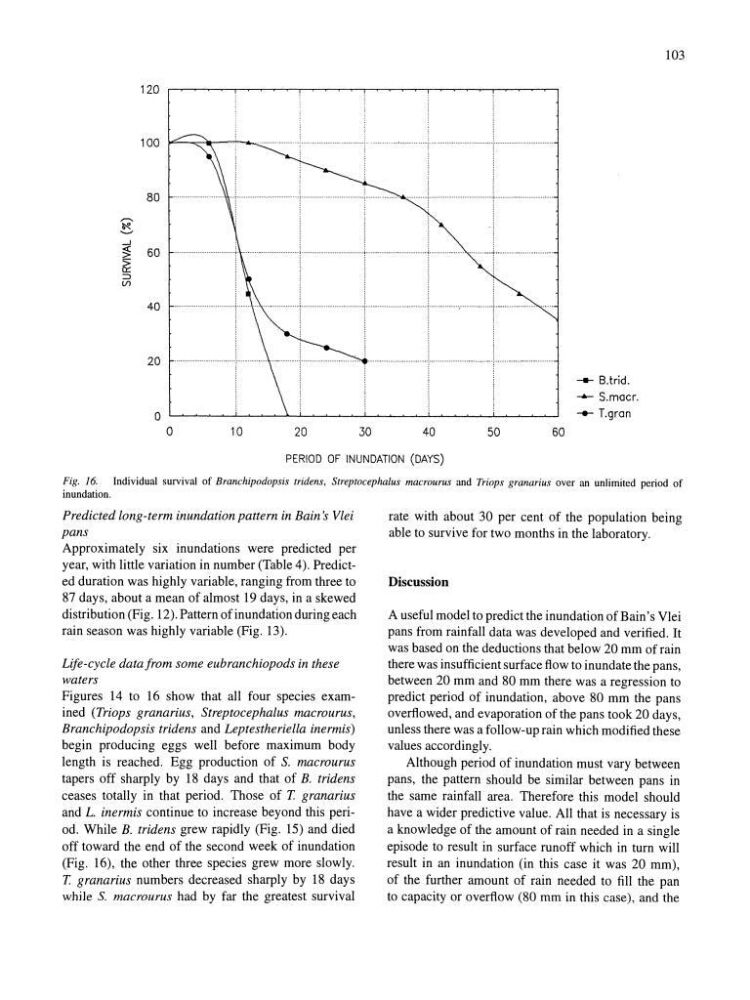
Fig. 16. Individual survival of Branchipodopsis tridens, Streptocephaius macrourus and Triops granarius over an unlimited period of
inundation.
Predicted long-term inundation pattern in Bain s Vlei
pans
Approximately six inundations were predicted per
year, with little variation in number (Table 4). Predicted duration was highly variable, ranging from three to
87 days, about a mean of almost 19 days, in a skewed
distribution (Fig. 12). Pattern of inundation during each
rain season was highly variable (Fig. 13).
Life-cycle data from some eubranchiopods in these
waters
Figures 14 to 16 show that all four species examined (Triops granarius, Streptocephalus macrourus,
Branchipodopsis tridens and Leptestheriella inermis)
begin producing eggs well before maximum body
length is reached. Egg production of S. macrourus
tapers off sharply by 18 days and that of B. tridens
ceases totally in that period. Those of T. granarius
and L. inermis continue to increase beyond this period. While B. tridens grew rapidly (Fig. 15) and died
off toward the end of the second week of inundation
(Fig. 16), the other three species grew more slowly.
T. granarius numbers decreased sharply by 18 days
while S. macrourus had by far the greatest survival
rate with about 30 per cent of the population being
able to survive for two months in the laboratory.
Discussion
A useful model to predict the inundation of Bain's Vlei
pans from rainfall data was developed and verified. It
was based on the deductions that below 20 mm of rain
there was insufficient surface flow to inundate the pans,
between 20 mm and 80 mm there was a regression to
predict period of inundation, above 80 mm the pans
overflowed, and evaporation of the pans took 20 days,
unless there was a follow-up rain which modified these
values accordingly.
Although period of inundation must vary between
pans, the pattern should be similar between pans in
the same rainfall area. Therefore this model should
have a wider predictive value. All that is necessary is
a knowledge of the amount of rain needed in a single
episode to result in surface runoff which in turn will
result in an inundation (in this case it was 20 mm),
of the further amount of rain needed to fill the pan
to capacity or overflow (80 mm in this case), and the
100
80
.........
~
....J
~ 60
~
=>
1Il
40
20
o o
10
20
30
40
50
60
-- B.trid .
.....e.- S.macr.
-+- T.gran
103
PERIOD OF INUNDATION (DAYS)
Fig. 16. Individual survival of Branchipodopsis tridens, Streptocephaius macrourus and Triops granarius over an unlimited period of
inundation.
Predicted long-term inundation pattern in Bain s Vlei
pans
Approximately six inundations were predicted per
year, with little variation in number (Table 4). Predicted duration was highly variable, ranging from three to
87 days, about a mean of almost 19 days, in a skewed
distribution (Fig. 12). Pattern of inundation during each
rain season was highly variable (Fig. 13).
Life-cycle data from some eubranchiopods in these
waters
Figures 14 to 16 show that all four species examined (Triops granarius, Streptocephalus macrourus,
Branchipodopsis tridens and Leptestheriella inermis)
begin producing eggs well before maximum body
length is reached. Egg production of S. macrourus
tapers off sharply by 18 days and that of B. tridens
ceases totally in that period. Those of T. granarius
and L. inermis continue to increase beyond this period. While B. tridens grew rapidly (Fig. 15) and died
off toward the end of the second week of inundation
(Fig. 16), the other three species grew more slowly.
T. granarius numbers decreased sharply by 18 days
while S. macrourus had by far the greatest survival
rate with about 30 per cent of the population being
able to survive for two months in the laboratory.
Discussion
A useful model to predict the inundation of Bain's Vlei
pans from rainfall data was developed and verified. It
was based on the deductions that below 20 mm of rain
there was insufficient surface flow to inundate the pans,
between 20 mm and 80 mm there was a regression to
predict period of inundation, above 80 mm the pans
overflowed, and evaporation of the pans took 20 days,
unless there was a follow-up rain which modified these
values accordingly.
Although period of inundation must vary between
pans, the pattern should be similar between pans in
the same rainfall area. Therefore this model should
have a wider predictive value. All that is necessary is
a knowledge of the amount of rain needed in a single
episode to result in surface runoff which in turn will
result in an inundation (in this case it was 20 mm),
of the further amount of rain needed to fill the pan
to capacity or overflow (80 mm in this case), and the