

CHAPTER 7
Community Structure
7.1
The Composition of Arthropod Communities
Despite their heterogeneous landscapes which are associated with strongly
fluctuating climatic variables, Mediterranean ecosystems support more or
less homogeneous faunas rich in both numbers of species and individuals.
According to Vitali-Di Castri (1973), the faunas in Mediterranean regions
were established prior to the development of the Mediterranean climate.
Most arthropod species inhabiting regions with Mediterranean climates are
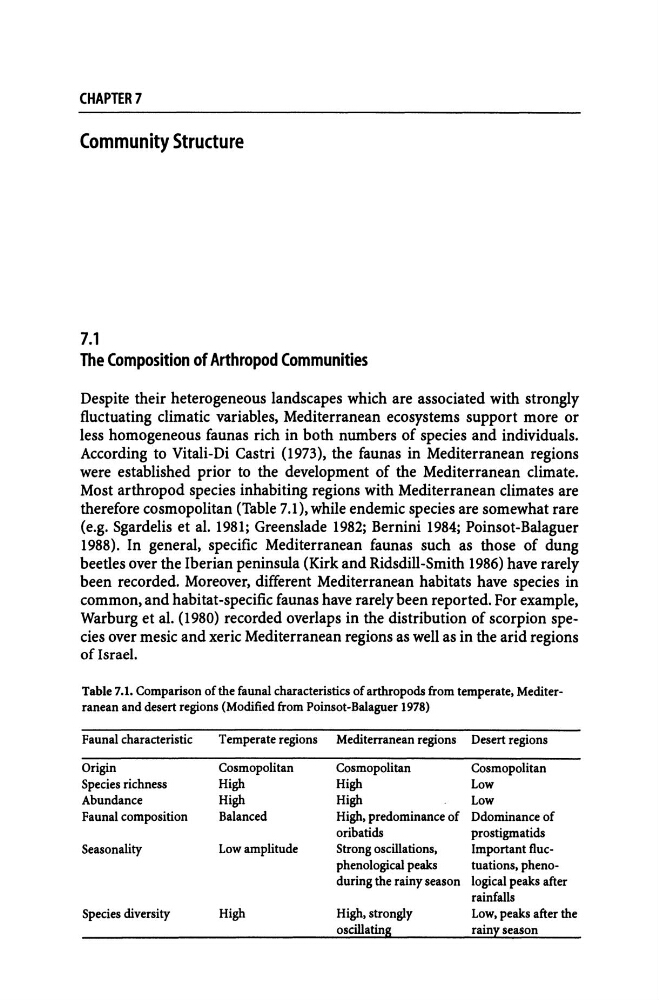
therefore cosmopolitan (Table 7.1), while endemic species are somewhat rare
(e.g. Sgardelis et al. 1981; Greenslade 1982; Bernini 1984; Poinsot-Balaguer
1988). In general, specific Mediterranean faunas such as those of dung
beetles over the Iberian peninsula (Kirk and Ridsdill-Smith 1986) have rarely
been recorded. Moreover, different Mediterranean habitats have species in
common, and habitat-specific faunas have rarely been reported. For example,
Warburg et al. (1980) recorded overlaps in the distribution of scorpion species over mesic and xeric Mediterranean regions as well as in the arid regions
of Israel.
Table 7.1. Comparison of the faunal characteristics of arthropods from temperate, Mediterranean and desert regions (Modified from Poinsot-Balaguer 1978)
Faunal characteristic
Temperate regions Mediterranean regions Desert regions
Origin
Cosmopolitan
Cosmopolitan
Cosmopolitan
Species richness
High
High
Low
Abundance
High
High
Low
Faunal composition
Balanced
High, predominance of Ddominance of
oribatids
prostigmatids
Seasonality
Low amplitude
Strong oscillations,
Important flucphenological peaks
tuations, phenoduring the rainy season logical peaks after
rainfalls
Species diversity
High
High, strongly
Low, peaks after the
oscillating
rainl season
Community Structure
7.1
The Composition of Arthropod Communities
Despite their heterogeneous landscapes which are associated with strongly
fluctuating climatic variables, Mediterranean ecosystems support more or
less homogeneous faunas rich in both numbers of species and individuals.
According to Vitali-Di Castri (1973), the faunas in Mediterranean regions
were established prior to the development of the Mediterranean climate.
Most arthropod species inhabiting regions with Mediterranean climates are
therefore cosmopolitan (Table 7.1), while endemic species are somewhat rare
(e.g. Sgardelis et al. 1981; Greenslade 1982; Bernini 1984; Poinsot-Balaguer
1988). In general, specific Mediterranean faunas such as those of dung
beetles over the Iberian peninsula (Kirk and Ridsdill-Smith 1986) have rarely
been recorded. Moreover, different Mediterranean habitats have species in
common, and habitat-specific faunas have rarely been reported. For example,
Warburg et al. (1980) recorded overlaps in the distribution of scorpion species over mesic and xeric Mediterranean regions as well as in the arid regions
of Israel.
Table 7.1. Comparison of the faunal characteristics of arthropods from temperate, Mediterranean and desert regions (Modified from Poinsot-Balaguer 1978)
Faunal characteristic
Temperate regions Mediterranean regions Desert regions
Origin
Cosmopolitan
Cosmopolitan
Cosmopolitan
Species richness
High
High
Low
Abundance
High
High
Low
Faunal composition
Balanced
High, predominance of Ddominance of
oribatids
prostigmatids
Seasonality
Low amplitude
Strong oscillations,
Important flucphenological peaks
tuations, phenoduring the rainy season logical peaks after
rainfalls
Species diversity
High
High, strongly
Low, peaks after the
oscillating
rainl season