

Numerical Responses of Microarthropods
83
0.8.-~---r--~-.------.---~-.----~~--~~--~--~~--,
al
~
""
i 0.7
Phryg.CoHemb
Sder.Cot::::: mb
Mons.Gomos.2
0.6
Mons.Gomos.l
.
Seler.Gomos
Mons.Colemb.l
p~yg.Gomos
·· .. ···· ............ ····S'Cler.Onl:'· .... ·• ........ •·· .... · .............. ··· ...... · .. r .................... · .......... ·· .. · .. ··· ...... ··· ...... ·
0,4
~0.3
CIJ
~
~
!
Mons.Collemb.2 !
~~2 ' -r
-' 0.2 L -__ ~ ____ ---"-____ ~ ____ -'--__ ~ ____ ---'-____ ~ _ _ _ -'--_ _ _ _ _ - '
0.2
0.6
Leptokyrtie----------------;;--;--:--------------:>~ Plotykyrtie
Kyrtosis
0,3
0,4
0,5
0.7
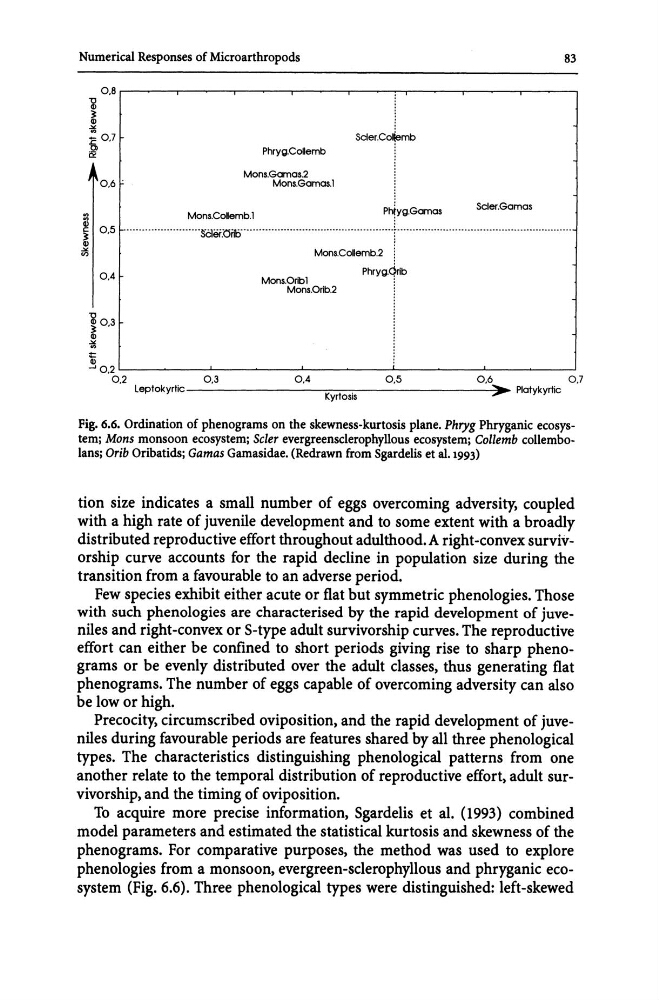
Fig. 6.6. Ordination of phenograms on the skewness-kurtosis plane. Phryg Phryganic ecosystem; Mons monsoon ecosystem; Seier evergreensclerophyllous ecosystem; Collemb collembolans; Orib Oribatids; Gamas Gamasidae. (Redrawn from Sgardelis et ai. 1993)
tion size indicates a small number of eggs overcoming adversity, coupled
with a high rate of juvenile development and to some extent with a broadly
distributed reproductive effort throughout adulthood. A right-convex survivorship curve accounts for the rapid decline in population size during the
transition from a favourable to an adverse period.
Few species exhibit either acute or flat but symmetric phenologies. Those
with such phenologies are characterised by the rapid development of juveniles and right-convex or S-type adult survivorship curves. The reproductive
effort can either be confined to short periods giving rise to sharp phenograms or be evenly distributed over the adult classes, thus generating flat
phenograms. The number of eggs capable of overcoming adversity can also
be low or high.
Precocity, circumscribed oviposition, and the rapid development of juveniles during favourable periods are features shared by all three phenological
types. The characteristics distinguishing phenological patterns from one
another relate to the temporal distribution of reproductive effort, adult survivorship, and the timing of oviposition.
To acquire more precise information, Sgardelis et al. (1993) combined
model parameters and estimated the statistical kurtosis and skewness of the
phenograms. For comparative purposes, the method was used to explore
phenologies from a monsoon, evergreen-sclerophyllous and phryganic ecosystem (Fig. 6.6). Three phenological types were distinguished: left-skewed
83
0.8.-~---r--~-.------.---~-.----~~--~~--~--~~--,
al
~
""
i 0.7
Phryg.CoHemb
Sder.Cot::::: mb
Mons.Gomos.2
0.6
Mons.Gomos.l
.
Seler.Gomos
Mons.Colemb.l
p~yg.Gomos
·· .. ···· ............ ····S'Cler.Onl:'· .... ·• ........ •·· .... · .............. ··· ...... · .. r .................... · .......... ·· .. · .. ··· ...... ··· ...... ·
0,4
~0.3
CIJ
~
~
!
Mons.Collemb.2 !
~~2 ' -r
-' 0.2 L -__ ~ ____ ---"-____ ~ ____ -'--__ ~ ____ ---'-____ ~ _ _ _ -'--_ _ _ _ _ - '
0.2
0.6
Leptokyrtie----------------;;--;--:--------------:>~ Plotykyrtie
Kyrtosis
0,3
0,4
0,5
0.7
Fig. 6.6. Ordination of phenograms on the skewness-kurtosis plane. Phryg Phryganic ecosystem; Mons monsoon ecosystem; Seier evergreensclerophyllous ecosystem; Collemb collembolans; Orib Oribatids; Gamas Gamasidae. (Redrawn from Sgardelis et ai. 1993)
tion size indicates a small number of eggs overcoming adversity, coupled
with a high rate of juvenile development and to some extent with a broadly
distributed reproductive effort throughout adulthood. A right-convex survivorship curve accounts for the rapid decline in population size during the
transition from a favourable to an adverse period.
Few species exhibit either acute or flat but symmetric phenologies. Those
with such phenologies are characterised by the rapid development of juveniles and right-convex or S-type adult survivorship curves. The reproductive
effort can either be confined to short periods giving rise to sharp phenograms or be evenly distributed over the adult classes, thus generating flat
phenograms. The number of eggs capable of overcoming adversity can also
be low or high.
Precocity, circumscribed oviposition, and the rapid development of juveniles during favourable periods are features shared by all three phenological
types. The characteristics distinguishing phenological patterns from one
another relate to the temporal distribution of reproductive effort, adult survivorship, and the timing of oviposition.
To acquire more precise information, Sgardelis et al. (1993) combined
model parameters and estimated the statistical kurtosis and skewness of the
phenograms. For comparative purposes, the method was used to explore
phenologies from a monsoon, evergreen-sclerophyllous and phryganic ecosystem (Fig. 6.6). Three phenological types were distinguished: left-skewed