

78
Phenological Patterns
2.0
1.5
, .0
0.5
4
2
Dailognatha quadricollis
m a m
m 8 m
\
\
,
a S o n d
Ca rterus calydonius
a s o n d
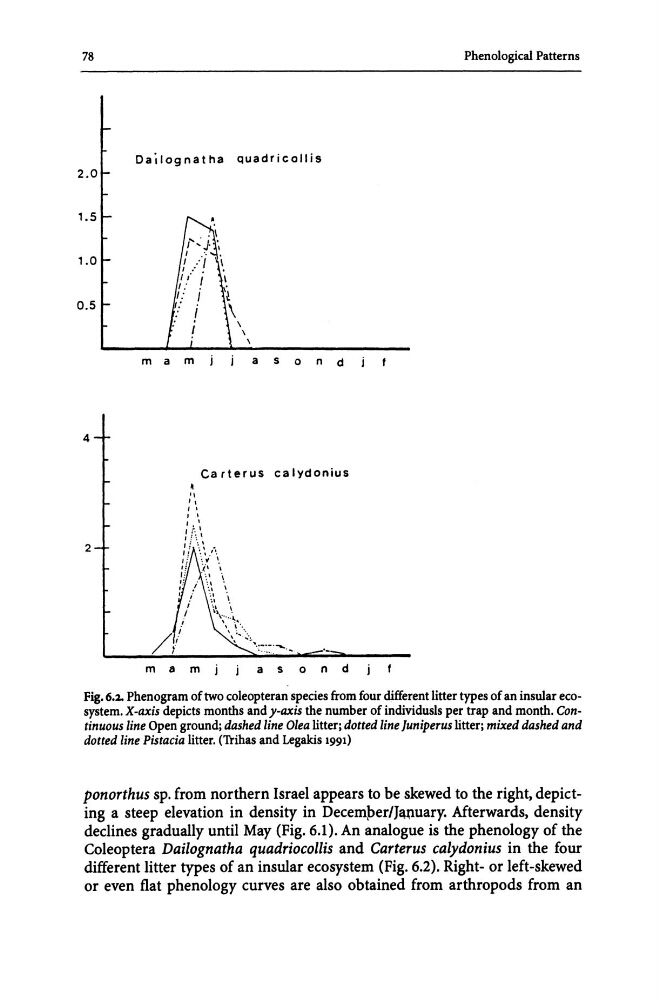
Fig. 6.2.. Phenogram of two coleopteran species from four different litter types of an insular ecosystem. X -axis depicts months and y-axis the number of individusls per trap and month. Continuous line Open ground; dashed line Olea litter; dotted line Juniperus litter; mixed dashed and
dotted line Pistacia litter. (1i'ihas and Legakis 1991)
ponorthus sp. from northern Israel appears to be skewed to the right, depicting a steep elevation in density in Decemper/JlWuary. Afterwards, density
declines gradually until May (Fig. 6.1). An analogue is the phenology of the
Coleoptera Dailognatha quadriocollis and Carterus calydonius in the four
different litter types of an insular ecosystem (Fig. 6.2). Right- or left-skewed
or even flat phenology curves are also obtained from arthropods from an
Phenological Patterns
2.0
1.5
, .0
0.5
4
2
Dailognatha quadricollis
m a m
m 8 m
\
\
,
a S o n d
Ca rterus calydonius
a s o n d
Fig. 6.2.. Phenogram of two coleopteran species from four different litter types of an insular ecosystem. X -axis depicts months and y-axis the number of individusls per trap and month. Continuous line Open ground; dashed line Olea litter; dotted line Juniperus litter; mixed dashed and
dotted line Pistacia litter. (1i'ihas and Legakis 1991)
ponorthus sp. from northern Israel appears to be skewed to the right, depicting a steep elevation in density in Decemper/JlWuary. Afterwards, density
declines gradually until May (Fig. 6.1). An analogue is the phenology of the
Coleoptera Dailognatha quadriocollis and Carterus calydonius in the four
different litter types of an insular ecosystem (Fig. 6.2). Right- or left-skewed
or even flat phenology curves are also obtained from arthropods from an