

68
Life Cycle Tactics and Development
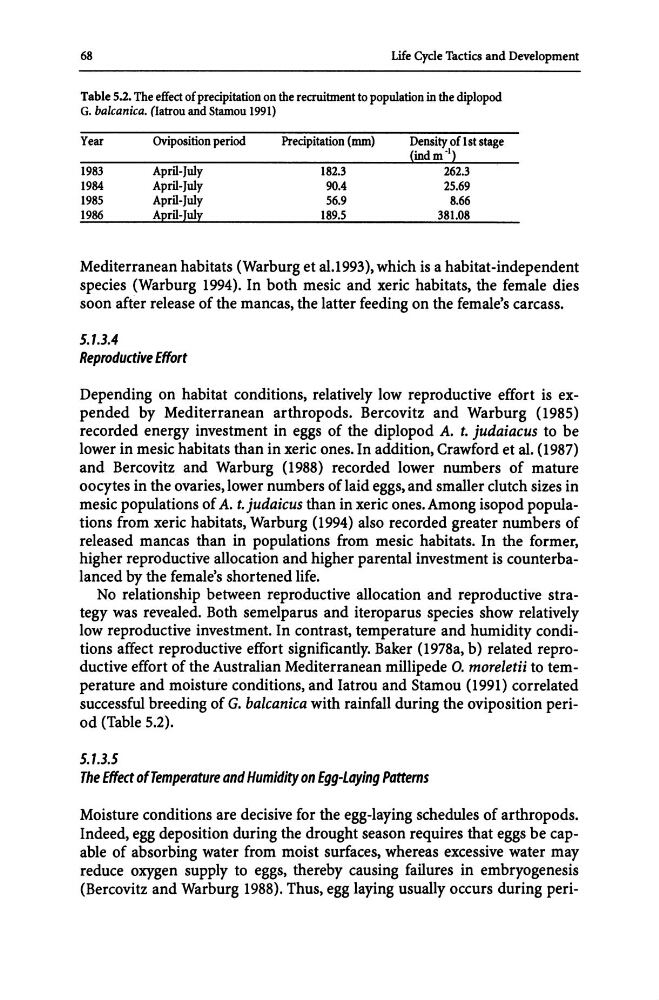
Table 5.2. The effect of precipitation on the recruitment to population in the diplopod
G. balcanica. (Iatrou and Stamou 1991)
Year
Oviposition period
Precipitation (mm)
Density of 1st stage
(indm .\)
1983
April-July
182.3
262.3
1984
April-July
90.4
25.69
1985
April-July
56.9
8.66
1986
April-July
189.5
381.08
Mediterranean habitats (Warburg et al.1993), which is a habitat-independent
species (Warburg 1994). In both mesic and xeric habitats, the female dies
soon after release of the mancas, the latter feeding on the female's carcass.
5.1.3.4
Reproductive Effort
Depending on habitat conditions, relatively low reproductive effort is expended by Mediterranean arthropods. Bercovitz and Warburg (1985)
recorded energy investment in eggs of the diplopod A. t. judaiacus to be
lower in mesic habitats than in xeric ones. In addition, Crawford et al. (1987)
and Bercovitz and Warburg (1988) recorded lower numbers of mature
oocytes in the ovaries, lower numbers of laid eggs, and smaller clutch sizes in
mesic populations of A. t. judaicus than in xeric ones. Among isopod populations from xeric habitats, Warburg (1994) also recorded greater numbers of
released mancas than in populations from mesic habitats. In the former,
higher reproductive allocation and higher parental investment is counterbalanced by the female's shortened life.
No relationship between reproductive allocation and reproductive strategy was revealed. Both semelparus and iteroparus species show relatively
low reproductive investment. In contrast, temperature and humidity conditions affect reproductive effort significantly. Baker (1978a, b) related reproductive effort of the Australian Mediterranean millipede O. moreletii to temperature and moisture conditions, and Iatrou and Stamou (1991) correlated
successful breeding of G. balcanica with rainfall during the oviposition period (Table 5.2).
5.1.3.5
The Effect of Temperature and Humidity on Egg-Laying Patterns
Moisture conditions are decisive for the egg-laying schedules of arthropods.
Indeed, egg deposition during the drought season requires that eggs be capable of absorbing water from moist surfaces, whereas excessive water may
reduce oxygen supply to eggs, thereby causing failures in embryogenesis
(Bercovitz and Warburg 1988). Thus, egg laying usually occurs during peri-
Life Cycle Tactics and Development
Table 5.2. The effect of precipitation on the recruitment to population in the diplopod
G. balcanica. (Iatrou and Stamou 1991)
Year
Oviposition period
Precipitation (mm)
Density of 1st stage
(indm .\)
1983
April-July
182.3
262.3
1984
April-July
90.4
25.69
1985
April-July
56.9
8.66
1986
April-July
189.5
381.08
Mediterranean habitats (Warburg et al.1993), which is a habitat-independent
species (Warburg 1994). In both mesic and xeric habitats, the female dies
soon after release of the mancas, the latter feeding on the female's carcass.
5.1.3.4
Reproductive Effort
Depending on habitat conditions, relatively low reproductive effort is expended by Mediterranean arthropods. Bercovitz and Warburg (1985)
recorded energy investment in eggs of the diplopod A. t. judaiacus to be
lower in mesic habitats than in xeric ones. In addition, Crawford et al. (1987)
and Bercovitz and Warburg (1988) recorded lower numbers of mature
oocytes in the ovaries, lower numbers of laid eggs, and smaller clutch sizes in
mesic populations of A. t. judaicus than in xeric ones. Among isopod populations from xeric habitats, Warburg (1994) also recorded greater numbers of
released mancas than in populations from mesic habitats. In the former,
higher reproductive allocation and higher parental investment is counterbalanced by the female's shortened life.
No relationship between reproductive allocation and reproductive strategy was revealed. Both semelparus and iteroparus species show relatively
low reproductive investment. In contrast, temperature and humidity conditions affect reproductive effort significantly. Baker (1978a, b) related reproductive effort of the Australian Mediterranean millipede O. moreletii to temperature and moisture conditions, and Iatrou and Stamou (1991) correlated
successful breeding of G. balcanica with rainfall during the oviposition period (Table 5.2).
5.1.3.5
The Effect of Temperature and Humidity on Egg-Laying Patterns
Moisture conditions are decisive for the egg-laying schedules of arthropods.
Indeed, egg deposition during the drought season requires that eggs be capable of absorbing water from moist surfaces, whereas excessive water may
reduce oxygen supply to eggs, thereby causing failures in embryogenesis
(Bercovitz and Warburg 1988). Thus, egg laying usually occurs during peri-