

66
0,3
Life Cycle Tactics and Development
............... P. alfera
- - - S. cf /alPes
i;'
i 0,2 /\
...................... A. 0I.Idem
.!!
I
fr······ .
0,1 'I
II
oouJu!---J--~/~"'~''''-'''-'''''~~----~----~
, 0
1 0
20
30
40
50
Time (weeks)
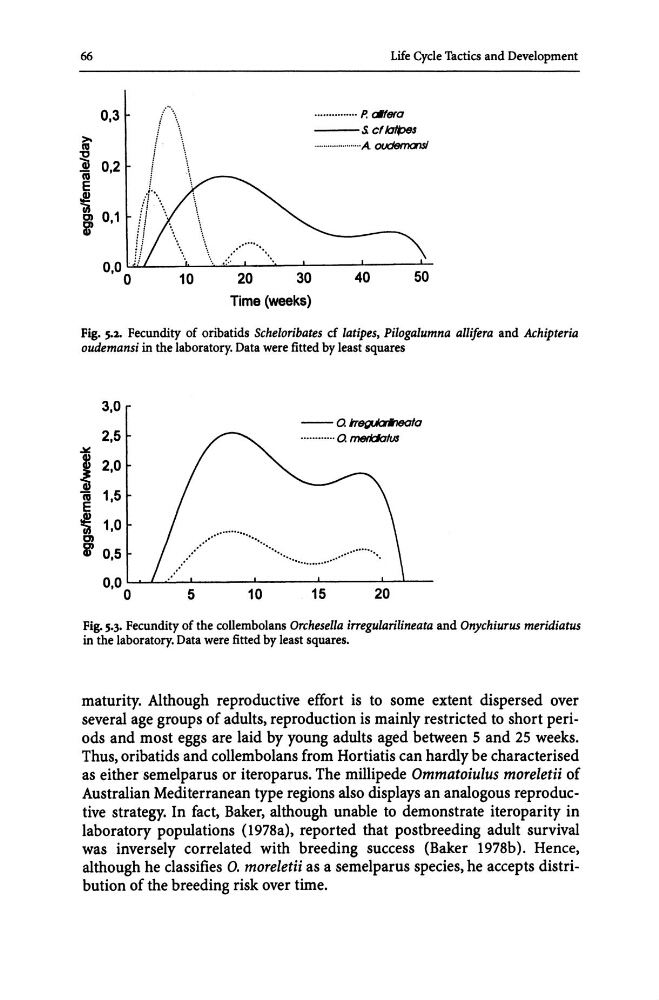
Fig. 5.:1. Fecundity of oribatids Scheloribates cf latipes, Pilogalumna allifera and Achipteria
oudemansi in the laboratory. Data were fitted by least squares
3,0
--- a ir6(Jlialheala
2,5
............ a merlclatus
~
i
2,0
1,5
ca
E
~ 1,0
CI
~ 0,5
0,0 0
...................... _ .. _-.. , .................................. -.... .
5
10
15
20
Fig. 5.3. Fecundity of the collembolans Orchesella irregularilineata and Onychiurus meridiatus
in the laboratory. Data were fitted by least squares.
maturity. Although reproductive effort is to some extent dispersed over
several age groups of adults, reproduction is mainly restricted to short periods and most eggs are laid by young adults aged between 5 and 25 weeks.
Thus, oribatids and collembolans from Hortiatis can hardly be characterised
as eithersemelparus or iteroparus. The millipede Ommatoiulus moreletii of
Australian Mediterranean type regions also displays an analogous reproductive strategy. In fact, Baker, although unable to demonstrate iteroparity in
laboratory populations (1978a), reported that postbreeding adult survival
was inversely correlated with breeding success (Baker 1978b). Hence,
although he classifies O. moreletii as a semelparus species, he accepts distribution of the breeding risk over time.
0,3
Life Cycle Tactics and Development
............... P. alfera
- - - S. cf /alPes
i;'
i 0,2 /\
...................... A. 0I.Idem
.!!
I
fr······ .
0,1 'I
II
oouJu!---J--~/~"'~''''-'''-'''''~~----~----~
, 0
1 0
20
30
40
50
Time (weeks)
Fig. 5.:1. Fecundity of oribatids Scheloribates cf latipes, Pilogalumna allifera and Achipteria
oudemansi in the laboratory. Data were fitted by least squares
3,0
--- a ir6(Jlialheala
2,5
............ a merlclatus
~
i
2,0
1,5
ca
E
~ 1,0
CI
~ 0,5
0,0 0
...................... _ .. _-.. , .................................. -.... .
5
10
15
20
Fig. 5.3. Fecundity of the collembolans Orchesella irregularilineata and Onychiurus meridiatus
in the laboratory. Data were fitted by least squares.
maturity. Although reproductive effort is to some extent dispersed over
several age groups of adults, reproduction is mainly restricted to short periods and most eggs are laid by young adults aged between 5 and 25 weeks.
Thus, oribatids and collembolans from Hortiatis can hardly be characterised
as eithersemelparus or iteroparus. The millipede Ommatoiulus moreletii of
Australian Mediterranean type regions also displays an analogous reproductive strategy. In fact, Baker, although unable to demonstrate iteroparity in
laboratory populations (1978a), reported that postbreeding adult survival
was inversely correlated with breeding success (Baker 1978b). Hence,
although he classifies O. moreletii as a semelparus species, he accepts distribution of the breeding risk over time.