

Life History Characteristics
61
80
F
80
60
60
40
40
20
20
'0
0 0
0
x
>.
0
"'0
......
(IJ 80
"0
0
80
C
E 60
60
~ ......
OJ 40
40
OJ
~ 20
20
(IJ
E 0
0
C
g
";;;
0
0.
"5 80
80
A
0
60
60
40
40
20
20
0
0
May
June
JlAy
May
June
JlAy
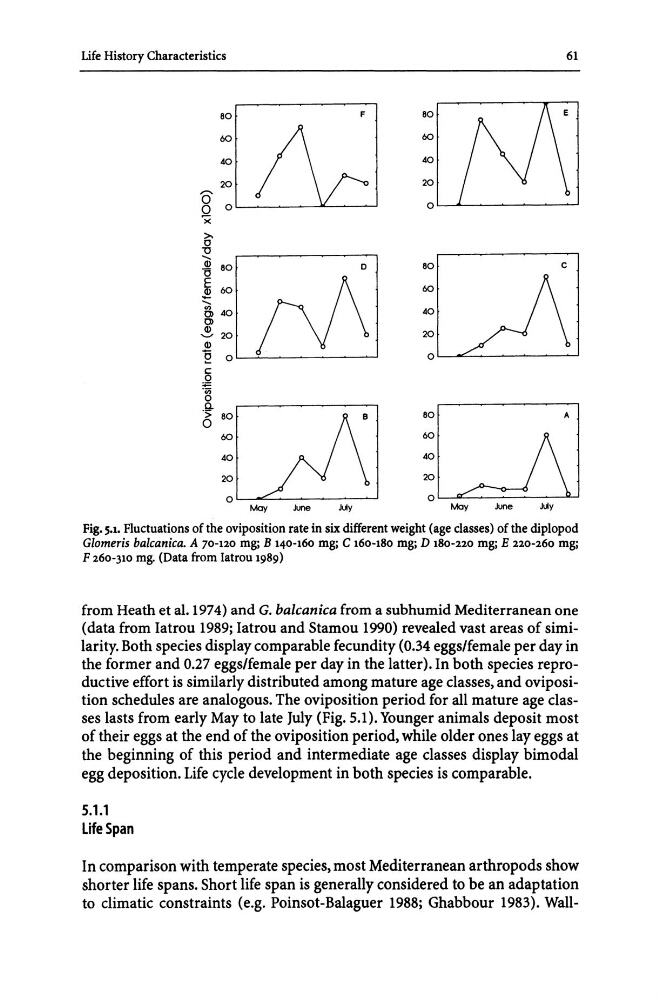
Fig. 5.1. Fluctuations of the oviposition rate in six different weight (age classes) of the diplopod
Glomeris ba/canica. A 70-120 mg; B 140-160 mg; C 160-180 mg; D 180-220 mg; E 220-260 mg;
F 260-310 mg" (Data from Iatrou 1989)
from Heath et al.1974) and G. balcanica from a subhumid Mediterranean one
(data from Iatrou 1989; Iatrou and Stamou 1990) revealed vast areas of similarity. Both species display comparable fecundity (0.34 eggs/female per day in
the former and 0.27 eggs/female per day in the latter). In both species reproductive effort is similarly distributed among mature age classes, and oviposition schedules are analogous. The oviposition period for all mature age classes lasts from early May to late July (Fig. 5.1). Younger animals deposit most
of their eggs at the end of the oviposition period, while older ones lay eggs at
the beginning of this period and intermediate age classes display bimodal
egg deposition. Life cycle development in both species is comparable.
5.1.1
Life Span
In comparison with temperate species, most Mediterranean arthropods show
shorter life spans. Short life span is generally considered to be an adaptation
to climatic constraints (e.g. Poinsot-Balaguer 1988; Ghabbour 1983). Wall-
61
80
F
80
60
60
40
40
20
20
'0
0 0
0
x
>.
0
"'0
......
(IJ 80
"0
0
80
C
E 60
60
~ ......
OJ 40
40
OJ
~ 20
20
(IJ
E 0
0
C
g
";;;
0
0.
"5 80
80
A
0
60
60
40
40
20
20
0
0
May
June
JlAy
May
June
JlAy
Fig. 5.1. Fluctuations of the oviposition rate in six different weight (age classes) of the diplopod
Glomeris ba/canica. A 70-120 mg; B 140-160 mg; C 160-180 mg; D 180-220 mg; E 220-260 mg;
F 260-310 mg" (Data from Iatrou 1989)
from Heath et al.1974) and G. balcanica from a subhumid Mediterranean one
(data from Iatrou 1989; Iatrou and Stamou 1990) revealed vast areas of similarity. Both species display comparable fecundity (0.34 eggs/female per day in
the former and 0.27 eggs/female per day in the latter). In both species reproductive effort is similarly distributed among mature age classes, and oviposition schedules are analogous. The oviposition period for all mature age classes lasts from early May to late July (Fig. 5.1). Younger animals deposit most
of their eggs at the end of the oviposition period, while older ones lay eggs at
the beginning of this period and intermediate age classes display bimodal
egg deposition. Life cycle development in both species is comparable.
5.1.1
Life Span
In comparison with temperate species, most Mediterranean arthropods show
shorter life spans. Short life span is generally considered to be an adaptation
to climatic constraints (e.g. Poinsot-Balaguer 1988; Ghabbour 1983). Wall-