

4
Introduction
40
80
U
...0
E
~ 30 •
E
:J
60
+c
2
0
Q.
40 .2
E
'0.
.g2
()
10
~
20 a..
0
Jan Mar May Jul Sep Nov Jan Mar May Jul Sep Nov
Time (months)
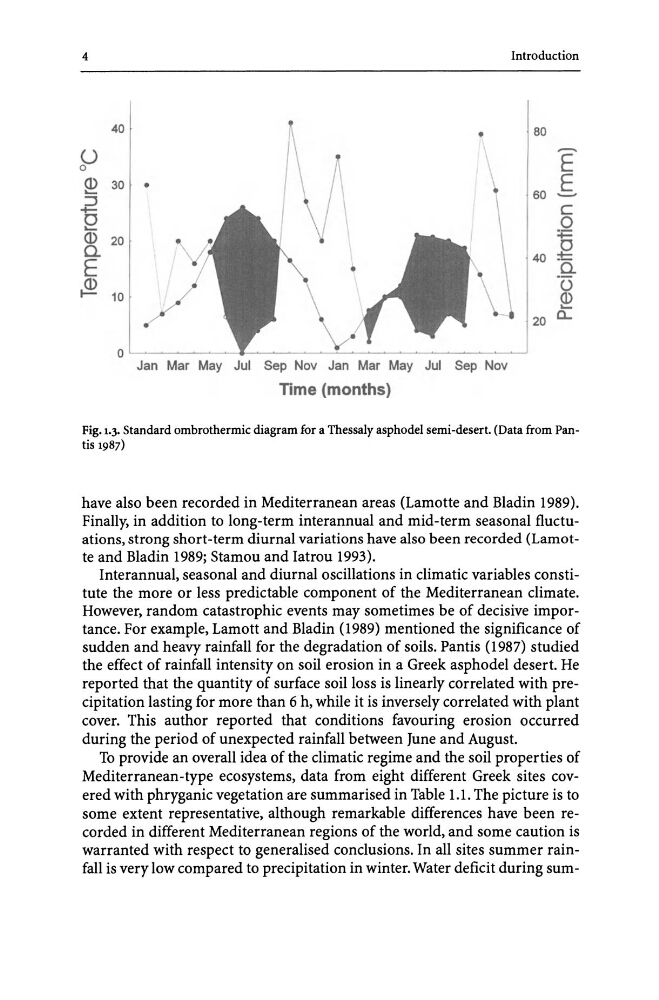
Fig.l.3. Standard ombrothermic diagram for a Thessaly asphodel semi· desert. (Data from Pantis 1987)
have also been recorded in Mediterranean areas (Lamotte and Bladin 1989).
Finally, in addition to long-term interannual and mid-term seasonal fluctuations, strong short-term diurnal variations have also been recorded (Lamotte and Bladin 1989; Stamou and Iatrou 1993).
Interannual, seasonal and diurnal oscillations in climatic variables constitute the more or less predictable component of the Mediterranean climate.
However, random catastrophic events may sometimes be of decisive importance. For example, Lamott and Bladin (1989) mentioned the significance of
sudden and heavy rainfall for the degradation of soils. Pant is (1987) studied
the effect of rainfall intensity on soil erosion in a Greek asphodel desert. He
reported that the quantity of surface soil loss is linearly correlated with precipitation lasting for more than 6 h, while it is inversely correlated with plant
cover. This author reported that conditions favouring erosion occurred
during the period of unexpected rainfall between June and August.
To provide an overall idea of the climatic regime and the soil properties of
Mediterranean-type ecosystems, data from eight different Greek sites covered with phryganic vegetation are summarised in Table 1.1. The picture is to
some extent representative, although remarkable differences have been recorded in different Mediterranean regions of the world, and some caution is
warranted with respect to generalised conclusions. In all sites summer rainfall is very low compared to precipitation in winter. Water deficit during sum-
Introduction
40
80
U
...0
E
~ 30 •
E
:J
60
+c
2
0
Q.
40 .2
E
'0.
.g2
()
10
~
20 a..
0
Jan Mar May Jul Sep Nov Jan Mar May Jul Sep Nov
Time (months)
Fig.l.3. Standard ombrothermic diagram for a Thessaly asphodel semi· desert. (Data from Pantis 1987)
have also been recorded in Mediterranean areas (Lamotte and Bladin 1989).
Finally, in addition to long-term interannual and mid-term seasonal fluctuations, strong short-term diurnal variations have also been recorded (Lamotte and Bladin 1989; Stamou and Iatrou 1993).
Interannual, seasonal and diurnal oscillations in climatic variables constitute the more or less predictable component of the Mediterranean climate.
However, random catastrophic events may sometimes be of decisive importance. For example, Lamott and Bladin (1989) mentioned the significance of
sudden and heavy rainfall for the degradation of soils. Pant is (1987) studied
the effect of rainfall intensity on soil erosion in a Greek asphodel desert. He
reported that the quantity of surface soil loss is linearly correlated with precipitation lasting for more than 6 h, while it is inversely correlated with plant
cover. This author reported that conditions favouring erosion occurred
during the period of unexpected rainfall between June and August.
To provide an overall idea of the climatic regime and the soil properties of
Mediterranean-type ecosystems, data from eight different Greek sites covered with phryganic vegetation are summarised in Table 1.1. The picture is to
some extent representative, although remarkable differences have been recorded in different Mediterranean regions of the world, and some caution is
warranted with respect to generalised conclusions. In all sites summer rainfall is very low compared to precipitation in winter. Water deficit during sum-