

2
severe winter
Q cold winter
200
160
120
80
o
40
o
0
o
o
mild winter
o
o
o
o
humi d
subhumi d
semiarid
ari d
======i====~=======t==---~perarid
-3
o
7
mlC)
Introduction
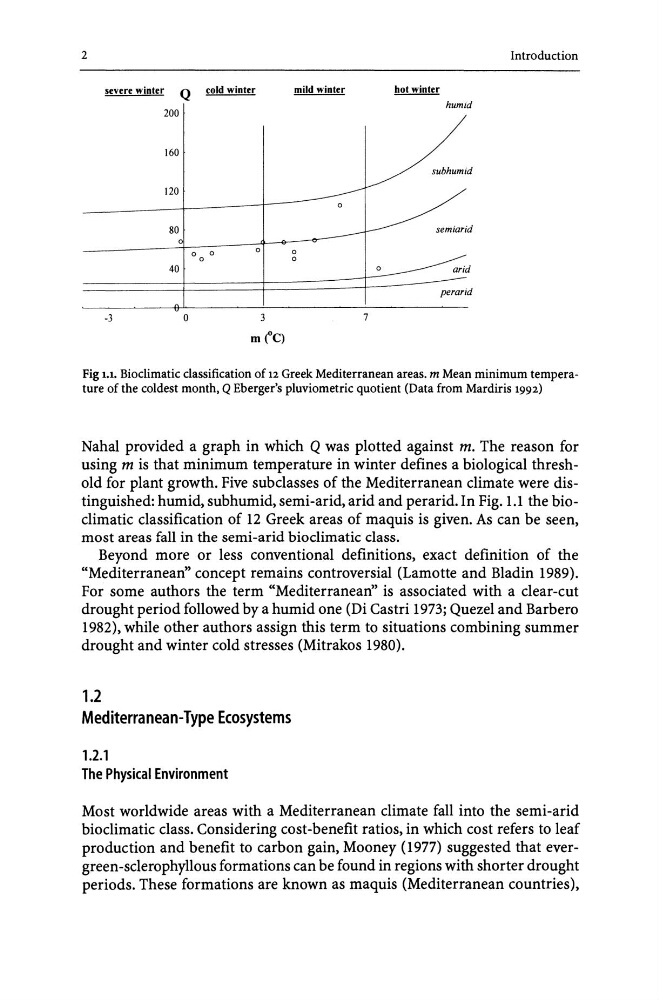
Fig 1.1. Bioclimatic classification of 12 Greek Mediterranean areas. m Mean minimum temperature of the coldest month, Q Eberger's pluviometric quotient (Data from Mardiris 1992)
Nahal provided a graph in which Q was plotted against m. The reason for
using m is that minimum temperature in winter defines a biological threshold for plant growth. Five subclasses of the Mediterranean climate were distinguished: humid, subhumid, semi-arid, arid and perarid. In Fig. 1.1 the bioclimatic classification of 12 Greek areas of maquis is given. As can be seen,
most areas fall in the semi-arid bioclimatic class.
Beyond more or less conventional definitions, exact definition of the
"Mediterranean" concept remains controversial (Lamotte and Bladin 1989).
For some authors the term "Mediterranean" is associated with a clear-cut
drought period followed by a humid one (Di Castri 1973; Quezel and Barbero
1982), while other authors assign this term to situations combining summer
drought and winter cold stresses (Mitrakos 1980).
1.2
Mediterranean-Type Ecosystems
1.2.1
The Physical Environment
Most worldwide areas with a Mediterranean climate fall into the semi-arid
bioclimatic class. Considering cost-benefit ratios, in which cost refers to leaf
production and benefit to carbon gain, Mooney (1977) suggested that evergreen-sclerophyllous formations can be found in regions with shorter drought
periods. These formations are known as maquis (Mediterranean countries),
severe winter
Q cold winter
200
160
120
80
o
40
o
0
o
o
mild winter
o
o
o
o
humi d
subhumi d
semiarid
ari d
======i====~=======t==---~perarid
-3
o
7
mlC)
Introduction
Fig 1.1. Bioclimatic classification of 12 Greek Mediterranean areas. m Mean minimum temperature of the coldest month, Q Eberger's pluviometric quotient (Data from Mardiris 1992)
Nahal provided a graph in which Q was plotted against m. The reason for
using m is that minimum temperature in winter defines a biological threshold for plant growth. Five subclasses of the Mediterranean climate were distinguished: humid, subhumid, semi-arid, arid and perarid. In Fig. 1.1 the bioclimatic classification of 12 Greek areas of maquis is given. As can be seen,
most areas fall in the semi-arid bioclimatic class.
Beyond more or less conventional definitions, exact definition of the
"Mediterranean" concept remains controversial (Lamotte and Bladin 1989).
For some authors the term "Mediterranean" is associated with a clear-cut
drought period followed by a humid one (Di Castri 1973; Quezel and Barbero
1982), while other authors assign this term to situations combining summer
drought and winter cold stresses (Mitrakos 1980).
1.2
Mediterranean-Type Ecosystems
1.2.1
The Physical Environment
Most worldwide areas with a Mediterranean climate fall into the semi-arid
bioclimatic class. Considering cost-benefit ratios, in which cost refers to leaf
production and benefit to carbon gain, Mooney (1977) suggested that evergreen-sclerophyllous formations can be found in regions with shorter drought
periods. These formations are known as maquis (Mediterranean countries),