

Synthesis
121
1.0
..r 0.8
e
~
~
0.6
e
~ 0.4
:E ;..
:a
.9 0.1
~
0.0
.. ~ l ~ ~
.. ~ a ~
III
Do ~ ~ ~
0
Do
::I
~ ~
Z
-< ~ . .
Time (months)
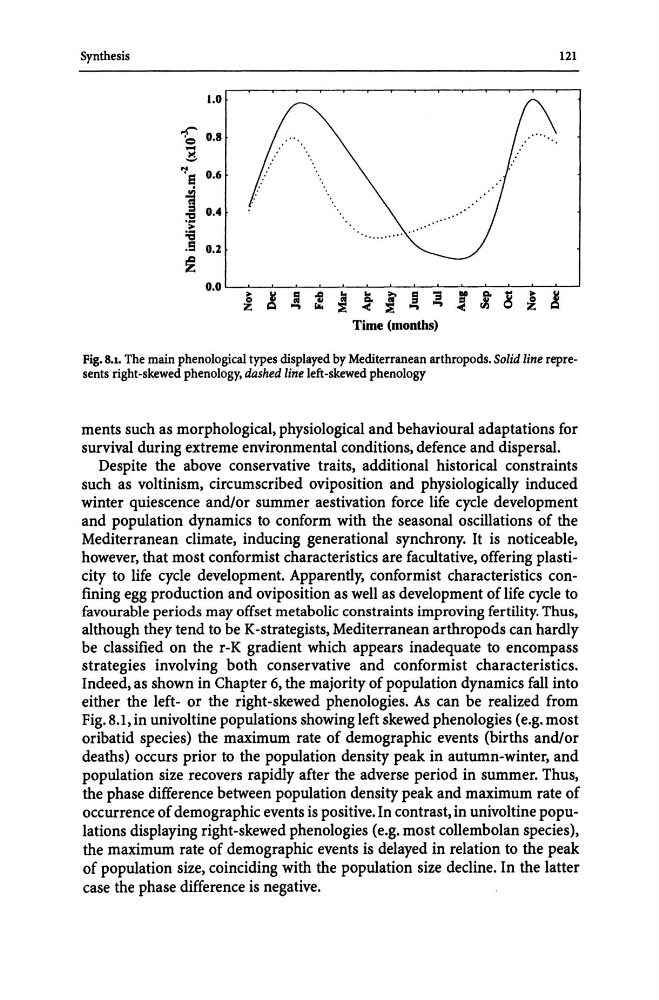
Fig. 8.1. The main phenological types displayed by Mediterranean arthropods. Solid line represents right-skewed phenology, dashed line left-skewed phenology
ments such as morphological, physiological and behavioural adaptations for
survival during extreme environmental conditions, defence and dispersal.
Despite the above conservative traits, additional historical constraints
such as voltinism, circumscribed oviposition and physiologically induced
winter quiescence and/or summer aestivation force life cycle development
and population dynamics to conform with the seasonal oscillations of the
Mediterranean climate, inducing generational synchrony. It is noticeable,
however, that most conformist characteristics are facultative, offering plasticity to life cycle development. Apparently, conformist characteristics confining egg production and oviposition as well as development of life cycle to
favourable periods may offset metabolic constraints improving fertility. Thus,
although they tend to be K-strategists, Mediterranean arthropods can hardly
be classified on the r-K gradient which appears inadequate to encompass
strategies involving both conservative and conformist characteristics.
Indeed, as shown in Chapter 6, the majority of population dynamics fall into
either the left- or the right-skewed phenologies. As can be realized from
Fig. 8.1, in univoltine populations showing left skewed phenologies (e.g. most
oribatid species) the maximum rate of demographic events (births and/or
deaths) occurs prior to the population density peak in autumn-winter, and
population size recovers rapidly after the adverse period in summer. Thus,
the phase difference between population density peak and maximum rate of
occurrence of demographic events is positive. In contrast, in univoltine populations displaying right-skewed phenologies (e.g. most collembolan species),
the maximum rate of demographic events is delayed in relation to the peak
of population size, coinciding with the population size decline. In the latter
case the phase difference is negative.
121
1.0
..r 0.8
e
~
~
0.6
e
~ 0.4
:E ;..
:a
.9 0.1
~
0.0
.. ~ l ~ ~
.. ~ a ~
III
Do ~ ~ ~
0
Do
::I
~ ~
Z
-< ~ . .
Time (months)
Fig. 8.1. The main phenological types displayed by Mediterranean arthropods. Solid line represents right-skewed phenology, dashed line left-skewed phenology
ments such as morphological, physiological and behavioural adaptations for
survival during extreme environmental conditions, defence and dispersal.
Despite the above conservative traits, additional historical constraints
such as voltinism, circumscribed oviposition and physiologically induced
winter quiescence and/or summer aestivation force life cycle development
and population dynamics to conform with the seasonal oscillations of the
Mediterranean climate, inducing generational synchrony. It is noticeable,
however, that most conformist characteristics are facultative, offering plasticity to life cycle development. Apparently, conformist characteristics confining egg production and oviposition as well as development of life cycle to
favourable periods may offset metabolic constraints improving fertility. Thus,
although they tend to be K-strategists, Mediterranean arthropods can hardly
be classified on the r-K gradient which appears inadequate to encompass
strategies involving both conservative and conformist characteristics.
Indeed, as shown in Chapter 6, the majority of population dynamics fall into
either the left- or the right-skewed phenologies. As can be realized from
Fig. 8.1, in univoltine populations showing left skewed phenologies (e.g. most
oribatid species) the maximum rate of demographic events (births and/or
deaths) occurs prior to the population density peak in autumn-winter, and
population size recovers rapidly after the adverse period in summer. Thus,
the phase difference between population density peak and maximum rate of
occurrence of demographic events is positive. In contrast, in univoltine populations displaying right-skewed phenologies (e.g. most collembolan species),
the maximum rate of demographic events is delayed in relation to the peak
of population size, coinciding with the population size decline. In the latter
case the phase difference is negative.