

94
N
'"
·x
«
Axis 1
Community Structure
APR-2
Geophllomorphe
AI'R=l
MAA-I
Isopode
-----:7'" Julldee
EfI-2
JAN-I
JAN,-2 NQJ.,JIhoblomo
e
SCenfDlIfdiI. I
DEC!rPo/ydesmldee
NO~..2 DEC,-J
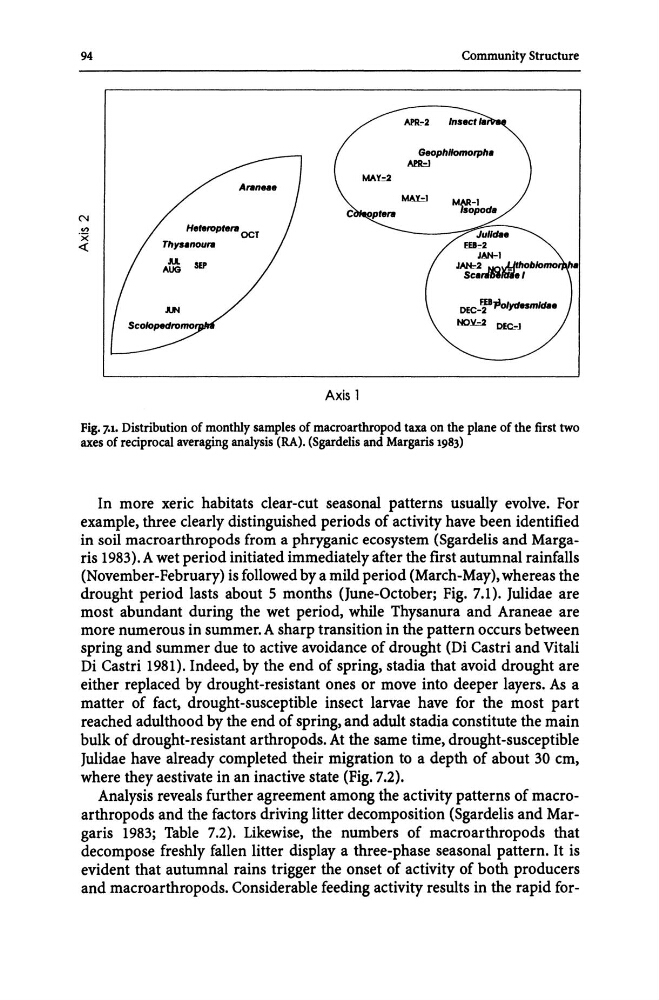
Fig. 7.1. Distribution of monthly samples of macroartbropod taxa on the plane of the first two
axes of reciprocal averaging analysis (RA). (Sgardelis and Margaris 1983)
In more xeric habitats clear-cut seasonal patterns usually evolve. For
example, three clearly distinguished periods of activity have been identified
in soil macroarthropods from a phryganic ecosystem (Sgardelis and Margaris 1983}.A wet period initiated immediately after the first autumnal rainfalls
(November-February) is followed by a mild period (March-May), whereas the
drought period lasts about 5 months (June-October; Fig. 7.1). Julidae are
most abundant during the wet period, while Thysanura and Araneae are
more numerous in summer. A sharp transition in the pattern occurs between
spring and summer due to active avoidance of drought (Di Castri and Vitali
Di Castri 1981). Indeed, by the end of spring, stadia that avoid drought are
either replaced by drought-resistant ones or move into deeper layers. As a
matter of fact, drought-susceptible insect larvae have for the most part
reached adulthood by the end of spring, and adult stadia constitute the main
bulk of drought-resistant arthropods. At the same time, drought-susceptible
Julidae have already completed their migration to a depth of about 30 cm,
where they aestivate in an inactive state (Fig. 7.2).
Analysis reveals further agreement among the activity patterns of macroarthropods and the factors driving litter decomposition (Sgardelis and Margaris 1983; Table 7.2). Likewise, the numbers of macroarthropods that
decompose freshly fallen litter display a three-phase seasonal pattern. It is
evident that autumnal rains trigger the onset of activity of both producers
and macroarthropods. Considerable feeding activity results in the rapid for-
N
'"
·x
«
Axis 1
Community Structure
APR-2
Geophllomorphe
AI'R=l
MAA-I
Isopode
-----:7'" Julldee
EfI-2
JAN-I
JAN,-2 NQJ.,JIhoblomo
e
SCenfDlIfdiI. I
DEC!rPo/ydesmldee
NO~..2 DEC,-J
Fig. 7.1. Distribution of monthly samples of macroartbropod taxa on the plane of the first two
axes of reciprocal averaging analysis (RA). (Sgardelis and Margaris 1983)
In more xeric habitats clear-cut seasonal patterns usually evolve. For
example, three clearly distinguished periods of activity have been identified
in soil macroarthropods from a phryganic ecosystem (Sgardelis and Margaris 1983}.A wet period initiated immediately after the first autumnal rainfalls
(November-February) is followed by a mild period (March-May), whereas the
drought period lasts about 5 months (June-October; Fig. 7.1). Julidae are
most abundant during the wet period, while Thysanura and Araneae are
more numerous in summer. A sharp transition in the pattern occurs between
spring and summer due to active avoidance of drought (Di Castri and Vitali
Di Castri 1981). Indeed, by the end of spring, stadia that avoid drought are
either replaced by drought-resistant ones or move into deeper layers. As a
matter of fact, drought-susceptible insect larvae have for the most part
reached adulthood by the end of spring, and adult stadia constitute the main
bulk of drought-resistant arthropods. At the same time, drought-susceptible
Julidae have already completed their migration to a depth of about 30 cm,
where they aestivate in an inactive state (Fig. 7.2).
Analysis reveals further agreement among the activity patterns of macroarthropods and the factors driving litter decomposition (Sgardelis and Margaris 1983; Table 7.2). Likewise, the numbers of macroarthropods that
decompose freshly fallen litter display a three-phase seasonal pattern. It is
evident that autumnal rains trigger the onset of activity of both producers
and macroarthropods. Considerable feeding activity results in the rapid for-