

5 Mitigating the Impacts of Paralytic Shellfish Poisoning During Harmful. . .
55
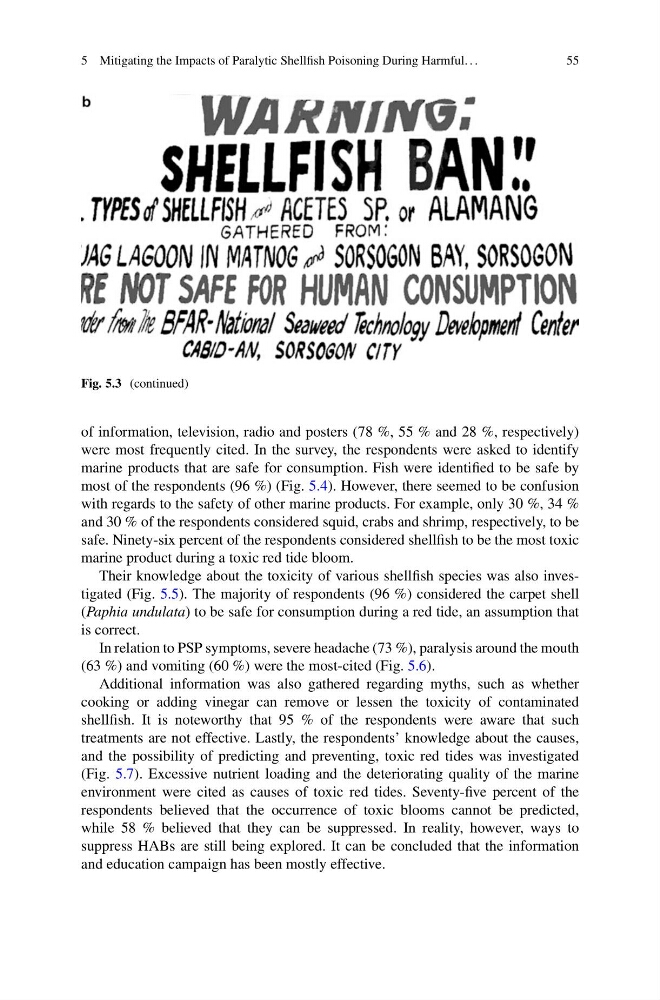
Fig. 5.3 (continued)
of information, television, radio and posters (78 %, 55 % and 28 %, respectively)
were most frequently cited. In the survey, the respondents were asked to identify
marine products that are safe for consumption. Fish were identified to be safe by
most of the respondents (96 %) (Fig. 5.4). However, there seemed to be confusion
with regards to the safety of other marine products. For example, only 30 %, 34 %
and 30 % of the respondents considered squid, crabs and shrimp, respectively, to be
safe. Ninety-six percent of the respondents considered shellfish to be the most toxic
marine product during a toxic red tide bloom.
Their knowledge about the toxicity of various shellfish species was also investigated (Fig. 5.5). The majority of respondents (96 %) considered the carpet shell
(Paphia undulata) to be safe for consumption during a red tide, an assumption that
is correct.
In relation to PSP symptoms, severe headache (73 %), paralysis around the mouth
(63 %) and vomiting (60 %) were the most-cited (Fig. 5.6).
Additional information was also gathered regarding myths, such as whether
cooking or adding vinegar can remove or lessen the toxicity of contaminated
shellfish. It is noteworthy that 95 % of the respondents were aware that such
treatments are not effective. Lastly, the respondents’ knowledge about the causes,
and the possibility of predicting and preventing, toxic red tides was investigated
(Fig. 5.7). Excessive nutrient loading and the deteriorating quality of the marine
environment were cited as causes of toxic red tides. Seventy-five percent of the
respondents believed that the occurrence of toxic blooms cannot be predicted,
while 58 % believed that they can be suppressed. In reality, however, ways to
suppress HABs are still being explored. It can be concluded that the information
and education campaign has been mostly effective.
55
Fig. 5.3 (continued)
of information, television, radio and posters (78 %, 55 % and 28 %, respectively)
were most frequently cited. In the survey, the respondents were asked to identify
marine products that are safe for consumption. Fish were identified to be safe by
most of the respondents (96 %) (Fig. 5.4). However, there seemed to be confusion
with regards to the safety of other marine products. For example, only 30 %, 34 %
and 30 % of the respondents considered squid, crabs and shrimp, respectively, to be
safe. Ninety-six percent of the respondents considered shellfish to be the most toxic
marine product during a toxic red tide bloom.
Their knowledge about the toxicity of various shellfish species was also investigated (Fig. 5.5). The majority of respondents (96 %) considered the carpet shell
(Paphia undulata) to be safe for consumption during a red tide, an assumption that
is correct.
In relation to PSP symptoms, severe headache (73 %), paralysis around the mouth
(63 %) and vomiting (60 %) were the most-cited (Fig. 5.6).
Additional information was also gathered regarding myths, such as whether
cooking or adding vinegar can remove or lessen the toxicity of contaminated
shellfish. It is noteworthy that 95 % of the respondents were aware that such
treatments are not effective. Lastly, the respondents’ knowledge about the causes,
and the possibility of predicting and preventing, toxic red tides was investigated
(Fig. 5.7). Excessive nutrient loading and the deteriorating quality of the marine
environment were cited as causes of toxic red tides. Seventy-five percent of the
respondents believed that the occurrence of toxic blooms cannot be predicted,
while 58 % believed that they can be suppressed. In reality, however, ways to
suppress HABs are still being explored. It can be concluded that the information
and education campaign has been mostly effective.