

32
J. Haure et al.
0.5
0.7
0.9
1.1
1.3
1.5
1.7
1.9
0
1
2
3
4
5
6
7
8
9 10 11 12 13 14 15
Days
GTX2-3 standard mean concentration
(µmol.L
-1
)
Seawater
Artificial seawater
Buffered aqueous
solution pH=8,1
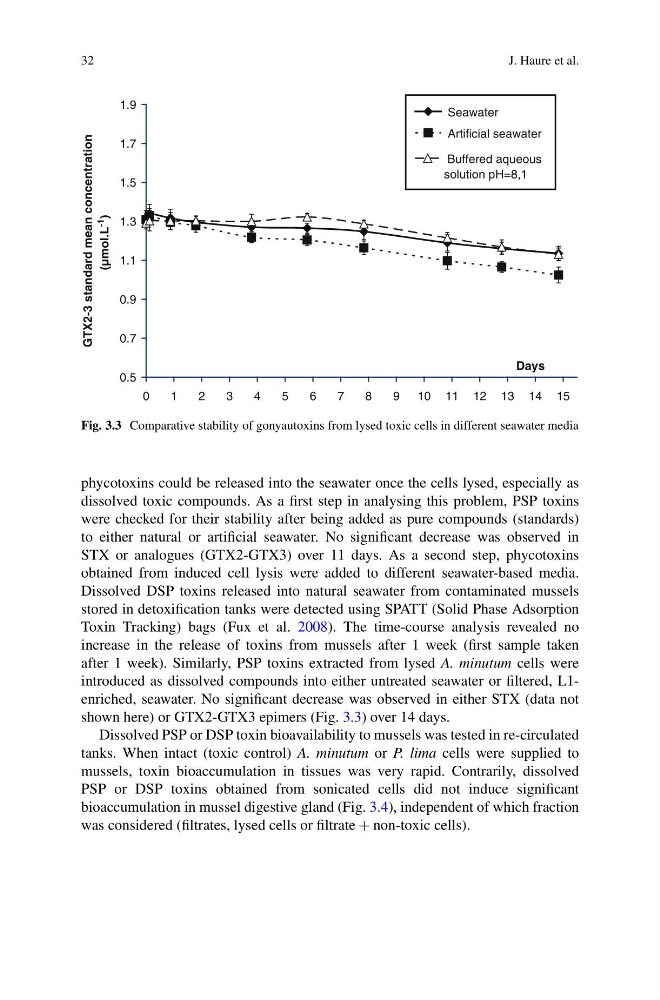
Fig. 3.3 Comparative stability of gonyautoxins from lysed toxic cells in different seawater media
phycotoxins could be released into the seawater once the cells lysed, especially as
dissolved toxic compounds. As a first step in analysing this problem, PSP toxins
were checked for their stability after being added as pure compounds (standards)
to either natural or artificial seawater. No significant decrease was observed in
STX or analogues (GTX2-GTX3) over 11 days. As a second step, phycotoxins
obtained from induced cell lysis were added to different seawater-based media.
Dissolved DSP toxins released into natural seawater from contaminated mussels
stored in detoxification tanks were detected using SPATT (Solid Phase Adsorption
Toxin Tracking) bags (Fux et al. 2008). The time-course analysis revealed no
increase in the release of toxins from mussels after 1 week (first sample taken
after 1 week). Similarly, PSP toxins extracted from lysed A. minutum cells were
introduced as dissolved compounds into either untreated seawater or filtered, L1enriched, seawater. No significant decrease was observed in either STX (data not
shown here) or GTX2-GTX3 epimers (Fig. 3.3) over 14 days.
Dissolved PSP or DSP toxin bioavailability to mussels was tested in re-circulated
tanks. When intact (toxic control) A. minutum or P. lima cells were supplied to
mussels, toxin bioaccumulation in tissues was very rapid. Contrarily, dissolved
PSP or DSP toxins obtained from sonicated cells did not induce significant
bioaccumulation in mussel digestive gland (Fig. 3.4), independent of which fraction
was considered (filtrates, lysed cells or filtrate C non-toxic cells).
J. Haure et al.
0.5
0.7
0.9
1.1
1.3
1.5
1.7
1.9
0
1
2
3
4
5
6
7
8
9 10 11 12 13 14 15
Days
GTX2-3 standard mean concentration
(µmol.L
-1
)
Seawater
Artificial seawater
Buffered aqueous
solution pH=8,1
Fig. 3.3 Comparative stability of gonyautoxins from lysed toxic cells in different seawater media
phycotoxins could be released into the seawater once the cells lysed, especially as
dissolved toxic compounds. As a first step in analysing this problem, PSP toxins
were checked for their stability after being added as pure compounds (standards)
to either natural or artificial seawater. No significant decrease was observed in
STX or analogues (GTX2-GTX3) over 11 days. As a second step, phycotoxins
obtained from induced cell lysis were added to different seawater-based media.
Dissolved DSP toxins released into natural seawater from contaminated mussels
stored in detoxification tanks were detected using SPATT (Solid Phase Adsorption
Toxin Tracking) bags (Fux et al. 2008). The time-course analysis revealed no
increase in the release of toxins from mussels after 1 week (first sample taken
after 1 week). Similarly, PSP toxins extracted from lysed A. minutum cells were
introduced as dissolved compounds into either untreated seawater or filtered, L1enriched, seawater. No significant decrease was observed in either STX (data not
shown here) or GTX2-GTX3 epimers (Fig. 3.3) over 14 days.
Dissolved PSP or DSP toxin bioavailability to mussels was tested in re-circulated
tanks. When intact (toxic control) A. minutum or P. lima cells were supplied to
mussels, toxin bioaccumulation in tissues was very rapid. Contrarily, dissolved
PSP or DSP toxins obtained from sonicated cells did not induce significant
bioaccumulation in mussel digestive gland (Fig. 3.4), independent of which fraction
was considered (filtrates, lysed cells or filtrate C non-toxic cells).