

16
A.B. Goya and S. Maldonado
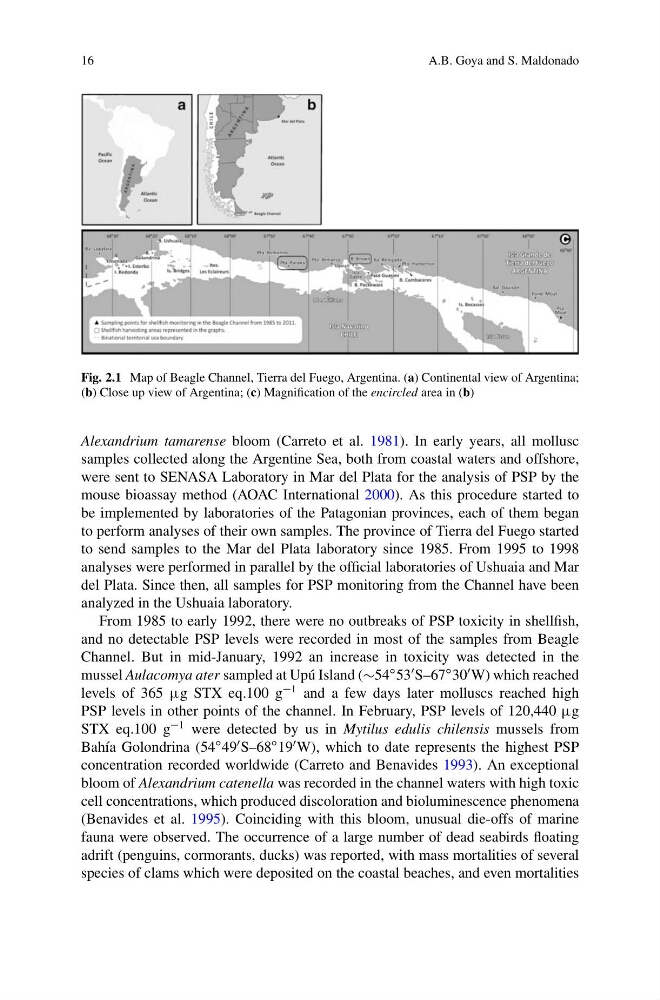
Fig. 2.1 Map of Beagle Channel, Tierra del Fuego, Argentina. (a) Continental view of Argentina;
(b) Close up view of Argentina; (c) Magnification of the encircled area in (b)
Alexandrium tamarense bloom (Carreto et al. 1981). In early years, all mollusc
samples collected along the Argentine Sea, both from coastal waters and offshore,
were sent to SENASA Laboratory in Mar del Plata for the analysis of PSP by the
mouse bioassay method (AOAC International 2000). As this procedure started to
be implemented by laboratories of the Patagonian provinces, each of them began
to perform analyses of their own samples. The province of Tierra del Fuego started
to send samples to the Mar del Plata laboratory since 1985. From 1995 to 1998
analyses were performed in parallel by the official laboratories of Ushuaia and Mar
del Plata. Since then, all samples for PSP monitoring from the Channel have been
analyzed in the Ushuaia laboratory.
From 1985 to early 1992, there were no outbreaks of PSP toxicity in shellfish,
and no detectable PSP levels were recorded in most of the samples from Beagle
Channel. But in mid-January, 1992 an increase in toxicity was detected in the
mussel Aulacomya ater sampled at Up´ u Island (54
ı 53
0 S–67
ı 30
0 W) which reached
levels of 365 g STX eq.100 g
1 and a few days later molluscs reached high
PSP levels in other points of the channel. In February, PSP levels of 120,440 g
STX eq.100 g
1 were detected by us in Mytilus edulis chilensis mussels from
Bah´ ıa Golondrina (54
ı 49
0 S–68
ı 19
0 W), which to date represents the highest PSP
concentration recorded worldwide (Carreto and Benavides 1993). An exceptional
bloom of Alexandrium catenella was recorded in the channel waters with high toxic
cell concentrations, which produced discoloration and bioluminescence phenomena
(Benavides et al. 1995). Coinciding with this bloom, unusual die-offs of marine
fauna were observed. The occurrence of a large number of dead seabirds floating
adrift (penguins, cormorants, ducks) was reported, with mass mortalities of several
species of clams which were deposited on the coastal beaches, and even mortalities
A.B. Goya and S. Maldonado
Fig. 2.1 Map of Beagle Channel, Tierra del Fuego, Argentina. (a) Continental view of Argentina;
(b) Close up view of Argentina; (c) Magnification of the encircled area in (b)
Alexandrium tamarense bloom (Carreto et al. 1981). In early years, all mollusc
samples collected along the Argentine Sea, both from coastal waters and offshore,
were sent to SENASA Laboratory in Mar del Plata for the analysis of PSP by the
mouse bioassay method (AOAC International 2000). As this procedure started to
be implemented by laboratories of the Patagonian provinces, each of them began
to perform analyses of their own samples. The province of Tierra del Fuego started
to send samples to the Mar del Plata laboratory since 1985. From 1995 to 1998
analyses were performed in parallel by the official laboratories of Ushuaia and Mar
del Plata. Since then, all samples for PSP monitoring from the Channel have been
analyzed in the Ushuaia laboratory.
From 1985 to early 1992, there were no outbreaks of PSP toxicity in shellfish,
and no detectable PSP levels were recorded in most of the samples from Beagle
Channel. But in mid-January, 1992 an increase in toxicity was detected in the
mussel Aulacomya ater sampled at Up´ u Island (54
ı 53
0 S–67
ı 30
0 W) which reached
levels of 365 g STX eq.100 g
1 and a few days later molluscs reached high
PSP levels in other points of the channel. In February, PSP levels of 120,440 g
STX eq.100 g
1 were detected by us in Mytilus edulis chilensis mussels from
Bah´ ıa Golondrina (54
ı 49
0 S–68
ı 19
0 W), which to date represents the highest PSP
concentration recorded worldwide (Carreto and Benavides 1993). An exceptional
bloom of Alexandrium catenella was recorded in the channel waters with high toxic
cell concentrations, which produced discoloration and bioluminescence phenomena
(Benavides et al. 1995). Coinciding with this bloom, unusual die-offs of marine
fauna were observed. The occurrence of a large number of dead seabirds floating
adrift (penguins, cormorants, ducks) was reported, with mass mortalities of several
species of clams which were deposited on the coastal beaches, and even mortalities