

1 Recent International Efforts to Improve Bivalve Molluscan Shellfish Safety
9
Table 1.2 Data on the prevalence of Salmonella in bivalve molluscs at market level (FAO/WHO
2011b)
Region
and year
No of single
samples
% positive
No of
batches % positive Reference
EU, 2007 1; 009
0.6 %
3,214
0.9 %
EFSA Journal 3:
223, 2009
EU, 2008
330
0.9 %
5
0
EFSA Journal
8:1496, 2010
EU, 2009
499
3.4 %
294
1 %
EFSA Journal 9:
2090, 2011
US, 2007
395
1.5 % are positive by
culture method and
8.6 % by more sensitive
PCR method
–
–
DePaola et al., Appl.
Environ
Microbiol., 76:
2574, 2010
• The Appropriate Level of Protection and related Food Safety Objectives/
Performance Objectives should be defined before a relevant sampling plan is
recommended.
• In the absence of these being defined, the assessment is based on the fact that
there is no evidence of a particular public health problem with regard to nontyphoidal salmonellosis associated with the consumption of bivalve molluscs.
• Given the data on the predictive ability of faecal bacterial indicators for
Salmonella spp., routine monitoring of harvesting areas for this pathogen would
have very limited value.
• Proper application of current classification procedures and associated controls in
control programmes should provide adequate protection.
• Current Codex Code of Practice for fish and fishery products does not recommend pathogen monitoring on a routine basis.
While considering these points, the 30th Session of CCFFP asked FAO/
WHO to:
• Undertake a risk assessment to determine whether there is a significant public
health risk from Salmonella associated with the consumption of bivalve molluscs and
• Evaluate whether a criterion for Salmonella is meaningful to ensure adequate
consumer health protection.
FAO/WHO started working on these two points with an Electronic Expert
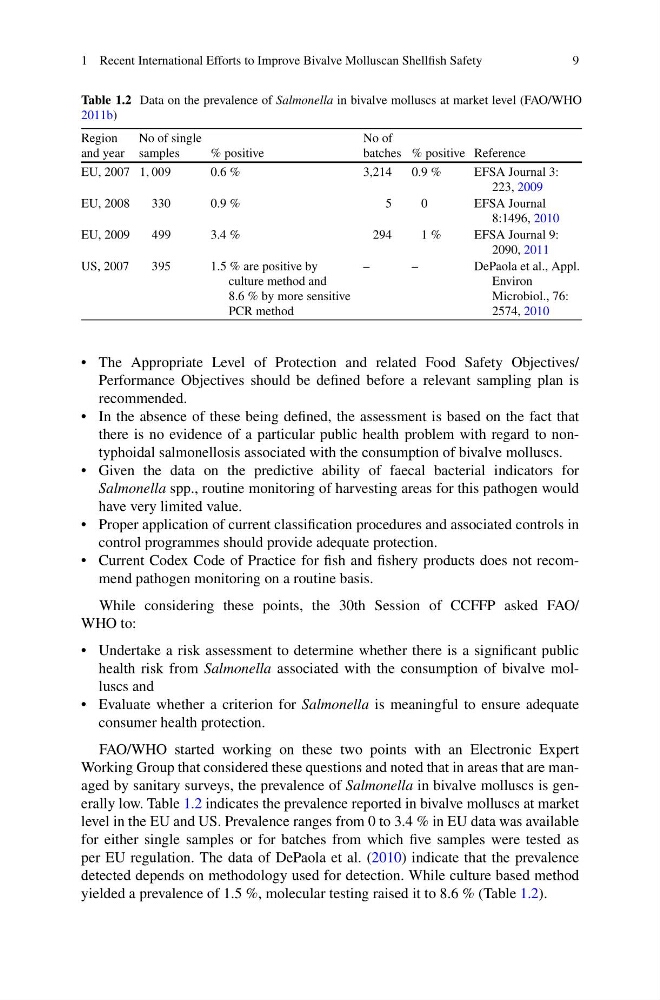
Working Group that considered these questions and noted that in areas that are managed by sanitary surveys, the prevalence of Salmonella in bivalve molluscs is generally low. Table 1.2 indicates the prevalence reported in bivalve molluscs at market
level in the EU and US. Prevalence ranges from 0 to 3.4 % in EU data was available
for either single samples or for batches from which five samples were tested as
per EU regulation. The data of DePaola et al. (2010) indicate that the prevalence
detected depends on methodology used for detection. While culture based method
yielded a prevalence of 1.5 %, molecular testing raised it to 8.6 % (Table 1.2).
9
Table 1.2 Data on the prevalence of Salmonella in bivalve molluscs at market level (FAO/WHO
2011b)
Region
and year
No of single
samples
% positive
No of
batches % positive Reference
EU, 2007 1; 009
0.6 %
3,214
0.9 %
EFSA Journal 3:
223, 2009
EU, 2008
330
0.9 %
5
0
EFSA Journal
8:1496, 2010
EU, 2009
499
3.4 %
294
1 %
EFSA Journal 9:
2090, 2011
US, 2007
395
1.5 % are positive by
culture method and
8.6 % by more sensitive
PCR method
–
–
DePaola et al., Appl.
Environ
Microbiol., 76:
2574, 2010
• The Appropriate Level of Protection and related Food Safety Objectives/
Performance Objectives should be defined before a relevant sampling plan is
recommended.
• In the absence of these being defined, the assessment is based on the fact that
there is no evidence of a particular public health problem with regard to nontyphoidal salmonellosis associated with the consumption of bivalve molluscs.
• Given the data on the predictive ability of faecal bacterial indicators for
Salmonella spp., routine monitoring of harvesting areas for this pathogen would
have very limited value.
• Proper application of current classification procedures and associated controls in
control programmes should provide adequate protection.
• Current Codex Code of Practice for fish and fishery products does not recommend pathogen monitoring on a routine basis.
While considering these points, the 30th Session of CCFFP asked FAO/
WHO to:
• Undertake a risk assessment to determine whether there is a significant public
health risk from Salmonella associated with the consumption of bivalve molluscs and
• Evaluate whether a criterion for Salmonella is meaningful to ensure adequate
consumer health protection.
FAO/WHO started working on these two points with an Electronic Expert
Working Group that considered these questions and noted that in areas that are managed by sanitary surveys, the prevalence of Salmonella in bivalve molluscs is generally low. Table 1.2 indicates the prevalence reported in bivalve molluscs at market
level in the EU and US. Prevalence ranges from 0 to 3.4 % in EU data was available
for either single samples or for batches from which five samples were tested as
per EU regulation. The data of DePaola et al. (2010) indicate that the prevalence
detected depends on methodology used for detection. While culture based method
yielded a prevalence of 1.5 %, molecular testing raised it to 8.6 % (Table 1.2).