

206
R. Raine et al.
Methods and Materials
Sample Collection
Edible blue mussels (Mytulis edulis) were collected fortnightly during the period
June–September 2009 and weekly from May–September 2010 from Killary
Harbour (53
ı N 37
0 W, 09
ı 48
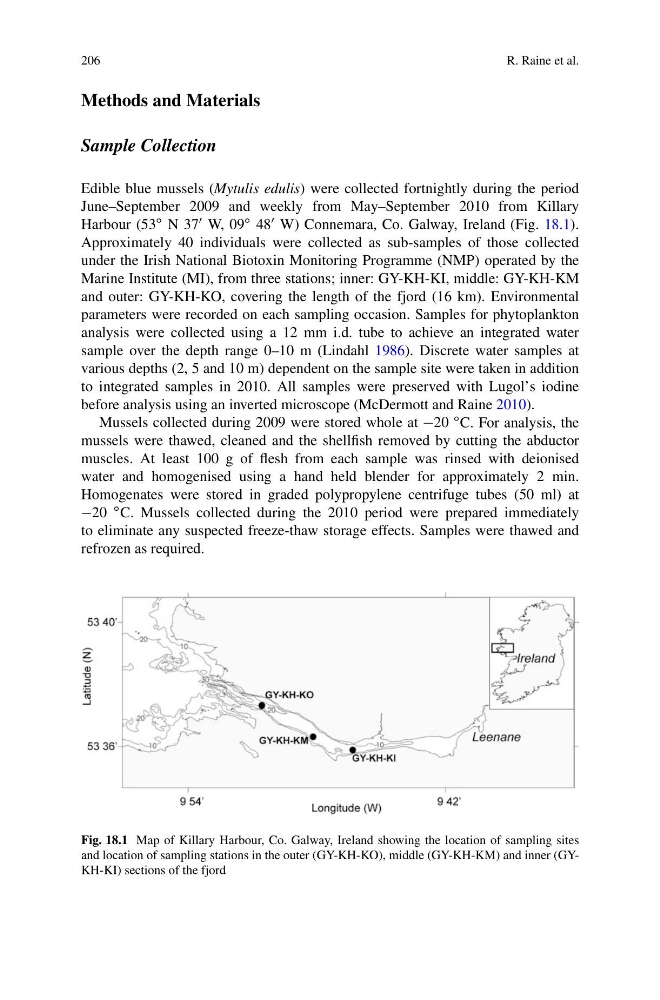
0 W) Connemara, Co. Galway, Ireland (Fig. 18.1).
Approximately 40 individuals were collected as sub-samples of those collected
under the Irish National Biotoxin Monitoring Programme (NMP) operated by the
Marine Institute (MI), from three stations; inner: GY-KH-KI, middle: GY-KH-KM
and outer: GY-KH-KO, covering the length of the fjord (16 km). Environmental
parameters were recorded on each sampling occasion. Samples for phytoplankton
analysis were collected using a 12 mm i.d. tube to achieve an integrated water
sample over the depth range 0–10 m (Lindahl 1986). Discrete water samples at
various depths (2, 5 and 10 m) dependent on the sample site were taken in addition
to integrated samples in 2010. All samples were preserved with Lugol’s iodine
before analysis using an inverted microscope (McDermott and Raine 2010).
Mussels collected during 2009 were stored whole at 20
ı C. For analysis, the
mussels were thawed, cleaned and the shellfish removed by cutting the abductor
muscles. At least 100 g of flesh from each sample was rinsed with deionised
water and homogenised using a hand held blender for approximately 2 min.
Homogenates were stored in graded polypropylene centrifuge tubes (50 ml) at
20
ı C. Mussels collected during the 2010 period were prepared immediately
to eliminate any suspected freeze-thaw storage effects. Samples were thawed and
refrozen as required.
Fig. 18.1 Map of Killary Harbour, Co. Galway, Ireland showing the location of sampling sites
and location of sampling stations in the outer (GY-KH-KO), middle (GY-KH-KM) and inner (GYKH-KI) sections of the fjord
R. Raine et al.
Methods and Materials
Sample Collection
Edible blue mussels (Mytulis edulis) were collected fortnightly during the period
June–September 2009 and weekly from May–September 2010 from Killary
Harbour (53
ı N 37
0 W, 09
ı 48
0 W) Connemara, Co. Galway, Ireland (Fig. 18.1).
Approximately 40 individuals were collected as sub-samples of those collected
under the Irish National Biotoxin Monitoring Programme (NMP) operated by the
Marine Institute (MI), from three stations; inner: GY-KH-KI, middle: GY-KH-KM
and outer: GY-KH-KO, covering the length of the fjord (16 km). Environmental
parameters were recorded on each sampling occasion. Samples for phytoplankton
analysis were collected using a 12 mm i.d. tube to achieve an integrated water
sample over the depth range 0–10 m (Lindahl 1986). Discrete water samples at
various depths (2, 5 and 10 m) dependent on the sample site were taken in addition
to integrated samples in 2010. All samples were preserved with Lugol’s iodine
before analysis using an inverted microscope (McDermott and Raine 2010).
Mussels collected during 2009 were stored whole at 20
ı C. For analysis, the
mussels were thawed, cleaned and the shellfish removed by cutting the abductor
muscles. At least 100 g of flesh from each sample was rinsed with deionised
water and homogenised using a hand held blender for approximately 2 min.
Homogenates were stored in graded polypropylene centrifuge tubes (50 ml) at
20
ı C. Mussels collected during the 2010 period were prepared immediately
to eliminate any suspected freeze-thaw storage effects. Samples were thawed and
refrozen as required.
Fig. 18.1 Map of Killary Harbour, Co. Galway, Ireland showing the location of sampling sites
and location of sampling stations in the outer (GY-KH-KO), middle (GY-KH-KM) and inner (GYKH-KI) sections of the fjord