

7 Regulatory Perspective in Translating Science into Policy. . .
85
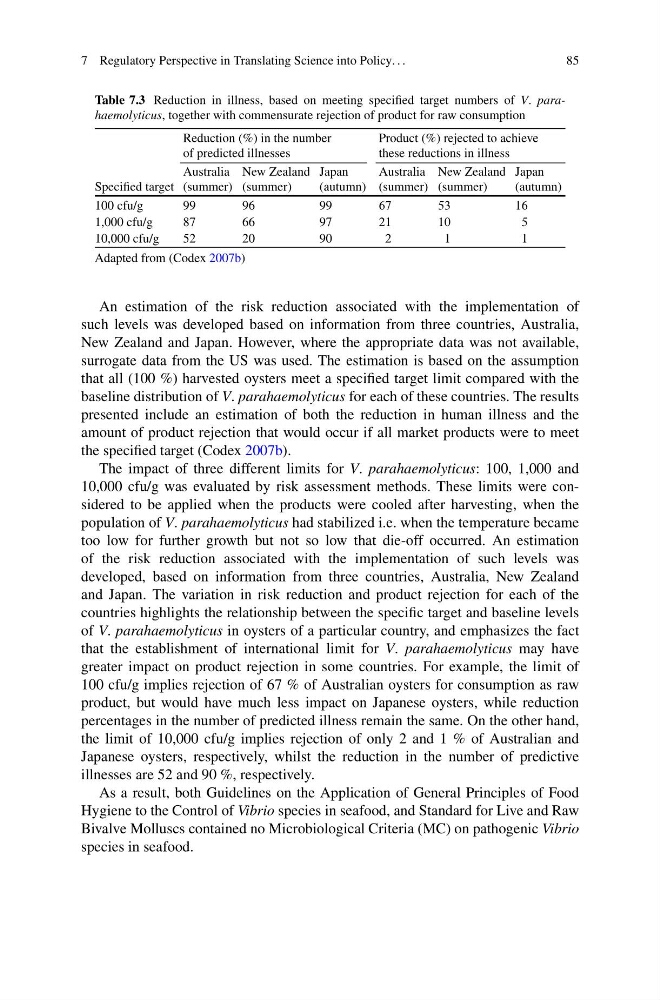
Table 7.3 Reduction in illness, based on meeting specified target numbers of V. parahaemolyticus, together with commensurate rejection of product for raw consumption
Reduction (%) in the number
of predicted illnesses
Product (%) rejected to achieve
these reductions in illness
Specified target
Australia
(summer)
New Zealand
(summer)
Japan
(autumn)
Australia
(summer)
New Zealand
(summer)
Japan
(autumn)
100 cfu/g
99
96
99
67
53
16
1,000 cfu/g
87
66
97
21
10
5
10,000 cfu/g
52
20
90
2
1
1
Adapted from (Codex 2007b)
An estimation of the risk reduction associated with the implementation of
such levels was developed based on information from three countries, Australia,
New Zealand and Japan. However, where the appropriate data was not available,
surrogate data from the US was used. The estimation is based on the assumption
that all (100 %) harvested oysters meet a specified target limit compared with the
baseline distribution of V. parahaemolyticus for each of these countries. The results
presented include an estimation of both the reduction in human illness and the
amount of product rejection that would occur if all market products were to meet
the specified target (Codex 2007b).
The impact of three different limits for V. parahaemolyticus: 100, 1,000 and
10,000 cfu/g was evaluated by risk assessment methods. These limits were considered to be applied when the products were cooled after harvesting, when the
population of V. parahaemolyticus had stabilized i.e. when the temperature became
too low for further growth but not so low that die-off occurred. An estimation
of the risk reduction associated with the implementation of such levels was
developed, based on information from three countries, Australia, New Zealand
and Japan. The variation in risk reduction and product rejection for each of the
countries highlights the relationship between the specific target and baseline levels
of V. parahaemolyticus in oysters of a particular country, and emphasizes the fact
that the establishment of international limit for V. parahaemolyticus may have
greater impact on product rejection in some countries. For example, the limit of
100 cfu/g implies rejection of 67 % of Australian oysters for consumption as raw
product, but would have much less impact on Japanese oysters, while reduction
percentages in the number of predicted illness remain the same. On the other hand,
the limit of 10,000 cfu/g implies rejection of only 2 and 1 % of Australian and
Japanese oysters, respectively, whilst the reduction in the number of predictive
illnesses are 52 and 90 %, respectively.
As a result, both Guidelines on the Application of General Principles of Food
Hygiene to the Control of Vibrio species in seafood, and Standard for Live and Raw
Bivalve Molluscs contained no Microbiological Criteria (MC) on pathogenic Vibrio
species in seafood.
85
Table 7.3 Reduction in illness, based on meeting specified target numbers of V. parahaemolyticus, together with commensurate rejection of product for raw consumption
Reduction (%) in the number
of predicted illnesses
Product (%) rejected to achieve
these reductions in illness
Specified target
Australia
(summer)
New Zealand
(summer)
Japan
(autumn)
Australia
(summer)
New Zealand
(summer)
Japan
(autumn)
100 cfu/g
99
96
99
67
53
16
1,000 cfu/g
87
66
97
21
10
5
10,000 cfu/g
52
20
90
2
1
1
Adapted from (Codex 2007b)
An estimation of the risk reduction associated with the implementation of
such levels was developed based on information from three countries, Australia,
New Zealand and Japan. However, where the appropriate data was not available,
surrogate data from the US was used. The estimation is based on the assumption
that all (100 %) harvested oysters meet a specified target limit compared with the
baseline distribution of V. parahaemolyticus for each of these countries. The results
presented include an estimation of both the reduction in human illness and the
amount of product rejection that would occur if all market products were to meet
the specified target (Codex 2007b).
The impact of three different limits for V. parahaemolyticus: 100, 1,000 and
10,000 cfu/g was evaluated by risk assessment methods. These limits were considered to be applied when the products were cooled after harvesting, when the
population of V. parahaemolyticus had stabilized i.e. when the temperature became
too low for further growth but not so low that die-off occurred. An estimation
of the risk reduction associated with the implementation of such levels was
developed, based on information from three countries, Australia, New Zealand
and Japan. The variation in risk reduction and product rejection for each of the
countries highlights the relationship between the specific target and baseline levels
of V. parahaemolyticus in oysters of a particular country, and emphasizes the fact
that the establishment of international limit for V. parahaemolyticus may have
greater impact on product rejection in some countries. For example, the limit of
100 cfu/g implies rejection of 67 % of Australian oysters for consumption as raw
product, but would have much less impact on Japanese oysters, while reduction
percentages in the number of predicted illness remain the same. On the other hand,
the limit of 10,000 cfu/g implies rejection of only 2 and 1 % of Australian and
Japanese oysters, respectively, whilst the reduction in the number of predictive
illnesses are 52 and 90 %, respectively.
As a result, both Guidelines on the Application of General Principles of Food
Hygiene to the Control of Vibrio species in seafood, and Standard for Live and Raw
Bivalve Molluscs contained no Microbiological Criteria (MC) on pathogenic Vibrio
species in seafood.