

7 Regulatory Perspective in Translating Science into Policy. . .
83
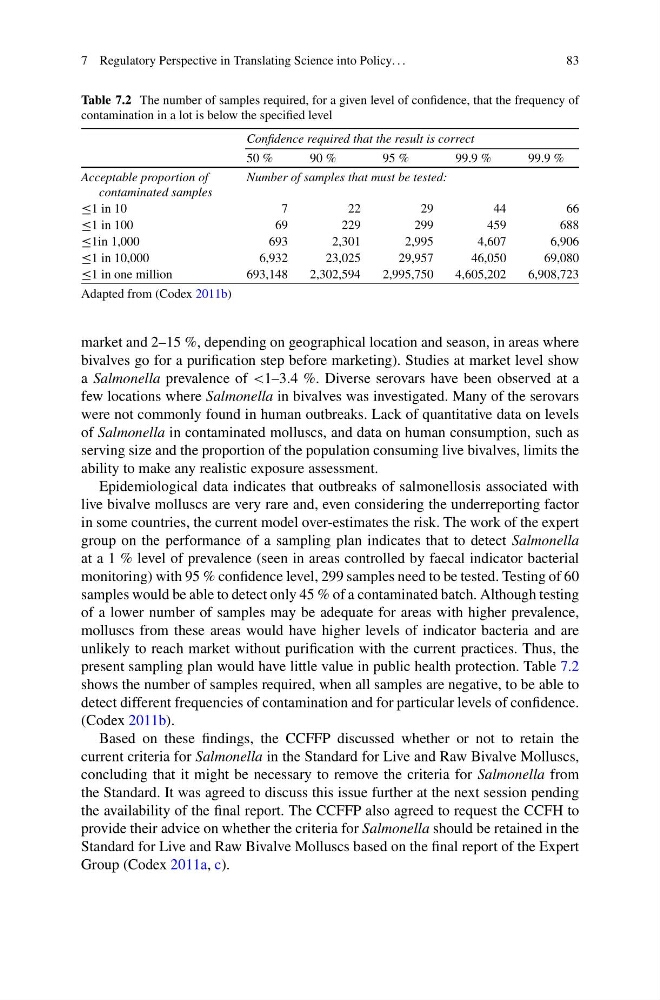
Table 7.2 The number of samples required, for a given level of confidence, that the frequency of
contamination in a lot is below the specified level
Confidence required that the result is correct
50 %
90 %
95 %
99.9 %
99.9 %
Acceptable proportion of
contaminated samples
Number of samples that must be tested:
Ä1 in 10
7
22
29
44
66
Ä1 in 100
69
229
299
459
688
Ä1in 1,000
693
2,301
2,995
4,607
6,906
Ä1 in 10,000
6,932
23,025
29,957
46,050
69,080
Ä1 in one million
693,148
2,302,594
2,995,750
4,605,202
6,908,723
Adapted from (Codex 2011b)
market and 2–15 %, depending on geographical location and season, in areas where
bivalves go for a purification step before marketing). Studies at market level show
a Salmonella prevalence of <1–3.4 %. Diverse serovars have been observed at a
few locations where Salmonella in bivalves was investigated. Many of the serovars
were not commonly found in human outbreaks. Lack of quantitative data on levels
of Salmonella in contaminated molluscs, and data on human consumption, such as
serving size and the proportion of the population consuming live bivalves, limits the
ability to make any realistic exposure assessment.
Epidemiological data indicates that outbreaks of salmonellosis associated with
live bivalve molluscs are very rare and, even considering the underreporting factor
in some countries, the current model over-estimates the risk. The work of the expert
group on the performance of a sampling plan indicates that to detect Salmonella
at a 1 % level of prevalence (seen in areas controlled by faecal indicator bacterial
monitoring) with 95 % confidence level, 299 samples need to be tested. Testing of 60
samples would be able to detect only 45 % of a contaminated batch. Although testing
of a lower number of samples may be adequate for areas with higher prevalence,
molluscs from these areas would have higher levels of indicator bacteria and are
unlikely to reach market without purification with the current practices. Thus, the
present sampling plan would have little value in public health protection. Table 7.2
shows the number of samples required, when all samples are negative, to be able to
detect different frequencies of contamination and for particular levels of confidence.
(Codex 2011b).
Based on these findings, the CCFFP discussed whether or not to retain the
current criteria for Salmonella in the Standard for Live and Raw Bivalve Molluscs,
concluding that it might be necessary to remove the criteria for Salmonella from
the Standard. It was agreed to discuss this issue further at the next session pending
the availability of the final report. The CCFFP also agreed to request the CCFH to
provide their advice on whether the criteria for Salmonella should be retained in the
Standard for Live and Raw Bivalve Molluscs based on the final report of the Expert
Group (Codex 2011a, c).
83
Table 7.2 The number of samples required, for a given level of confidence, that the frequency of
contamination in a lot is below the specified level
Confidence required that the result is correct
50 %
90 %
95 %
99.9 %
99.9 %
Acceptable proportion of
contaminated samples
Number of samples that must be tested:
Ä1 in 10
7
22
29
44
66
Ä1 in 100
69
229
299
459
688
Ä1in 1,000
693
2,301
2,995
4,607
6,906
Ä1 in 10,000
6,932
23,025
29,957
46,050
69,080
Ä1 in one million
693,148
2,302,594
2,995,750
4,605,202
6,908,723
Adapted from (Codex 2011b)
market and 2–15 %, depending on geographical location and season, in areas where
bivalves go for a purification step before marketing). Studies at market level show
a Salmonella prevalence of <1–3.4 %. Diverse serovars have been observed at a
few locations where Salmonella in bivalves was investigated. Many of the serovars
were not commonly found in human outbreaks. Lack of quantitative data on levels
of Salmonella in contaminated molluscs, and data on human consumption, such as
serving size and the proportion of the population consuming live bivalves, limits the
ability to make any realistic exposure assessment.
Epidemiological data indicates that outbreaks of salmonellosis associated with
live bivalve molluscs are very rare and, even considering the underreporting factor
in some countries, the current model over-estimates the risk. The work of the expert
group on the performance of a sampling plan indicates that to detect Salmonella
at a 1 % level of prevalence (seen in areas controlled by faecal indicator bacterial
monitoring) with 95 % confidence level, 299 samples need to be tested. Testing of 60
samples would be able to detect only 45 % of a contaminated batch. Although testing
of a lower number of samples may be adequate for areas with higher prevalence,
molluscs from these areas would have higher levels of indicator bacteria and are
unlikely to reach market without purification with the current practices. Thus, the
present sampling plan would have little value in public health protection. Table 7.2
shows the number of samples required, when all samples are negative, to be able to
detect different frequencies of contamination and for particular levels of confidence.
(Codex 2011b).
Based on these findings, the CCFFP discussed whether or not to retain the
current criteria for Salmonella in the Standard for Live and Raw Bivalve Molluscs,
concluding that it might be necessary to remove the criteria for Salmonella from
the Standard. It was agreed to discuss this issue further at the next session pending
the availability of the final report. The CCFFP also agreed to request the CCFH to
provide their advice on whether the criteria for Salmonella should be retained in the
Standard for Live and Raw Bivalve Molluscs based on the final report of the Expert
Group (Codex 2011a, c).