

The Allocation of Net Assimilate
69
with initial conditions B(O) =Bj and E(O) = 0 at the start of instar i. At the end
of instar i (after the instar duration D, has elapsed), B equals the body mass at
the start of the next instar (i + 1) plus the mass of the exuvium that will be lost
at the transition to the new instar (M,), that is, B(D,) = BI+I + Mp while E equals
the accumulated egg production during instar i; E(D,) = Er Both the dimensionless fraction of assimilate allocated to reproduction (R) and the specific
net assimilation rate (g) are assumed to be functions of body mass.
The Growth History of Daphnia pulex. As body mass changes continuously
within each instar while body length changes only at instar transitions,
body weight estimated from body length will be valid only with reference to
a specific point in the molt cycle, most commonly at the entry of new instar
(Lynch 1989). Carapace length at a given instar i (Lp mm) and body weight
at the entry of the same instar (Bp Jig C) in Daphnia are usually found to be
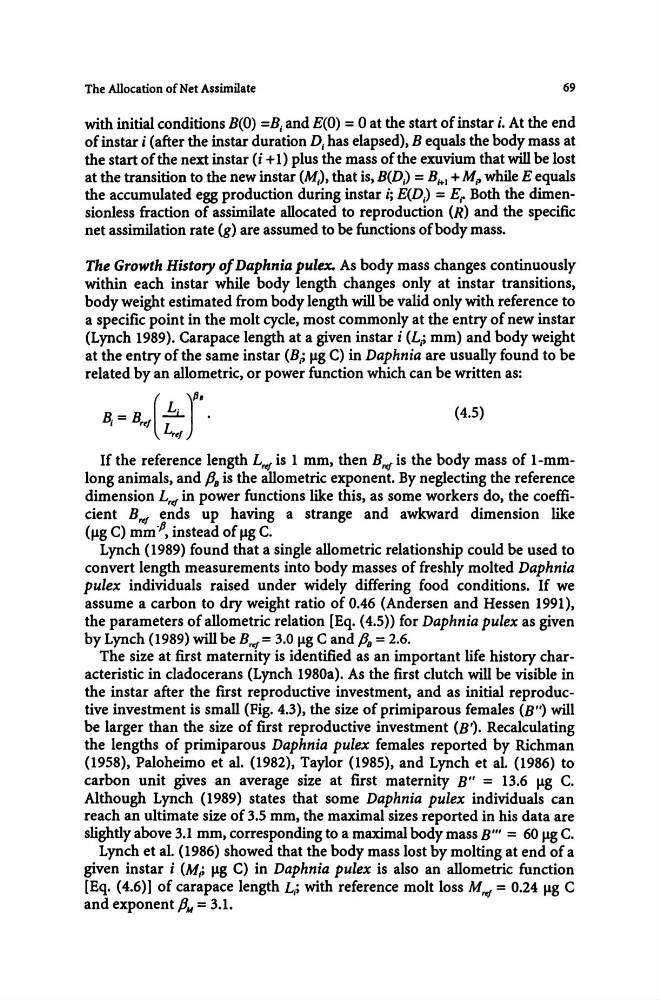
related by an allometric, or power function which can be written as:
1\ = 1\,,( tT
(4.5)
If the reference length L", is 1 mm, then B", is the body mass of I-mmlong animals, and PB is the allometric exponent. By neglecting the reference
dimension L", in power functions like this, as some workers do, the coefficient B", ends up having a strange and awkward dimension like
(Jig C) mm .p, instead of Jig C.
Lynch (1989) found that a single allometric relationship could be used to
convert length measurements into body masses of freshly molted Daphnia
pulex individuals raised under widely differing food conditions. If we
assume a carbon to dry weight ratio of 0.46 (Andersen and Hessen 1991),
the parameters of allometric relation [Eq. (4.5» for Daphnia pulex as given
by Lynch (1989) will be B",= 3.0 Jig C and PB = 2.6.
The size at first maternity is identified as an important life history characteristic in dadocerans (Lynch 1980a). As the first dutch will be visible in
the instar after the first reproductive investment, and as initial reproductive investment is small (Fig. 4.3), the size of primiparous females (B") will
be larger than the size of first reproductive investment (B'). Recalculating
the lengths of primiparous Daphnia pulex females reported by Richman
(1958), Paloheimo et al. (1982), Taylor (1985), and Lynch et al. (1986) to
carbon unit gives an average size at first maternity B" = 13.6 Jig C.
Although Lynch (1989) states that some Daphnia pulex individuals can
reach an ultimate size of 3.5 mm, the maximal sizes reported in his data are
slightly above 3.1 mm, corresponding to a maximal body mass B'" = 60 J1S C.
Lynch et al. (1986) showed that the body mass lost by molting at end of a
given instar i (M,; Jig C) in Daphnia pulex is also an allometric function
[Eq. (4.6)] of carapace length L,; with reference molt loss M", = 0.24 Jig C
and exponent P", = 3.1.
69
with initial conditions B(O) =Bj and E(O) = 0 at the start of instar i. At the end
of instar i (after the instar duration D, has elapsed), B equals the body mass at
the start of the next instar (i + 1) plus the mass of the exuvium that will be lost
at the transition to the new instar (M,), that is, B(D,) = BI+I + Mp while E equals
the accumulated egg production during instar i; E(D,) = Er Both the dimensionless fraction of assimilate allocated to reproduction (R) and the specific
net assimilation rate (g) are assumed to be functions of body mass.
The Growth History of Daphnia pulex. As body mass changes continuously
within each instar while body length changes only at instar transitions,
body weight estimated from body length will be valid only with reference to
a specific point in the molt cycle, most commonly at the entry of new instar
(Lynch 1989). Carapace length at a given instar i (Lp mm) and body weight
at the entry of the same instar (Bp Jig C) in Daphnia are usually found to be
related by an allometric, or power function which can be written as:
1\ = 1\,,( tT
(4.5)
If the reference length L", is 1 mm, then B", is the body mass of I-mmlong animals, and PB is the allometric exponent. By neglecting the reference
dimension L", in power functions like this, as some workers do, the coefficient B", ends up having a strange and awkward dimension like
(Jig C) mm .p, instead of Jig C.
Lynch (1989) found that a single allometric relationship could be used to
convert length measurements into body masses of freshly molted Daphnia
pulex individuals raised under widely differing food conditions. If we
assume a carbon to dry weight ratio of 0.46 (Andersen and Hessen 1991),
the parameters of allometric relation [Eq. (4.5» for Daphnia pulex as given
by Lynch (1989) will be B",= 3.0 Jig C and PB = 2.6.
The size at first maternity is identified as an important life history characteristic in dadocerans (Lynch 1980a). As the first dutch will be visible in
the instar after the first reproductive investment, and as initial reproductive investment is small (Fig. 4.3), the size of primiparous females (B") will
be larger than the size of first reproductive investment (B'). Recalculating
the lengths of primiparous Daphnia pulex females reported by Richman
(1958), Paloheimo et al. (1982), Taylor (1985), and Lynch et al. (1986) to
carbon unit gives an average size at first maternity B" = 13.6 Jig C.
Although Lynch (1989) states that some Daphnia pulex individuals can
reach an ultimate size of 3.5 mm, the maximal sizes reported in his data are
slightly above 3.1 mm, corresponding to a maximal body mass B'" = 60 J1S C.
Lynch et al. (1986) showed that the body mass lost by molting at end of a
given instar i (M,; Jig C) in Daphnia pulex is also an allometric function
[Eq. (4.6)] of carapace length L,; with reference molt loss M", = 0.24 Jig C
and exponent P", = 3.1.