

50
Algae and Nutrients: Uptake and Utilization ofLimiting ...
Phosphorus Competition Between Algae and Bacteria. Although planktonic
bacteria have traditionally been considered as sources of inorganic nutrients
through their activity as mineralizers of dissolved organic material, recent
research has indicated that growth of heterotrophic bacteria may often appear
to be limited by inorganic nutrients rather than organic carbon (Azam et al.
1983; Thingstad 1987). It will therefore be of some importance to make an
assessment of the relative competitive abilities of these two functional compartments of the pelagic food web. Vadstein et al. (1988) found that bacteria
have variable internal stores of phosphorus, and that the relationship between
growth rate and P:C ratio could be descn"bed by the Droop model, much in the
same way as with algae. Data on phosphorus-limited growth in bacteria are
generally less abundant than for algae, but published values give a fair indication that the minimal P requirements of bacteria are an order of maFtude
higher than in algae. Bacterial P subsistence quotas [Qb'; (tJg P) (mg Cr] compiled by Shuter (1978) and Vadstein et al. (1988) range from 17 to 72, with a
median around 40.
As might be expected from the high minimum requirements for phosphorus
found in bacteria, their storage capacity seem to be limited compared to what is
observed in algae. For example, the data of Chen (1974) indicate Qb"IQ b ' = 2.2 in
Corynebacterium bovis, while observations from a natural community in the
lake Nesj0vatn (Vadstein et al. 1988) indicate Qb''1Qb' = 3 (when omitting one
high value that also was excluded in their fit to the Droop hyperbola). Assuming
a phosphorus storage capacity in bacteria around 3 translates the asymptotic
growth rate Jib = 0.13 h-I = 3.1 day"1 estimated in both Vadstein et al. (1988) and
Vadstein and Olsen (1989), to a maximal growth rate ofJ.l'~ = 2.1 day"l.
The relatively few data available (summarized in Table 5 of Vadstein and
Olsen 1989) indicate that maximal P-specific uptake affinities in planktonic bacteria are at least an order of magnitude larger than in phytoplankton, suggesting a typical value around a~ IQb' = 40 I (tJ8 pr l day-I for bacterio-plankton.
Combining this with a subsistence quota of 40 (tJ8 P) (mg Cr l gives a maximal P
uptake affinity of 1600 I (mg C)-I day"\ or more than two orders of magnitude
higher than the parameter value considered typical for algae in Table 3.1.
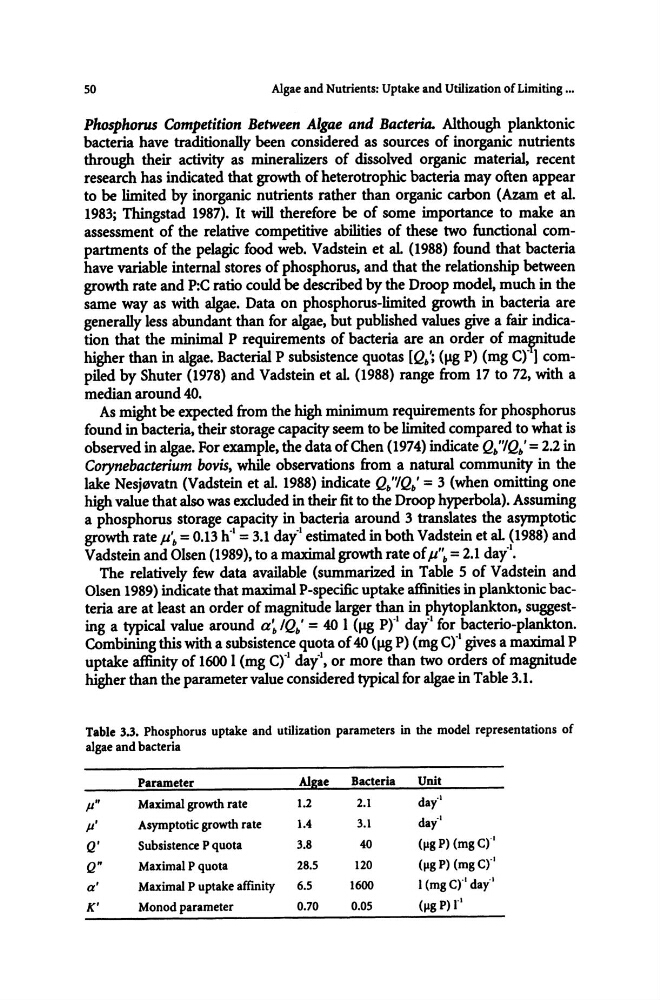
Table 3.3. Phosphorus uptake and utilization parameters in the model representations of
algae and bacteria
Parameter
AlS!e
Bacteria
Unit
p"
Maximal growth rate
1.2
2.1
day"'
p'
Asymptotic growth rate
1.4
3.1
day"'
Q'
Subsistence P quota
3.8
40
(l1g P) (mg Cr'
Q"
Maximal P quota
28.5
120
(l1g P) (mg Cr'
a'
Maximal P uptake affmity
6.5
1600
I (mg cr' day·'
K'
Monod parameter
0.70
0.05
(l1g P) r'
Algae and Nutrients: Uptake and Utilization ofLimiting ...
Phosphorus Competition Between Algae and Bacteria. Although planktonic
bacteria have traditionally been considered as sources of inorganic nutrients
through their activity as mineralizers of dissolved organic material, recent
research has indicated that growth of heterotrophic bacteria may often appear
to be limited by inorganic nutrients rather than organic carbon (Azam et al.
1983; Thingstad 1987). It will therefore be of some importance to make an
assessment of the relative competitive abilities of these two functional compartments of the pelagic food web. Vadstein et al. (1988) found that bacteria
have variable internal stores of phosphorus, and that the relationship between
growth rate and P:C ratio could be descn"bed by the Droop model, much in the
same way as with algae. Data on phosphorus-limited growth in bacteria are
generally less abundant than for algae, but published values give a fair indication that the minimal P requirements of bacteria are an order of maFtude
higher than in algae. Bacterial P subsistence quotas [Qb'; (tJg P) (mg Cr] compiled by Shuter (1978) and Vadstein et al. (1988) range from 17 to 72, with a
median around 40.
As might be expected from the high minimum requirements for phosphorus
found in bacteria, their storage capacity seem to be limited compared to what is
observed in algae. For example, the data of Chen (1974) indicate Qb"IQ b ' = 2.2 in
Corynebacterium bovis, while observations from a natural community in the
lake Nesj0vatn (Vadstein et al. 1988) indicate Qb''1Qb' = 3 (when omitting one
high value that also was excluded in their fit to the Droop hyperbola). Assuming
a phosphorus storage capacity in bacteria around 3 translates the asymptotic
growth rate Jib = 0.13 h-I = 3.1 day"1 estimated in both Vadstein et al. (1988) and
Vadstein and Olsen (1989), to a maximal growth rate ofJ.l'~ = 2.1 day"l.
The relatively few data available (summarized in Table 5 of Vadstein and
Olsen 1989) indicate that maximal P-specific uptake affinities in planktonic bacteria are at least an order of magnitude larger than in phytoplankton, suggesting a typical value around a~ IQb' = 40 I (tJ8 pr l day-I for bacterio-plankton.
Combining this with a subsistence quota of 40 (tJ8 P) (mg Cr l gives a maximal P
uptake affinity of 1600 I (mg C)-I day"\ or more than two orders of magnitude
higher than the parameter value considered typical for algae in Table 3.1.
Table 3.3. Phosphorus uptake and utilization parameters in the model representations of
algae and bacteria
Parameter
AlS!e
Bacteria
Unit
p"
Maximal growth rate
1.2
2.1
day"'
p'
Asymptotic growth rate
1.4
3.1
day"'
Q'
Subsistence P quota
3.8
40
(l1g P) (mg Cr'
Q"
Maximal P quota
28.5
120
(l1g P) (mg Cr'
a'
Maximal P uptake affmity
6.5
1600
I (mg cr' day·'
K'
Monod parameter
0.70
0.05
(l1g P) r'