

The Dynamics of the Pelagic Phosphorus Cycle
29
will be determined by the balance between growth and loss through the
differential equation
ZJ =[gj-(q + D)]~,
(2.12)
where 8 J and q are the specific growth and mortality rates (day"l) of
populationj.
Although the pool of dissolved inorganic phosphorus will almost always
be a minor fraction of total P, this compartment serves as the key link
between regeneration and uptake and will be an essential part of every
model describing exploitative competition for phosphorus between phytoplankton species. Without the interference of plankton organisms, the net
rate of change in the inorganic P concentration (P,) will be as for a conservative substance: the difference between the external supply rate and the
loss rate through the outflow [the first term in Eq. (2.13»). The activities of
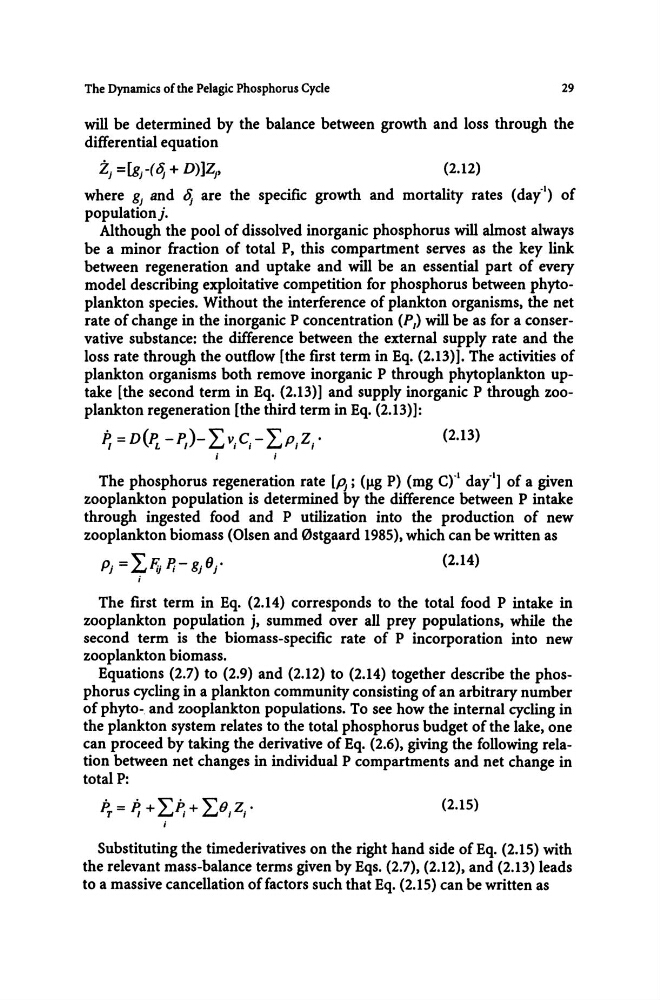
plankton organisms both remove inorganic P through phytoplankton uptake [the second term in Eq. (2.13») and supply inorganic P through zooplankton regeneration [the third term in Eq. (2.13»):
~ =D(Pz, -~)- ~>/C/- LP/Z/,
(2.13)
The phosphorus regeneration rate [.0; (J18 P) (mg Cr l day"l] of a given
zooplankton population is determined by the difference between P intake
through ingested food and P utilization into the production of new
zooplankton biomass (Olsen and 0stgaard 1985), which can be written as
Pj = LFv P;- 8/Jj'
(2.14)
;
The first term in Eq. (2.14) corresponds to the total food P intake in
zooplankton population j, summed over all prey populations, while the
second term is the biomass-specific rate of P incorporation into new
zooplankton biomass.
Equations (2.7) to (2.9) and (2.12) to (2.14) together describe the phosphorus cycling in a plankton community consisting of an arbitrary number
of phyto- and zooplankton populations. To see how the internal cycling in
the plankton system relates to the total phosphorus budget of the lake, one
can proceed by taking the derivative of Eq. (2.6), giving the following relation between net changes in individual P compartments and net change in
total P:
(2.15)
Substituting the timederivatives on the right hand side of Eq. (2.15) with
the relevant mass-balance terms given by Eqs. (2.7), (2.12), and (2.13) leads
to a massive cancellation of factors such that Eq. (2.15) can be written as
29
will be determined by the balance between growth and loss through the
differential equation
ZJ =[gj-(q + D)]~,
(2.12)
where 8 J and q are the specific growth and mortality rates (day"l) of
populationj.
Although the pool of dissolved inorganic phosphorus will almost always
be a minor fraction of total P, this compartment serves as the key link
between regeneration and uptake and will be an essential part of every
model describing exploitative competition for phosphorus between phytoplankton species. Without the interference of plankton organisms, the net
rate of change in the inorganic P concentration (P,) will be as for a conservative substance: the difference between the external supply rate and the
loss rate through the outflow [the first term in Eq. (2.13»). The activities of
plankton organisms both remove inorganic P through phytoplankton uptake [the second term in Eq. (2.13») and supply inorganic P through zooplankton regeneration [the third term in Eq. (2.13»):
~ =D(Pz, -~)- ~>/C/- LP/Z/,
(2.13)
The phosphorus regeneration rate [.0; (J18 P) (mg Cr l day"l] of a given
zooplankton population is determined by the difference between P intake
through ingested food and P utilization into the production of new
zooplankton biomass (Olsen and 0stgaard 1985), which can be written as
Pj = LFv P;- 8/Jj'
(2.14)
;
The first term in Eq. (2.14) corresponds to the total food P intake in
zooplankton population j, summed over all prey populations, while the
second term is the biomass-specific rate of P incorporation into new
zooplankton biomass.
Equations (2.7) to (2.9) and (2.12) to (2.14) together describe the phosphorus cycling in a plankton community consisting of an arbitrary number
of phyto- and zooplankton populations. To see how the internal cycling in
the plankton system relates to the total phosphorus budget of the lake, one
can proceed by taking the derivative of Eq. (2.6), giving the following relation between net changes in individual P compartments and net change in
total P:
(2.15)
Substituting the timederivatives on the right hand side of Eq. (2.15) with
the relevant mass-balance terms given by Eqs. (2.7), (2.12), and (2.13) leads
to a massive cancellation of factors such that Eq. (2.15) can be written as