

14
The Biogeochemical Theatre - Phosphorus Cycling and Phosphorus Household in Lakes
2.1 Phosphorus Mass-Balance Models
Based on the broad consensus that phosphorus is the mineral nutrient
most likely to become limiting to the yield of primary producers in lakes
(Schindler 1977, 1978), controlling P inputs and predicting responses to
changes in P loading have been among the major concerns of lake management. Prediction is commonly based on a family of phosphorus massbalance models directly descending from the pioneering work of Vollenweider (1968).
The total lake content of phosphorus is the product of the lake volume
(V; 1) and the total P concentration in the lake [Prj (Ilg P) rl), while the total
P loading rate is the product of the volume-averaged concentration in the inflowing water [P,; (Ilg P) n and the water flow into the lake
(q/; 1 day"I). Ifwe adopt the assumption that concentrations in the lake and
in the outflowing water are equal, which is often called the continuously
stirred tank reactor (CSTR) assumption in engineering literature (e.g.,
Reckhowand Chapra 1983), phosphorus will be lost through the outflow at
a rate which will be proportional to the water flow rate out of the lake
(qo; 1 day"l) and the concentration in the lake (P r ). For nonconservative elements like phosphorus, there will also be net losses or gains due to internal
processes in the lake [S,.; (Ilg P) r l day"I). The rate of change in lake content
will be the difference between gains from the inflow, losses through the
outflow, and the contribution from internal sources and sinks (here, and
elsewhere in the forthcoming sections, the notation x will mean the derivative of x with respect to time):
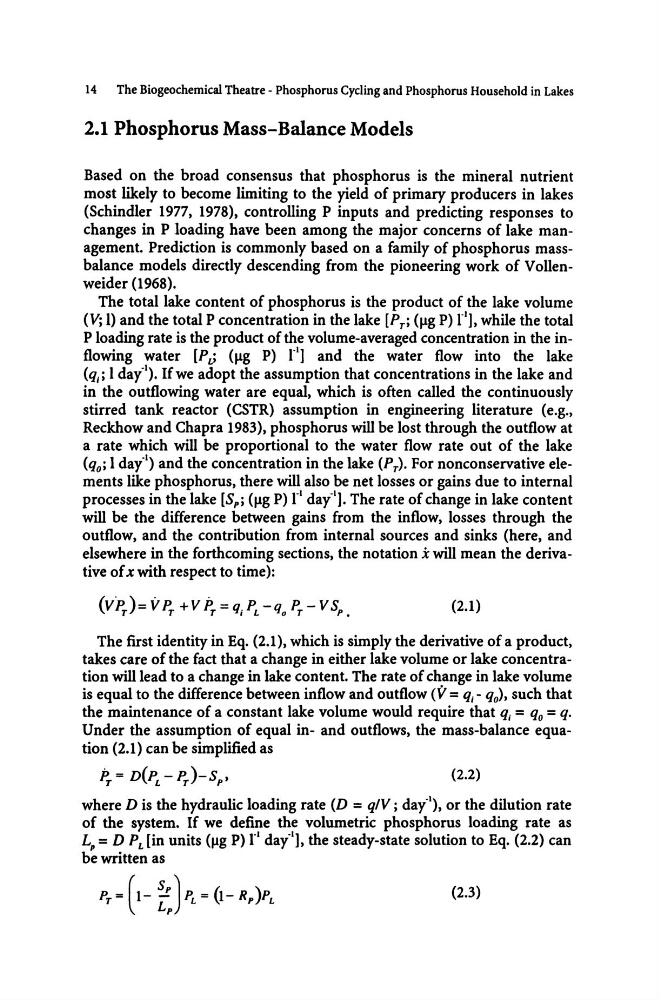
(2.1)
The first identity in Eq. (2.1), which is simply the derivative of a product,
takes care of the fact that a change in either lake volume or lake concentration will lead to a change in lake content. The rate of change in lake volume
is equal to the difference between inflow and outflow (V = q; - qo), such that
the maintenance of a constant lake volume would require that q/ = % = q.
Under the assumption of equal in- and outflows, the mass-balance equation (2.1) can be simplified as
i;. = D(P L - ~)-S,.,
(2.2)
where D is the hydraulic loading rate (D = q/V; day·I), or the dilution rate
of the system. If we define the volumetric phosphorus loading rate as
Lp = D P L [in units (Ilg P) r l day"I), the steady-state solution to Eq. (2.2) can
be written as
(2.3)
The Biogeochemical Theatre - Phosphorus Cycling and Phosphorus Household in Lakes
2.1 Phosphorus Mass-Balance Models
Based on the broad consensus that phosphorus is the mineral nutrient
most likely to become limiting to the yield of primary producers in lakes
(Schindler 1977, 1978), controlling P inputs and predicting responses to
changes in P loading have been among the major concerns of lake management. Prediction is commonly based on a family of phosphorus massbalance models directly descending from the pioneering work of Vollenweider (1968).
The total lake content of phosphorus is the product of the lake volume
(V; 1) and the total P concentration in the lake [Prj (Ilg P) rl), while the total
P loading rate is the product of the volume-averaged concentration in the inflowing water [P,; (Ilg P) n and the water flow into the lake
(q/; 1 day"I). Ifwe adopt the assumption that concentrations in the lake and
in the outflowing water are equal, which is often called the continuously
stirred tank reactor (CSTR) assumption in engineering literature (e.g.,
Reckhowand Chapra 1983), phosphorus will be lost through the outflow at
a rate which will be proportional to the water flow rate out of the lake
(qo; 1 day"l) and the concentration in the lake (P r ). For nonconservative elements like phosphorus, there will also be net losses or gains due to internal
processes in the lake [S,.; (Ilg P) r l day"I). The rate of change in lake content
will be the difference between gains from the inflow, losses through the
outflow, and the contribution from internal sources and sinks (here, and
elsewhere in the forthcoming sections, the notation x will mean the derivative of x with respect to time):
(2.1)
The first identity in Eq. (2.1), which is simply the derivative of a product,
takes care of the fact that a change in either lake volume or lake concentration will lead to a change in lake content. The rate of change in lake volume
is equal to the difference between inflow and outflow (V = q; - qo), such that
the maintenance of a constant lake volume would require that q/ = % = q.
Under the assumption of equal in- and outflows, the mass-balance equation (2.1) can be simplified as
i;. = D(P L - ~)-S,.,
(2.2)
where D is the hydraulic loading rate (D = q/V; day·I), or the dilution rate
of the system. If we define the volumetric phosphorus loading rate as
Lp = D P L [in units (Ilg P) r l day"I), the steady-state solution to Eq. (2.2) can
be written as
(2.3)