

170
Approaching Planktonic Food Webs: Competition, Coexistence, and Chaos
0.0
Achnanthes 1
RhodomoMS 2
Oscillatoria 2
Nitzschia 1
Scenedesmus I
Rhizochrysis 1
Cryptomonas 2
Synedra I
Elakatotrix I
Chlamydomonas 2
Chrysochronllllina 2
Anabaena 2
Ulotrix I
Asterionella I
MougeOlia 1
Stephanodiscus 2
Chlorella 2
Aphallizomenol1 2
Dinobryon 2
Fragilaria 2
Sphaerocysris I
•
•
•
Selectivity index
0.2
0.4
0.6
•
•
•
•
•
•
•
•
•
0.8
1.0
•
•
•
•
•
•
~--------------------------------------~
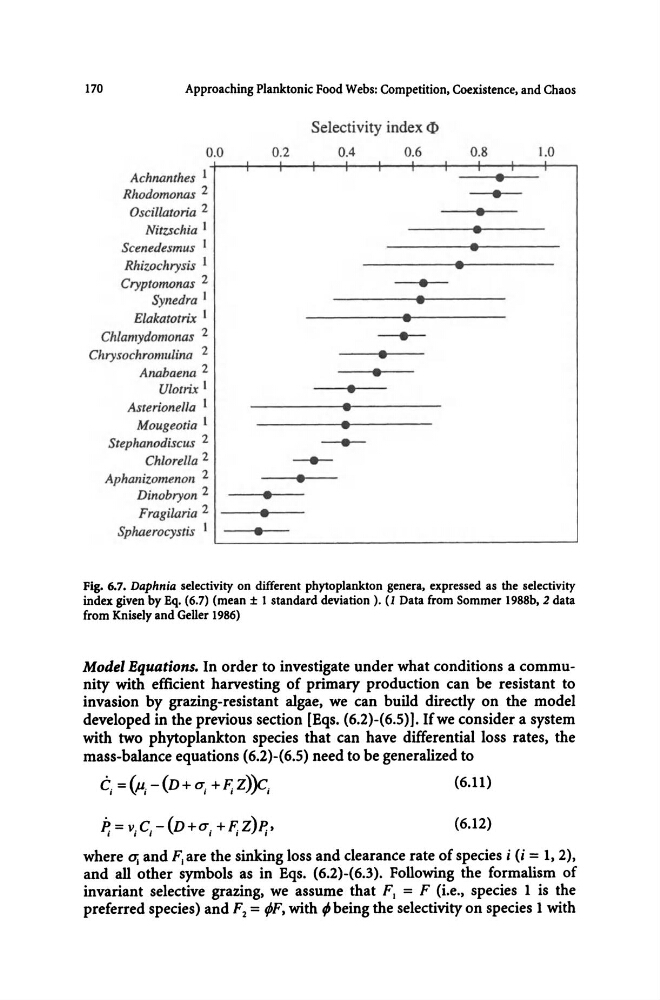
Fig. 6.7. Daphnia selectivity on different phytoplankton genera, expressed as the selectivity
index given by Eq. (6.7) (mean ± 1 standard deviation ). (1 Data from Sommer 1988b, 2 data
from Knisely and Geller 1986)
Model Equations. In order to investigate under what conditions a community with efficient harvesting of primary production can be resistant to
invasion by grazing-resistant algae, we can build directly on the model
developed in the previous section [Eqs. (6.2)-(6.5)]. Ifwe consider a system
with two phytoplankton species that can have differential loss rates, the
mass-balance equations (6.2)-(6.5) need to be generalized to
C. = { p. - (D + a. + F Z),\",.
(6.11)
, ~,
"
r./'-,
(6.12)
where OJ and F, are the sinking loss and clearance rate of species i (i = 1,2),
and all other symbols as in Eqs. (6.2}-{6.3). Following the formalism of
invariant selective grazing, we assume that F, = F (i.e., species 1 is the
preferred species) and F2 = tPF, with tP being the selectivity on species 1 with
Approaching Planktonic Food Webs: Competition, Coexistence, and Chaos
0.0
Achnanthes 1
RhodomoMS 2
Oscillatoria 2
Nitzschia 1
Scenedesmus I
Rhizochrysis 1
Cryptomonas 2
Synedra I
Elakatotrix I
Chlamydomonas 2
Chrysochronllllina 2
Anabaena 2
Ulotrix I
Asterionella I
MougeOlia 1
Stephanodiscus 2
Chlorella 2
Aphallizomenol1 2
Dinobryon 2
Fragilaria 2
Sphaerocysris I
•
•
•
Selectivity index
0.2
0.4
0.6
•
•
•
•
•
•
•
•
•
0.8
1.0
•
•
•
•
•
•
~--------------------------------------~
Fig. 6.7. Daphnia selectivity on different phytoplankton genera, expressed as the selectivity
index given by Eq. (6.7) (mean ± 1 standard deviation ). (1 Data from Sommer 1988b, 2 data
from Knisely and Geller 1986)
Model Equations. In order to investigate under what conditions a community with efficient harvesting of primary production can be resistant to
invasion by grazing-resistant algae, we can build directly on the model
developed in the previous section [Eqs. (6.2)-(6.5)]. Ifwe consider a system
with two phytoplankton species that can have differential loss rates, the
mass-balance equations (6.2)-(6.5) need to be generalized to
C. = { p. - (D + a. + F Z),\",.
(6.11)
, ~,
"
r./'-,
(6.12)
where OJ and F, are the sinking loss and clearance rate of species i (i = 1,2),
and all other symbols as in Eqs. (6.2}-{6.3). Following the formalism of
invariant selective grazing, we assume that F, = F (i.e., species 1 is the
preferred species) and F2 = tPF, with tP being the selectivity on species 1 with