

150
Nutrients, Algae and Herbivores - the Paradox of Enrichment Revisited
The positive correlation between algal and zooplankton biomasses does
not necessarily imply that zooplankton biomass is controlled by phytoplankton abundance. It could also be that the relationship is confounded
by both variables being controlled by a common third variable like total
phosphorus. In a phosphorus-limited lake, available phosphorus could
function as a common carrying capacity, setting the upper limit to the
potential yields of both phyto- and zooplankton biomasses. Several studies
have, in fact, found more of the variance in zooplankton abundance to be
explained by total phosphorus, than by algal biomass (Hanson and Peters
1984; Yan 1986; Hessen 1992).
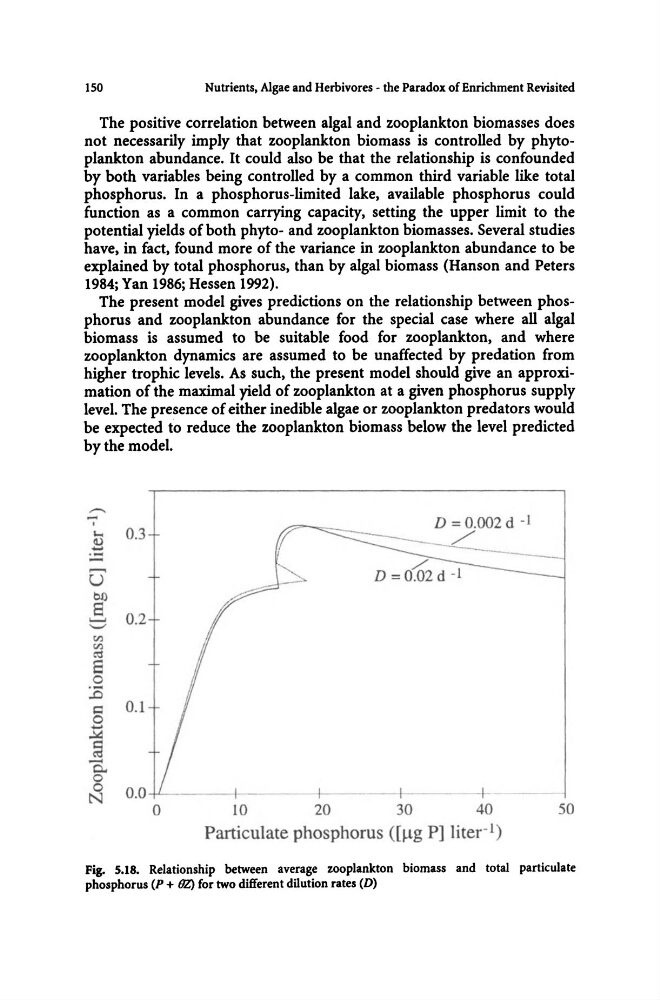
The present model gives predictions on the relationship between phosphorus and zooplankton abundance for the special case where all algal
biomass is assumed to be suitable food for zooplankton, and where
zooplankton dynamics are assumed to be unaffected by predation from
higher trophic levels. As such, the present model should give an approximation of the maximal yield of zooplankton at a given phosphorus supply
level. The presence of either inedible algae or zooplankton predators would
be expected to reduce the zooplankton biomass below the level predicted
by the model.
- .
t> 0.3
....
. -
-
U
bO
S
~
0.2
til
til
C':I
S
o
.....
.J:J
Q
o
~
- 0..
0.1
D=0.OO2d -1
:::::::::-----.- /
---.
D = 0:02 d -1
o
o
N
0.0 +'-- - -+-- - -+-- - -1- 1 - -
o
10
20
30
40
Particulate phosphorus ([~g P] liter-I)
50
Fig. S.18. Relationship between average zooplankton biomass and total particulate
phosphorus (P + HZ) for two different dilution rates (D)
Nutrients, Algae and Herbivores - the Paradox of Enrichment Revisited
The positive correlation between algal and zooplankton biomasses does
not necessarily imply that zooplankton biomass is controlled by phytoplankton abundance. It could also be that the relationship is confounded
by both variables being controlled by a common third variable like total
phosphorus. In a phosphorus-limited lake, available phosphorus could
function as a common carrying capacity, setting the upper limit to the
potential yields of both phyto- and zooplankton biomasses. Several studies
have, in fact, found more of the variance in zooplankton abundance to be
explained by total phosphorus, than by algal biomass (Hanson and Peters
1984; Yan 1986; Hessen 1992).
The present model gives predictions on the relationship between phosphorus and zooplankton abundance for the special case where all algal
biomass is assumed to be suitable food for zooplankton, and where
zooplankton dynamics are assumed to be unaffected by predation from
higher trophic levels. As such, the present model should give an approximation of the maximal yield of zooplankton at a given phosphorus supply
level. The presence of either inedible algae or zooplankton predators would
be expected to reduce the zooplankton biomass below the level predicted
by the model.
- .
t> 0.3
....
. -
-
U
bO
S
~
0.2
til
til
C':I
S
o
.....
.J:J
Q
o
~
- 0..
0.1
D=0.OO2d -1
:::::::::-----.- /
---.
D = 0:02 d -1
o
o
N
0.0 +'-- - -+-- - -+-- - -1- 1 - -
o
10
20
30
40
Particulate phosphorus ([~g P] liter-I)
50
Fig. S.18. Relationship between average zooplankton biomass and total particulate
phosphorus (P + HZ) for two different dilution rates (D)