

134
Nutrients. Algae and Herbivores - the Paradox of Enrichment Revisited
attraction will remain below a fIxed size as P loading is increased, which
again means that as P input is increased, the attraction basin of the internal
equilibrium will cover a diminishing fraction of the positive cone. In other
words, there will be an increasing likelihood that a given trajectory, starting
from a random initial condition, will lead to extinction of the grazer population when the system is enriched by increasing the P loading.
Focus or Limit Cycle. When the dilution rate is below the persistence
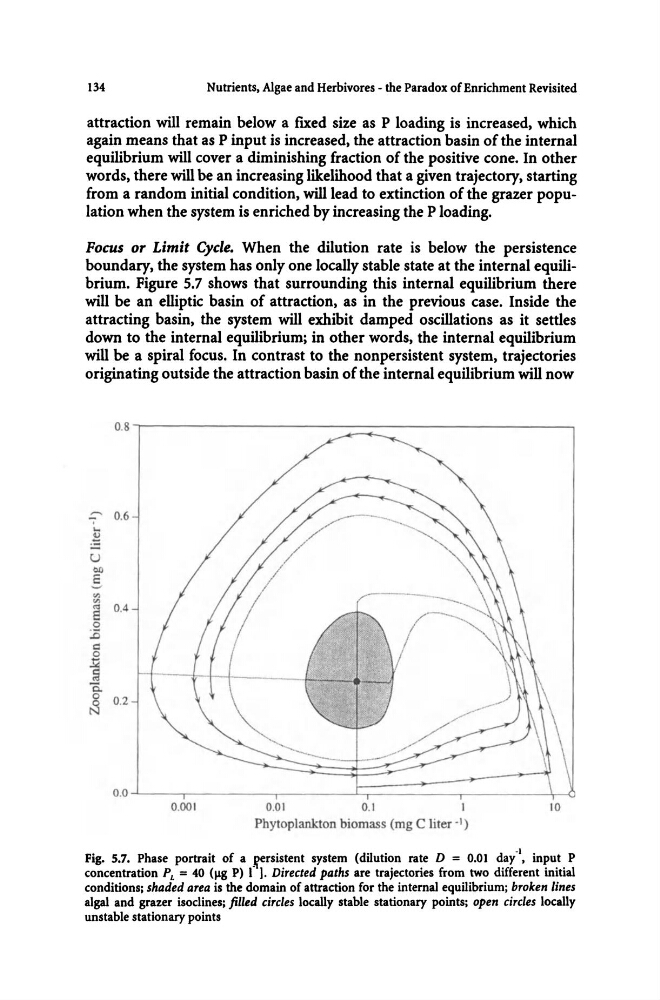
boundary, the system has only one locally stable state at the internal equilibrium. Figure 5.7 shows that surrounding this internal equilibrium there
will be an elliptic basin of attraction, as in the previous case. Inside the
attracting basin, the system will exhibit damped oscillations as it settles
down to the internal equilibrium; in other words, the internal equilibrium
will be a spiral focus. In contrast to the nonpersistent system, trajectories
originating outside the attraction basin of the internal equilibrium will now
0.8 . , - - - - - - - - - - - - - - - - - - - - - - - - ,
0.6
,
...
~
u
00
.s
'" '"
e
0.4
0
:0
c::
0
~
0.
0
0.2
~
o. o L-.,.---~==:1~~~=,=:====lj
0.001
0.01
0.1
1
10
Phytoplankton biomass (mg C liter -1)
Fig. 5.7. Phase portrait of a gersistent system (dilution rate D = 0.01 day'., input P
concentration P L = 40 (",g P) I J. Directed paths are trajectories from two different initial
conditions; shaded area is the domain of attraction for the internal equilibrium; broken lines
algal and grazer isoclines; filled circles locally stable stationary points; open circles locally
unstable stationary points
Nutrients. Algae and Herbivores - the Paradox of Enrichment Revisited
attraction will remain below a fIxed size as P loading is increased, which
again means that as P input is increased, the attraction basin of the internal
equilibrium will cover a diminishing fraction of the positive cone. In other
words, there will be an increasing likelihood that a given trajectory, starting
from a random initial condition, will lead to extinction of the grazer population when the system is enriched by increasing the P loading.
Focus or Limit Cycle. When the dilution rate is below the persistence
boundary, the system has only one locally stable state at the internal equilibrium. Figure 5.7 shows that surrounding this internal equilibrium there
will be an elliptic basin of attraction, as in the previous case. Inside the
attracting basin, the system will exhibit damped oscillations as it settles
down to the internal equilibrium; in other words, the internal equilibrium
will be a spiral focus. In contrast to the nonpersistent system, trajectories
originating outside the attraction basin of the internal equilibrium will now
0.8 . , - - - - - - - - - - - - - - - - - - - - - - - - ,
0.6
,
...
~
u
00
.s
'" '"
e
0.4
0
:0
c::
0
~
0.
0
0.2
~
o. o L-.,.---~==:1~~~=,=:====lj
0.001
0.01
0.1
1
10
Phytoplankton biomass (mg C liter -1)
Fig. 5.7. Phase portrait of a gersistent system (dilution rate D = 0.01 day'., input P
concentration P L = 40 (",g P) I J. Directed paths are trajectories from two different initial
conditions; shaded area is the domain of attraction for the internal equilibrium; broken lines
algal and grazer isoclines; filled circles locally stable stationary points; open circles locally
unstable stationary points