

120
Nutrients, Algae and Herbivores - the Paradox of Enrichment Revisited
Noticing that the specific ingestion rate / (dati) of the grazer is related to
the specific clearance rate F [1 (mg C)"I dati] by I = F C, we can reexpress
Eqs. (2.12) and (2.8), the mass-balance equations for phytoplankton and
zooplankton biomasses, as
Z=(X-(O+D»)z'
C=(P-(u+D)C-/Z
(5.1)
(5.2)
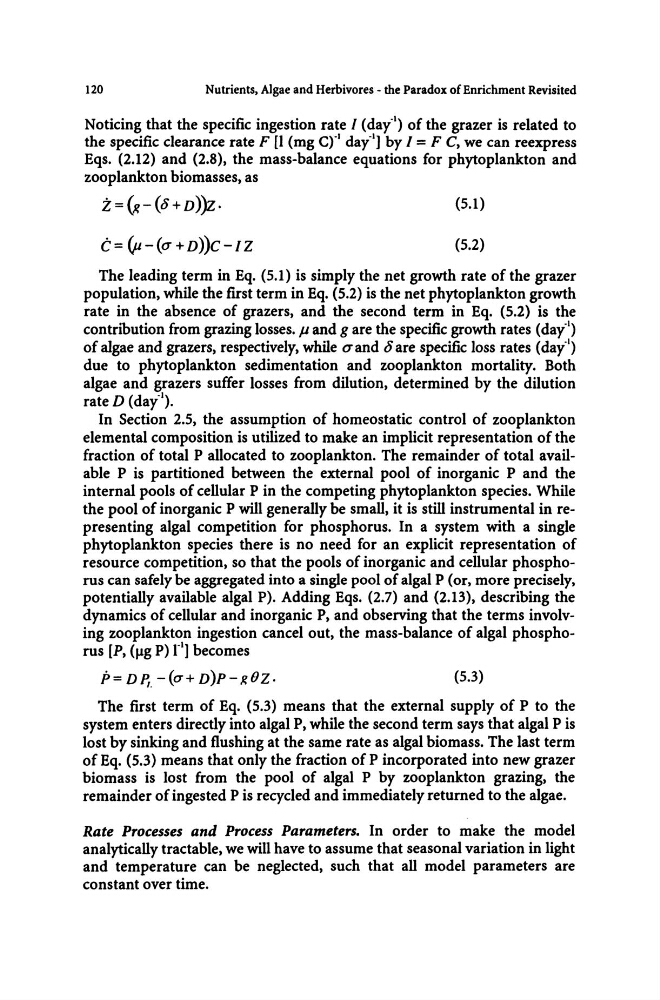
The leading term in Eq. (5.1) is simply the net growth rate of the grazer
population, while the fIrst term in Eq. (5.2) is the net phytoplankton growth
rate in the absence of grazers, and the second term in Eq. (5.2) is the
contnoution from grazing losses. II and g are the specific growth rates (dati)
of algae and grazers, respectively, while U and 8 are specific loss rates (dati)
due to phytoplankton sedimentation and zooplankton mortality. Both
algae and grazers suffer losses from dilution, determined by the dilution
rate D (dati).
In Section 2.5, the assumption of homeostatic control of zooplankton
elemental composition is utilized to make an implicit representation of the
fraction of total P allocated to zooplankton. The remainder of total available P is partitioned between the external pool of inorganic P and the
internal pools of cellular P in the competing phytoplankton species. While
the pool of inorganic P will generally be small, it is still instrumental in representing algal competition for phosphorus. In a system with a single
phytoplankton species there is no need for an explicit representation of
resource competition, so that the pools of inorganic and cellular phosphorus can safely be aggregated into a single pool of algal P (or, more precisely,
potentially available algal P). Adding Eqs. (2.7) and (2.13), describing the
dynamics of cellular and inorganic P, and observing that the terms involving zooplankton ingestion cancel out, the mass-balance of algal phosphorus [Po (JIg P) }"I] becomes
p= DP,. -(0'+ D)P-xBZ.
(5.3)
The fIrst term of Eq. (5.3) means that the external supply of P to the
system enters directly into algal P, while the second term says that algal P is
lost by sinking and flushing at the same rate as algal biomass. The last term
of Eq. (5.3) means that only the fraction of P incorporated into new grazer
biomass is lost from the pool of algal P by zooplankton grazing, the
remainder of ingested P is recycled and immediately returned to the algae.
Rate Processes and Process Parameters. In order to make the model
analytically tractable, we will have to assume that seasonal variation in light
and temperature can be neglected, such that all model parameters are
constant over time.
Nutrients, Algae and Herbivores - the Paradox of Enrichment Revisited
Noticing that the specific ingestion rate / (dati) of the grazer is related to
the specific clearance rate F [1 (mg C)"I dati] by I = F C, we can reexpress
Eqs. (2.12) and (2.8), the mass-balance equations for phytoplankton and
zooplankton biomasses, as
Z=(X-(O+D»)z'
C=(P-(u+D)C-/Z
(5.1)
(5.2)
The leading term in Eq. (5.1) is simply the net growth rate of the grazer
population, while the fIrst term in Eq. (5.2) is the net phytoplankton growth
rate in the absence of grazers, and the second term in Eq. (5.2) is the
contnoution from grazing losses. II and g are the specific growth rates (dati)
of algae and grazers, respectively, while U and 8 are specific loss rates (dati)
due to phytoplankton sedimentation and zooplankton mortality. Both
algae and grazers suffer losses from dilution, determined by the dilution
rate D (dati).
In Section 2.5, the assumption of homeostatic control of zooplankton
elemental composition is utilized to make an implicit representation of the
fraction of total P allocated to zooplankton. The remainder of total available P is partitioned between the external pool of inorganic P and the
internal pools of cellular P in the competing phytoplankton species. While
the pool of inorganic P will generally be small, it is still instrumental in representing algal competition for phosphorus. In a system with a single
phytoplankton species there is no need for an explicit representation of
resource competition, so that the pools of inorganic and cellular phosphorus can safely be aggregated into a single pool of algal P (or, more precisely,
potentially available algal P). Adding Eqs. (2.7) and (2.13), describing the
dynamics of cellular and inorganic P, and observing that the terms involving zooplankton ingestion cancel out, the mass-balance of algal phosphorus [Po (JIg P) }"I] becomes
p= DP,. -(0'+ D)P-xBZ.
(5.3)
The fIrst term of Eq. (5.3) means that the external supply of P to the
system enters directly into algal P, while the second term says that algal P is
lost by sinking and flushing at the same rate as algal biomass. The last term
of Eq. (5.3) means that only the fraction of P incorporated into new grazer
biomass is lost from the pool of algal P by zooplankton grazing, the
remainder of ingested P is recycled and immediately returned to the algae.
Rate Processes and Process Parameters. In order to make the model
analytically tractable, we will have to assume that seasonal variation in light
and temperature can be neglected, such that all model parameters are
constant over time.