

Population Survival and Proliferation: Demography
107
Intrinsic rate
of increase
Asymptotic
death rate
Threshold
food level
(
= --I ••••• f-·--· - -
B~ r----__ :~----------~----------··~ r.---.----C' ----f----.
e
~?£_==~~
-.,
-
. .
~
h
-.... - - -- . - . - - - - - - . - ----_
'" 8" r -...... - - - - - - - - - - -.-----------f-- - -
J! B'
R' I----.-.I------.. - - - - -t--- - -- - -110 f--.t-------------j •••• I-- ...... --- - - - . - -----j
, 1----1-- ------------+-- - ------ -.-------x
-
_
·0.5
0.0
0.5
-0.5
0.0
0.5
-0.5
0.0
0.5
Relative sensitivity
Relative sensitivity
Relative sensitivity
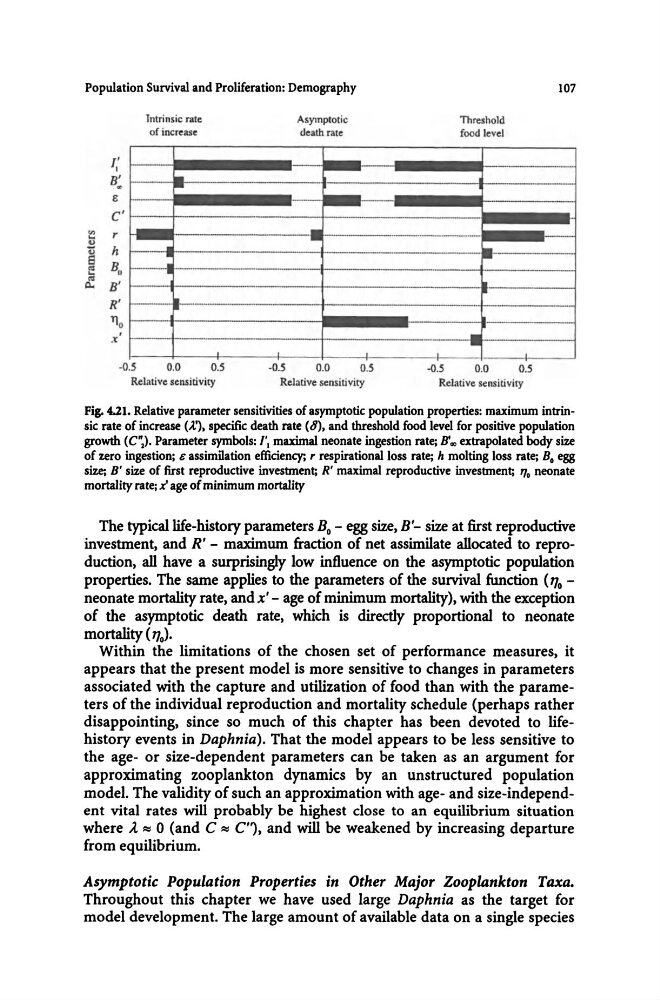
Fig. 4.21. Relative parameter sensitivities of asymptotic population properties: maximum intrinsic rate of increase (A'), specific death rate (8), and threshold food level for positive population
growth (C",). Parameter symbols: 1', maximal neonate ingestion rate; B' ao extrapolated body size
of zero ingestion; & assimilation efficiency; r respirational loss rate; h molting loss rate; B. egg
size; B' size of first reproductive investment; R' maximal reproductive investment; 110 neonate
mortality rate; x age of minimum mortality
The typical life-history parameters Bo - egg size, B'- size at first reproductive
investment, and R' - maximum fraction of net assimilate allocated to reproduction, all have a surprisingly low influence on the asymptotic population
properties. The same applies to the parameters of the survival function (1'/0 -
neonate mortality rate, and x' - age of minimum mortality), with the exception
of the asymptotic death rate, which is directly proportional to neonate
mortality (1'/0)'
Within the limitations of the chosen set of performance measures, it
appears that the present model is more sensitive to changes in parameters
associated with the capture and utilization of food than with the parameters of the individual reproduction and mortality schedule (perhaps rather
disappointing, since so much of this chapter has been devoted to lifehistory events in Daphnia). That the model appears to be less sensitive to
the age- or size-dependent parameters can be taken as an argument for
approximating zooplankton dynamics by an unstructured population
model. The validity of such an approximation with age- and size-independent vital rates will probably be highest close to an equilibrium situation
where A ~ 0 (and C ~ C'1, and will be weakened by increasing departure
from equilibrium.
Asymptotic Population Properties in Other Major Zooplankton Taxa.
Throughout this chapter we have used large Daphnia as the target for
model development. The large amount of available data on a single species
107
Intrinsic rate
of increase
Asymptotic
death rate
Threshold
food level
(
= --I ••••• f-·--· - -
B~ r----__ :~----------~----------··~ r.---.----C' ----f----.
e
~?£_==~~
-.,
-
. .
~
h
-.... - - -- . - . - - - - - - . - ----_
'" 8" r -...... - - - - - - - - - - -.-----------f-- - -
J! B'
R' I----.-.I------.. - - - - -t--- - -- - -110 f--.t-------------j •••• I-- ...... --- - - - . - -----j
, 1----1-- ------------+-- - ------ -.-------x
-
_
·0.5
0.0
0.5
-0.5
0.0
0.5
-0.5
0.0
0.5
Relative sensitivity
Relative sensitivity
Relative sensitivity
Fig. 4.21. Relative parameter sensitivities of asymptotic population properties: maximum intrinsic rate of increase (A'), specific death rate (8), and threshold food level for positive population
growth (C",). Parameter symbols: 1', maximal neonate ingestion rate; B' ao extrapolated body size
of zero ingestion; & assimilation efficiency; r respirational loss rate; h molting loss rate; B. egg
size; B' size of first reproductive investment; R' maximal reproductive investment; 110 neonate
mortality rate; x age of minimum mortality
The typical life-history parameters Bo - egg size, B'- size at first reproductive
investment, and R' - maximum fraction of net assimilate allocated to reproduction, all have a surprisingly low influence on the asymptotic population
properties. The same applies to the parameters of the survival function (1'/0 -
neonate mortality rate, and x' - age of minimum mortality), with the exception
of the asymptotic death rate, which is directly proportional to neonate
mortality (1'/0)'
Within the limitations of the chosen set of performance measures, it
appears that the present model is more sensitive to changes in parameters
associated with the capture and utilization of food than with the parameters of the individual reproduction and mortality schedule (perhaps rather
disappointing, since so much of this chapter has been devoted to lifehistory events in Daphnia). That the model appears to be less sensitive to
the age- or size-dependent parameters can be taken as an argument for
approximating zooplankton dynamics by an unstructured population
model. The validity of such an approximation with age- and size-independent vital rates will probably be highest close to an equilibrium situation
where A ~ 0 (and C ~ C'1, and will be weakened by increasing departure
from equilibrium.
Asymptotic Population Properties in Other Major Zooplankton Taxa.
Throughout this chapter we have used large Daphnia as the target for
model development. The large amount of available data on a single species