

Population Survival and Proliferation: Demography
101
Fecundity and Food Limitation. At a given food level C [(mg C) r1], the
solution of the Daphnia growth model [Eqs. (4.14)-(4.17)] will give as
output body size, net assimilation rate, and fraction of net assimilate
allocated to reproduction [B(x), g(x), and R(x),] as functions of age (x). The
maternity function, m(x), is defined as the number of offspring produced
by a female of a given age in a unit of time, or the net allocation rate to egg
production (R g B) divided by the mass of a single egg (Bo):
m(x) = R(x)g(x)B(x).
(4.31)
Bo
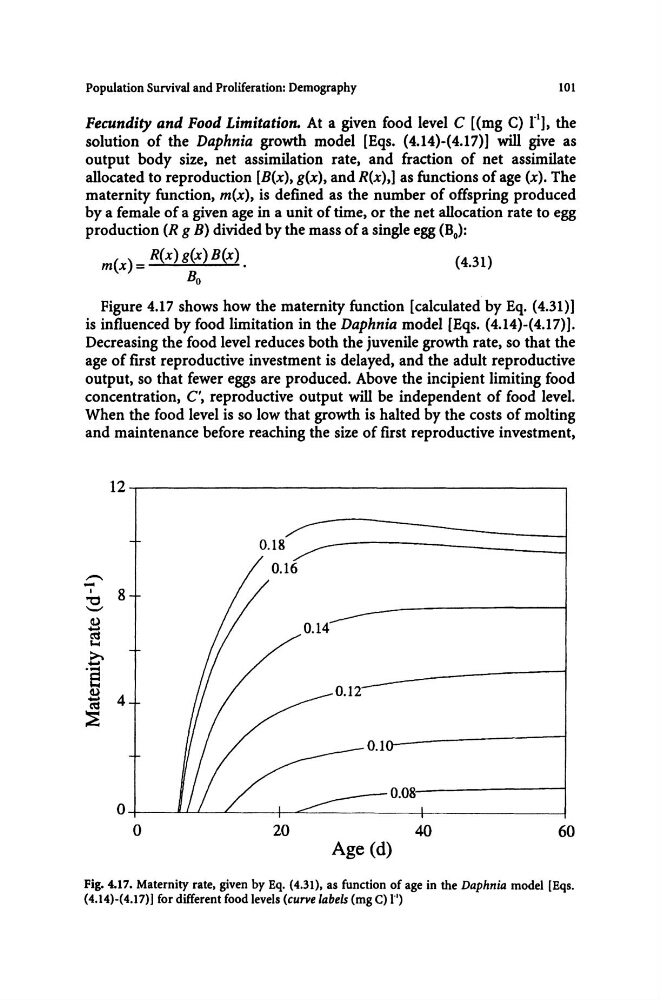
Figure 4.17 shows how the maternity function [calculated by Eq. (4.31)]
is influenced by food limitation in the Daphnia model [Eqs. (4.14)-(4.17)].
Decreasing the food level reduces both the juvenile growth rate, so that the
age of first reproductive investment is delayed, and the adult reproductive
output, so that fewer eggs are produced. Above the incipient limiting food
concentration, C', reproductive output will be independent of food level.
When the food level is so low that growth is halted by the costs of molting
and maintenance before reaching the size of fIrst reproductive investment,
12~------------------------------------~
-
- , 8
"0
'-"
0
~
""'
a
·s
0
4
ii
:s
0.1
0.08
0
0
20
40
60
Age (d)
Fig. 4.17. Maternity rate, given by Eq. (4.31), as function of age in the Daphnia model [Bqs.
(4.14)-(4.17)] for different food levels (curve labels (mgC) 1"' )
101
Fecundity and Food Limitation. At a given food level C [(mg C) r1], the
solution of the Daphnia growth model [Eqs. (4.14)-(4.17)] will give as
output body size, net assimilation rate, and fraction of net assimilate
allocated to reproduction [B(x), g(x), and R(x),] as functions of age (x). The
maternity function, m(x), is defined as the number of offspring produced
by a female of a given age in a unit of time, or the net allocation rate to egg
production (R g B) divided by the mass of a single egg (Bo):
m(x) = R(x)g(x)B(x).
(4.31)
Bo
Figure 4.17 shows how the maternity function [calculated by Eq. (4.31)]
is influenced by food limitation in the Daphnia model [Eqs. (4.14)-(4.17)].
Decreasing the food level reduces both the juvenile growth rate, so that the
age of first reproductive investment is delayed, and the adult reproductive
output, so that fewer eggs are produced. Above the incipient limiting food
concentration, C', reproductive output will be independent of food level.
When the food level is so low that growth is halted by the costs of molting
and maintenance before reaching the size of fIrst reproductive investment,
12~------------------------------------~
-
- , 8
"0
'-"
0
~
""'
a
·s
0
4
ii
:s
0.1
0.08
0
0
20
40
60
Age (d)
Fig. 4.17. Maternity rate, given by Eq. (4.31), as function of age in the Daphnia model [Bqs.
(4.14)-(4.17)] for different food levels (curve labels (mgC) 1"' )