

The Economy of Essential Elements
93
g = g' - (g')' (1- (Q/8)t
(4.25)
g'=e·l- r .
(4.26)
Equation (4.26) gives the net assimilation rate g' that would result if food
composition were optimal (e = e\ while Eq. (4.25) contains the reduction
in realized growth when food is P deficient. Eq. (4.25) is formulated so that
growth will be unaffected by food P content if the total carbon intake is
insufficient to maintain positive growth.
If P [(Il§ P) rl] is the concentration ofP contained in food particles and C
[(mg C) r] is the food C concentration, food composition will be suboptimal whenever P < BC, while food abundance will be limiting when C < C'.
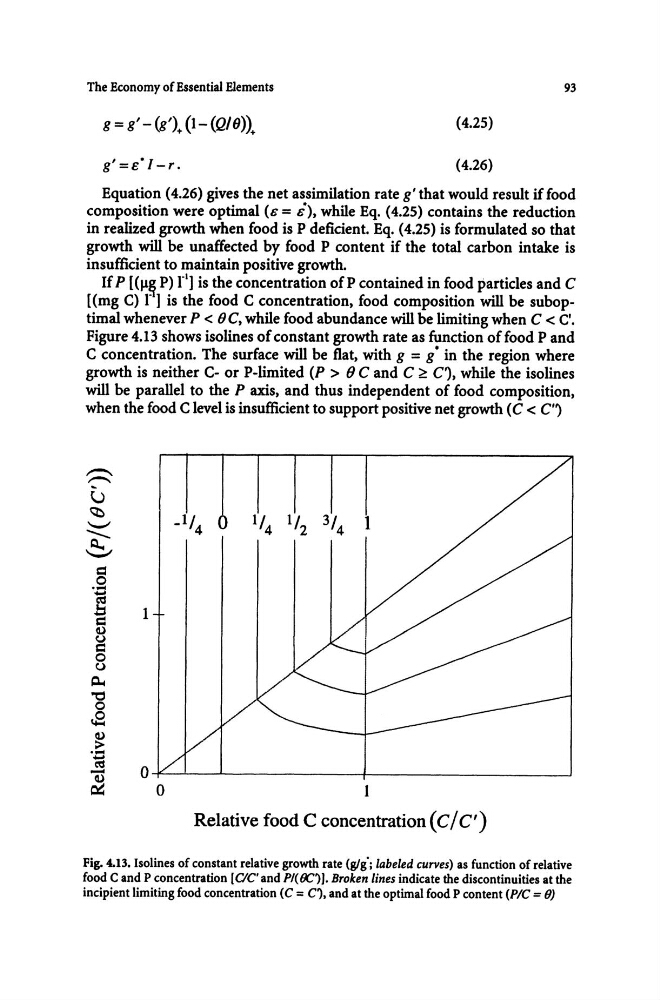
Figure 4.13 shows isolines of constant growth rate as function offood P and
C concentration. The surface will be flat, with g = g. in the region where
growth is neither C- or P-limited (P > 0 C and C ~ C1, while the isolines
will be parallel to the P axis, and thus independent of food composition,
when the food C level is insufficient to support positive net growth (C < C',
1
o~~--~--------------;---------------------~
o
Relative food C concentration (c / C')
Fig. 4.13. Isolines of constant relative growth rate (gig'; labeled curves) as function of relative
food C and P concentration (ClC' and PI( 8C)]. Broken lines indicate the discontinuities at the
incipient limiting food concentration (C = C~, and at the optimal food P content (PIC = 0)
93
g = g' - (g')' (1- (Q/8)t
(4.25)
g'=e·l- r .
(4.26)
Equation (4.26) gives the net assimilation rate g' that would result if food
composition were optimal (e = e\ while Eq. (4.25) contains the reduction
in realized growth when food is P deficient. Eq. (4.25) is formulated so that
growth will be unaffected by food P content if the total carbon intake is
insufficient to maintain positive growth.
If P [(Il§ P) rl] is the concentration ofP contained in food particles and C
[(mg C) r] is the food C concentration, food composition will be suboptimal whenever P < BC, while food abundance will be limiting when C < C'.
Figure 4.13 shows isolines of constant growth rate as function offood P and
C concentration. The surface will be flat, with g = g. in the region where
growth is neither C- or P-limited (P > 0 C and C ~ C1, while the isolines
will be parallel to the P axis, and thus independent of food composition,
when the food C level is insufficient to support positive net growth (C < C',
1
o~~--~--------------;---------------------~
o
Relative food C concentration (c / C')
Fig. 4.13. Isolines of constant relative growth rate (gig'; labeled curves) as function of relative
food C and P concentration (ClC' and PI( 8C)]. Broken lines indicate the discontinuities at the
incipient limiting food concentration (C = C~, and at the optimal food P content (PIC = 0)