

alexandri, Ophidiaster bayeri, Tamaria floridae and Tamaria halperni in the
Western Atlantic, Ophidiaster agassizi, Ophidiaster ludwigi along the Pacific
coasts, and Tamaria obstipa and Tamaria stria. Ophidiaster guildingii and Ophidiaster ophidianus in the Anfiatlantic. Narcissia canariensis and N. trigonaria are
Anfiatlantic, Narcissia gracilis and the subspecies N. gracilis malpeloensis occur
in the Pacific.
The second axis represents a Western–Eastern gradient. Pentametrocrinidae,
Elpidiidae, Hyocrinidae and Spatangidae characterize the positive part of this axis.
Pentametrocrinidae is present in the Canary Islands and is not shared with south
American regions, Elpidiidae and Hyocrinidae are shared by the Canary Islands
and all the Pacific regions except Easter Island, but are absent in the South
American coasts. In the same way, Spatangidae is a family shared by the Canary
Islands and the Pacific Mexican coast but is absent from the other regions.
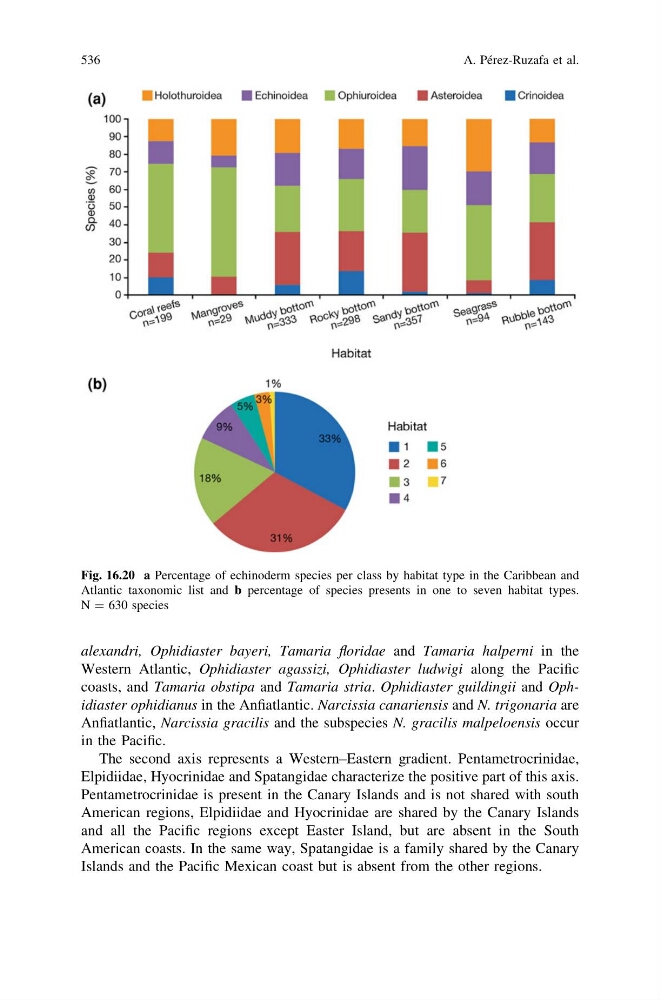
Fig. 16.20 a Percentage of echinoderm species per class by habitat type in the Caribbean and
Atlantic taxonomic list and b percentage of species presents in one to seven habitat types.
N = 630 species
536
A. Pérez-Ruzafa et al.
Western Atlantic, Ophidiaster agassizi, Ophidiaster ludwigi along the Pacific
coasts, and Tamaria obstipa and Tamaria stria. Ophidiaster guildingii and Ophidiaster ophidianus in the Anfiatlantic. Narcissia canariensis and N. trigonaria are
Anfiatlantic, Narcissia gracilis and the subspecies N. gracilis malpeloensis occur
in the Pacific.
The second axis represents a Western–Eastern gradient. Pentametrocrinidae,
Elpidiidae, Hyocrinidae and Spatangidae characterize the positive part of this axis.
Pentametrocrinidae is present in the Canary Islands and is not shared with south
American regions, Elpidiidae and Hyocrinidae are shared by the Canary Islands
and all the Pacific regions except Easter Island, but are absent in the South
American coasts. In the same way, Spatangidae is a family shared by the Canary
Islands and the Pacific Mexican coast but is absent from the other regions.
Fig. 16.20 a Percentage of echinoderm species per class by habitat type in the Caribbean and
Atlantic taxonomic list and b percentage of species presents in one to seven habitat types.
N = 630 species
536
A. Pérez-Ruzafa et al.