

The fishery is limited from Coronado Islands to Isla Natividad in Baja
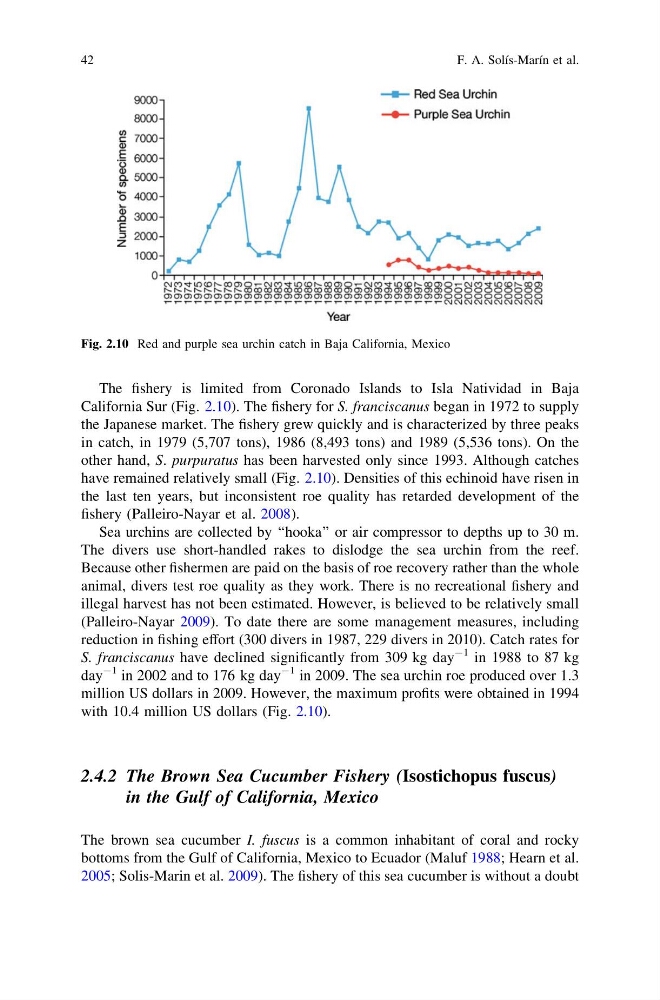
California Sur (Fig. 2.10). The fishery for S. franciscanus began in 1972 to supply
the Japanese market. The fishery grew quickly and is characterized by three peaks
in catch, in 1979 (5,707 tons), 1986 (8,493 tons) and 1989 (5,536 tons). On the
other hand, S. purpuratus has been harvested only since 1993. Although catches
have remained relatively small (Fig. 2.10). Densities of this echinoid have risen in
the last ten years, but inconsistent roe quality has retarded development of the
fishery (Palleiro-Nayar et al. 2008).
Sea urchins are collected by ‘‘hooka’’ or air compressor to depths up to 30 m.
The divers use short-handled rakes to dislodge the sea urchin from the reef.
Because other fishermen are paid on the basis of roe recovery rather than the whole
animal, divers test roe quality as they work. There is no recreational fishery and
illegal harvest has not been estimated. However, is believed to be relatively small
(Palleiro-Nayar 2009). To date there are some management measures, including
reduction in fishing effort (300 divers in 1987, 229 divers in 2010). Catch rates for
S. franciscanus have declined significantly from 309 kg day
-1 in 1988 to 87 kg
day
-1 in 2002 and to 176 kg day
-1 in 2009. The sea urchin roe produced over 1.3
million US dollars in 2009. However, the maximum profits were obtained in 1994
with 10.4 million US dollars (Fig. 2.10).
2.4.2 The Brown Sea Cucumber Fishery (Isostichopus fuscus)
in the Gulf of California, Mexico
The brown sea cucumber I. fuscus is a common inhabitant of coral and rocky
bottoms from the Gulf of California, Mexico to Ecuador (Maluf 1988; Hearn et al.
2005; Solis-Marin et al. 2009). The fishery of this sea cucumber is without a doubt
Fig. 2.10 Red and purple sea urchin catch in Baja California, Mexico
42
F. A. Solís-Marín et al.
California Sur (Fig. 2.10). The fishery for S. franciscanus began in 1972 to supply
the Japanese market. The fishery grew quickly and is characterized by three peaks
in catch, in 1979 (5,707 tons), 1986 (8,493 tons) and 1989 (5,536 tons). On the
other hand, S. purpuratus has been harvested only since 1993. Although catches
have remained relatively small (Fig. 2.10). Densities of this echinoid have risen in
the last ten years, but inconsistent roe quality has retarded development of the
fishery (Palleiro-Nayar et al. 2008).
Sea urchins are collected by ‘‘hooka’’ or air compressor to depths up to 30 m.
The divers use short-handled rakes to dislodge the sea urchin from the reef.
Because other fishermen are paid on the basis of roe recovery rather than the whole
animal, divers test roe quality as they work. There is no recreational fishery and
illegal harvest has not been estimated. However, is believed to be relatively small
(Palleiro-Nayar 2009). To date there are some management measures, including
reduction in fishing effort (300 divers in 1987, 229 divers in 2010). Catch rates for
S. franciscanus have declined significantly from 309 kg day
-1 in 1988 to 87 kg
day
-1 in 2002 and to 176 kg day
-1 in 2009. The sea urchin roe produced over 1.3
million US dollars in 2009. However, the maximum profits were obtained in 1994
with 10.4 million US dollars (Fig. 2.10).
2.4.2 The Brown Sea Cucumber Fishery (Isostichopus fuscus)
in the Gulf of California, Mexico
The brown sea cucumber I. fuscus is a common inhabitant of coral and rocky
bottoms from the Gulf of California, Mexico to Ecuador (Maluf 1988; Hearn et al.
2005; Solis-Marin et al. 2009). The fishery of this sea cucumber is without a doubt
Fig. 2.10 Red and purple sea urchin catch in Baja California, Mexico
42
F. A. Solís-Marín et al.