

the sea stars Oreaster reticulatus, Nymphaster arenatus, the sea urchins Diadema
antillarum antillarum, Brissus unicolor and the holothuroid Euapta lappa.
Cosmopolitan species are an important component in all the biogeographical
regions (Fig. 16.11). Except the Chilean and the Easter Island provinces, which are
dominated by cold temperate species. The Central and South American regions are
dominated by tropical species and to a lesser extent, temperate species with a wide
distribution range. In the Canary Islands, the warm temperate component is also
important.
Similarity between country faunas depends on climatic and trophic conditions
and on geographical proximity. The number of shared species is highly dependent
on the distance separating two countries (Fig. 16.12). The diminishing proportion
of shared species between two areas with increasing geographical distance is an
obvious feature of natural systems (Hengeveld 1990; Huston 1994; Rosenzweig
1995; Brown and Lomolino 1998; Hubbell 2001).
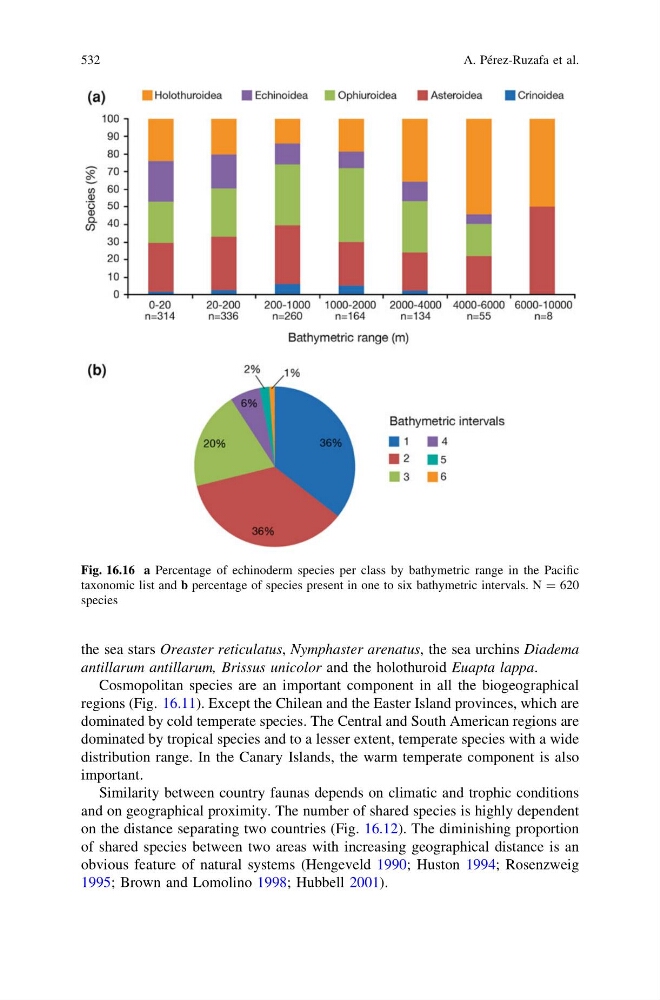
Fig. 16.16 a Percentage of echinoderm species per class by bathymetric range in the Pacific
taxonomic list and b percentage of species present in one to six bathymetric intervals. N = 620
species
532
A. Pérez-Ruzafa et al.
antillarum antillarum, Brissus unicolor and the holothuroid Euapta lappa.
Cosmopolitan species are an important component in all the biogeographical
regions (Fig. 16.11). Except the Chilean and the Easter Island provinces, which are
dominated by cold temperate species. The Central and South American regions are
dominated by tropical species and to a lesser extent, temperate species with a wide
distribution range. In the Canary Islands, the warm temperate component is also
important.
Similarity between country faunas depends on climatic and trophic conditions
and on geographical proximity. The number of shared species is highly dependent
on the distance separating two countries (Fig. 16.12). The diminishing proportion
of shared species between two areas with increasing geographical distance is an
obvious feature of natural systems (Hengeveld 1990; Huston 1994; Rosenzweig
1995; Brown and Lomolino 1998; Hubbell 2001).
Fig. 16.16 a Percentage of echinoderm species per class by bathymetric range in the Pacific
taxonomic list and b percentage of species present in one to six bathymetric intervals. N = 620
species
532
A. Pérez-Ruzafa et al.