

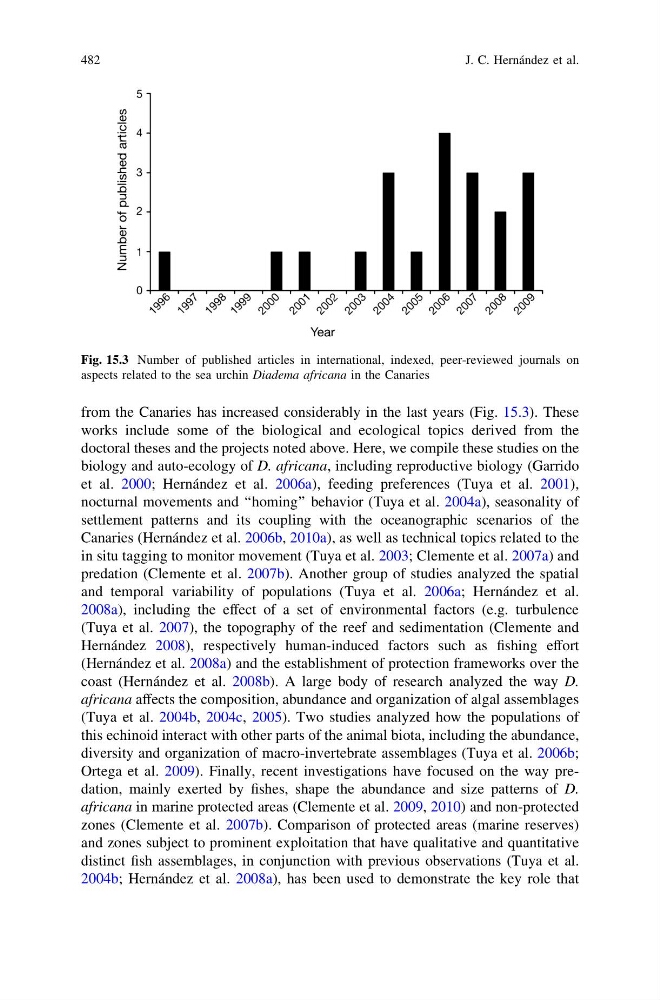
from the Canaries has increased considerably in the last years (Fig. 15.3). These
works include some of the biological and ecological topics derived from the
doctoral theses and the projects noted above. Here, we compile these studies on the
biology and auto-ecology of D. africana, including reproductive biology (Garrido
et al. 2000; Hernández et al. 2006a), feeding preferences (Tuya et al. 2001),
nocturnal movements and ‘‘homing’’ behavior (Tuya et al. 2004a), seasonality of
settlement patterns and its coupling with the oceanographic scenarios of the
Canaries (Hernández et al. 2006b, 2010a), as well as technical topics related to the
in situ tagging to monitor movement (Tuya et al. 2003; Clemente et al. 2007a) and
predation (Clemente et al. 2007b). Another group of studies analyzed the spatial
and temporal variability of populations (Tuya et al. 2006a; Hernández et al.
2008a), including the effect of a set of environmental factors (e.g. turbulence
(Tuya et al. 2007), the topography of the reef and sedimentation (Clemente and
Hernández 2008), respectively human-induced factors such as fishing effort
(Hernández et al. 2008a) and the establishment of protection frameworks over the
coast (Hernández et al. 2008b). A large body of research analyzed the way D.
africana affects the composition, abundance and organization of algal assemblages
(Tuya et al. 2004b, 2004c, 2005). Two studies analyzed how the populations of
this echinoid interact with other parts of the animal biota, including the abundance,
diversity and organization of macro-invertebrate assemblages (Tuya et al. 2006b;
Ortega et al. 2009). Finally, recent investigations have focused on the way predation, mainly exerted by fishes, shape the abundance and size patterns of D.
africana in marine protected areas (Clemente et al. 2009, 2010) and non-protected
zones (Clemente et al. 2007b). Comparison of protected areas (marine reserves)
and zones subject to prominent exploitation that have qualitative and quantitative
distinct fish assemblages, in conjunction with previous observations (Tuya et al.
2004b; Hernández et al. 2008a), has been used to demonstrate the key role that
Fig. 15.3 Number of published articles in international, indexed, peer-reviewed journals on
aspects related to the sea urchin Diadema africana in the Canaries
482
J. C. Hernández et al.
works include some of the biological and ecological topics derived from the
doctoral theses and the projects noted above. Here, we compile these studies on the
biology and auto-ecology of D. africana, including reproductive biology (Garrido
et al. 2000; Hernández et al. 2006a), feeding preferences (Tuya et al. 2001),
nocturnal movements and ‘‘homing’’ behavior (Tuya et al. 2004a), seasonality of
settlement patterns and its coupling with the oceanographic scenarios of the
Canaries (Hernández et al. 2006b, 2010a), as well as technical topics related to the
in situ tagging to monitor movement (Tuya et al. 2003; Clemente et al. 2007a) and
predation (Clemente et al. 2007b). Another group of studies analyzed the spatial
and temporal variability of populations (Tuya et al. 2006a; Hernández et al.
2008a), including the effect of a set of environmental factors (e.g. turbulence
(Tuya et al. 2007), the topography of the reef and sedimentation (Clemente and
Hernández 2008), respectively human-induced factors such as fishing effort
(Hernández et al. 2008a) and the establishment of protection frameworks over the
coast (Hernández et al. 2008b). A large body of research analyzed the way D.
africana affects the composition, abundance and organization of algal assemblages
(Tuya et al. 2004b, 2004c, 2005). Two studies analyzed how the populations of
this echinoid interact with other parts of the animal biota, including the abundance,
diversity and organization of macro-invertebrate assemblages (Tuya et al. 2006b;
Ortega et al. 2009). Finally, recent investigations have focused on the way predation, mainly exerted by fishes, shape the abundance and size patterns of D.
africana in marine protected areas (Clemente et al. 2009, 2010) and non-protected
zones (Clemente et al. 2007b). Comparison of protected areas (marine reserves)
and zones subject to prominent exploitation that have qualitative and quantitative
distinct fish assemblages, in conjunction with previous observations (Tuya et al.
2004b; Hernández et al. 2008a), has been used to demonstrate the key role that
Fig. 15.3 Number of published articles in international, indexed, peer-reviewed journals on
aspects related to the sea urchin Diadema africana in the Canaries
482
J. C. Hernández et al.