

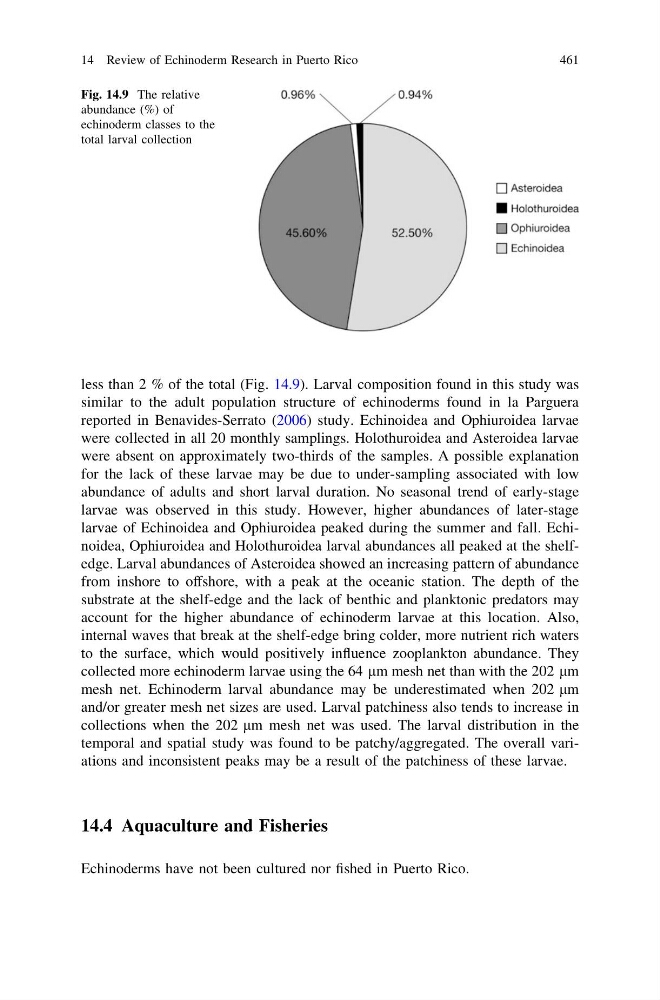
less than 2 % of the total (Fig. 14.9). Larval composition found in this study was
similar to the adult population structure of echinoderms found in la Parguera
reported in Benavides-Serrato (2006) study. Echinoidea and Ophiuroidea larvae
were collected in all 20 monthly samplings. Holothuroidea and Asteroidea larvae
were absent on approximately two-thirds of the samples. A possible explanation
for the lack of these larvae may be due to under-sampling associated with low
abundance of adults and short larval duration. No seasonal trend of early-stage
larvae was observed in this study. However, higher abundances of later-stage
larvae of Echinoidea and Ophiuroidea peaked during the summer and fall. Echinoidea, Ophiuroidea and Holothuroidea larval abundances all peaked at the shelfedge. Larval abundances of Asteroidea showed an increasing pattern of abundance
from inshore to offshore, with a peak at the oceanic station. The depth of the
substrate at the shelf-edge and the lack of benthic and planktonic predators may
account for the higher abundance of echinoderm larvae at this location. Also,
internal waves that break at the shelf-edge bring colder, more nutrient rich waters
to the surface, which would positively influence zooplankton abundance. They
collected more echinoderm larvae using the 64 lm mesh net than with the 202 lm
mesh net. Echinoderm larval abundance may be underestimated when 202 lm
and/or greater mesh net sizes are used. Larval patchiness also tends to increase in
collections when the 202 lm mesh net was used. The larval distribution in the
temporal and spatial study was found to be patchy/aggregated. The overall variations and inconsistent peaks may be a result of the patchiness of these larvae.
14.4 Aquaculture and Fisheries
Echinoderms have not been cultured nor fished in Puerto Rico.
Fig. 14.9 The relative
abundance (%) of
echinoderm classes to the
total larval collection
14 Review of Echinoderm Research in Puerto Rico
461
similar to the adult population structure of echinoderms found in la Parguera
reported in Benavides-Serrato (2006) study. Echinoidea and Ophiuroidea larvae
were collected in all 20 monthly samplings. Holothuroidea and Asteroidea larvae
were absent on approximately two-thirds of the samples. A possible explanation
for the lack of these larvae may be due to under-sampling associated with low
abundance of adults and short larval duration. No seasonal trend of early-stage
larvae was observed in this study. However, higher abundances of later-stage
larvae of Echinoidea and Ophiuroidea peaked during the summer and fall. Echinoidea, Ophiuroidea and Holothuroidea larval abundances all peaked at the shelfedge. Larval abundances of Asteroidea showed an increasing pattern of abundance
from inshore to offshore, with a peak at the oceanic station. The depth of the
substrate at the shelf-edge and the lack of benthic and planktonic predators may
account for the higher abundance of echinoderm larvae at this location. Also,
internal waves that break at the shelf-edge bring colder, more nutrient rich waters
to the surface, which would positively influence zooplankton abundance. They
collected more echinoderm larvae using the 64 lm mesh net than with the 202 lm
mesh net. Echinoderm larval abundance may be underestimated when 202 lm
and/or greater mesh net sizes are used. Larval patchiness also tends to increase in
collections when the 202 lm mesh net was used. The larval distribution in the
temporal and spatial study was found to be patchy/aggregated. The overall variations and inconsistent peaks may be a result of the patchiness of these larvae.
14.4 Aquaculture and Fisheries
Echinoderms have not been cultured nor fished in Puerto Rico.
Fig. 14.9 The relative
abundance (%) of
echinoderm classes to the
total larval collection
14 Review of Echinoderm Research in Puerto Rico
461