

been studied more in depth and their evolutionary associations have been welldescribed. This is the case for Hox genes (Méndez et al. 2000, serum amyloid
A protein (Santiago et al. 2000) and ependymin (Suarez-Castillo et al. 2007). The
latter is an excellent example of how studies in holothurians have served to
establish evolutionary patterns. In this case, prior to our study, ependymins were
thought to be a vertebrate-specific family. Its characterization in H. glaberrima
showed it was present in various invertebrate groups.
14.3 Distribution and Diversity of Echinoderms
Based on Hendler et al. (1995), Benavides-Serrato (2006), Pawson et al. (2009)
and the database of the National Museum of Natural History (NMNH) in Puerto
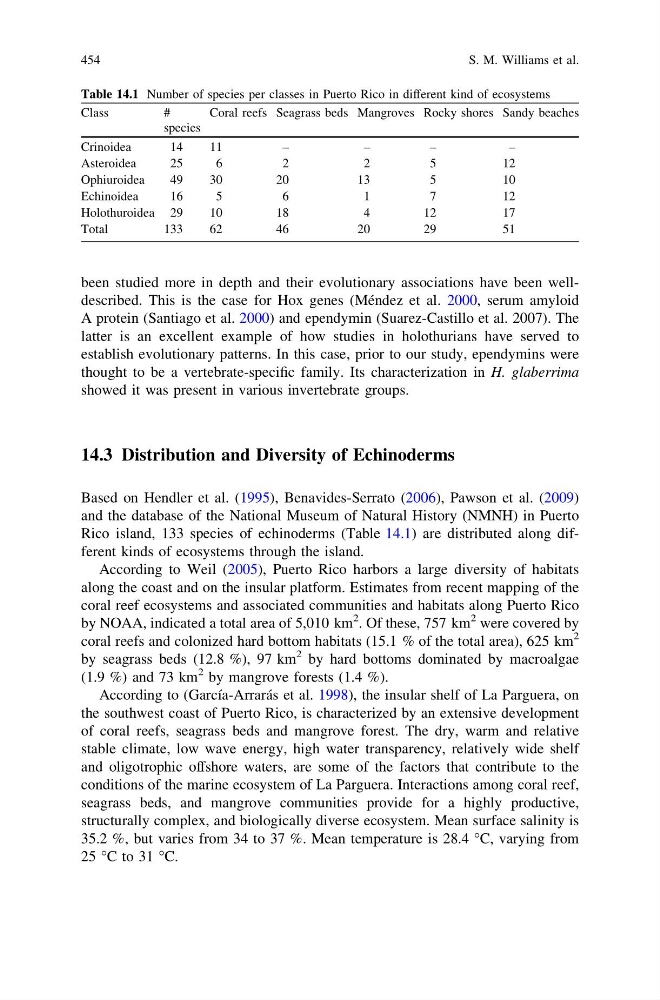
Rico island, 133 species of echinoderms (Table 14.1) are distributed along different kinds of ecosystems through the island.
According to Weil (2005), Puerto Rico harbors a large diversity of habitats
along the coast and on the insular platform. Estimates from recent mapping of the
coral reef ecosystems and associated communities and habitats along Puerto Rico
by NOAA, indicated a total area of 5,010 km
2 . Of these, 757 km
2 were covered by
coral reefs and colonized hard bottom habitats (15.1 % of the total area), 625 km
2
by seagrass beds (12.8 %), 97 km
2 by hard bottoms dominated by macroalgae
(1.9 %) and 73 km
2 by mangrove forests (1.4 %).
According to (García-Arrarás et al. 1998), the insular shelf of La Parguera, on
the southwest coast of Puerto Rico, is characterized by an extensive development
of coral reefs, seagrass beds and mangrove forest. The dry, warm and relative
stable climate, low wave energy, high water transparency, relatively wide shelf
and oligotrophic offshore waters, are some of the factors that contribute to the
conditions of the marine ecosystem of La Parguera. Interactions among coral reef,
seagrass beds, and mangrove communities provide for a highly productive,
structurally complex, and biologically diverse ecosystem. Mean surface salinity is
35.2 %, but varies from 34 to 37 %. Mean temperature is 28.4 °C, varying from
25 °C to 31 °C.
Table 14.1 Number of species per classes in Puerto Rico in different kind of ecosystems
Class
#
species
Coral reefs Seagrass beds Mangroves Rocky shores Sandy beaches
Crinoidea
14
11
–
–
–
–
Asteroidea
25
6
2
2
5
12
Ophiuroidea
49
30
20
13
5
10
Echinoidea
16
5
6
1
7
12
Holothuroidea 29
10
18
4
12
17
Total
133
62
46
20
29
51
454
S. M. Williams et al.
A protein (Santiago et al. 2000) and ependymin (Suarez-Castillo et al. 2007). The
latter is an excellent example of how studies in holothurians have served to
establish evolutionary patterns. In this case, prior to our study, ependymins were
thought to be a vertebrate-specific family. Its characterization in H. glaberrima
showed it was present in various invertebrate groups.
14.3 Distribution and Diversity of Echinoderms
Based on Hendler et al. (1995), Benavides-Serrato (2006), Pawson et al. (2009)
and the database of the National Museum of Natural History (NMNH) in Puerto
Rico island, 133 species of echinoderms (Table 14.1) are distributed along different kinds of ecosystems through the island.
According to Weil (2005), Puerto Rico harbors a large diversity of habitats
along the coast and on the insular platform. Estimates from recent mapping of the
coral reef ecosystems and associated communities and habitats along Puerto Rico
by NOAA, indicated a total area of 5,010 km
2 . Of these, 757 km
2 were covered by
coral reefs and colonized hard bottom habitats (15.1 % of the total area), 625 km
2
by seagrass beds (12.8 %), 97 km
2 by hard bottoms dominated by macroalgae
(1.9 %) and 73 km
2 by mangrove forests (1.4 %).
According to (García-Arrarás et al. 1998), the insular shelf of La Parguera, on
the southwest coast of Puerto Rico, is characterized by an extensive development
of coral reefs, seagrass beds and mangrove forest. The dry, warm and relative
stable climate, low wave energy, high water transparency, relatively wide shelf
and oligotrophic offshore waters, are some of the factors that contribute to the
conditions of the marine ecosystem of La Parguera. Interactions among coral reef,
seagrass beds, and mangrove communities provide for a highly productive,
structurally complex, and biologically diverse ecosystem. Mean surface salinity is
35.2 %, but varies from 34 to 37 %. Mean temperature is 28.4 °C, varying from
25 °C to 31 °C.
Table 14.1 Number of species per classes in Puerto Rico in different kind of ecosystems
Class
#
species
Coral reefs Seagrass beds Mangroves Rocky shores Sandy beaches
Crinoidea
14
11
–
–
–
–
Asteroidea
25
6
2
2
5
12
Ophiuroidea
49
30
20
13
5
10
Echinoidea
16
5
6
1
7
12
Holothuroidea 29
10
18
4
12
17
Total
133
62
46
20
29
51
454
S. M. Williams et al.