

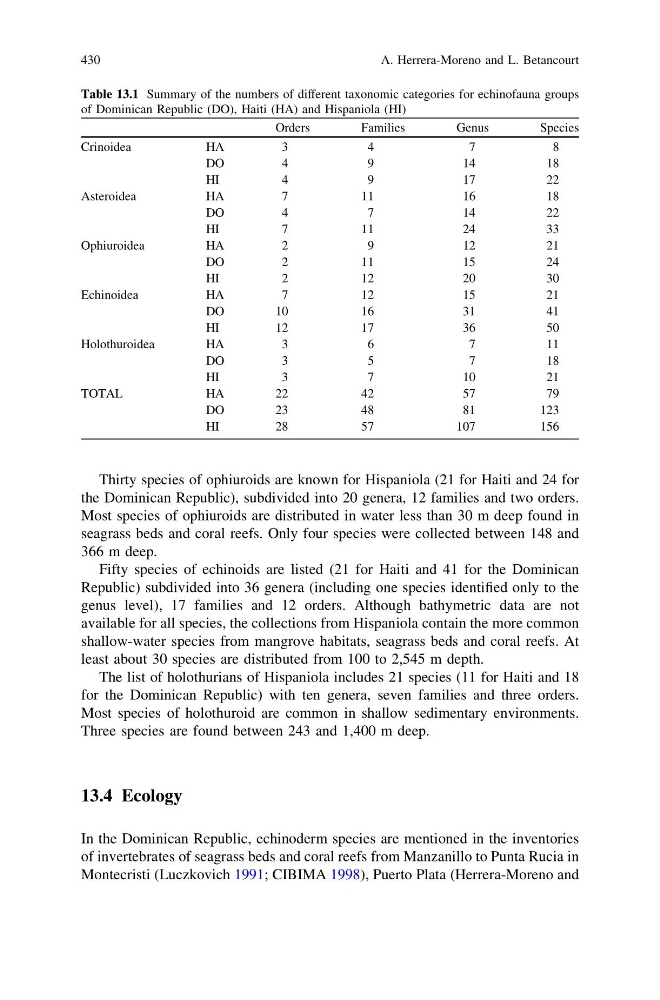
Thirty species of ophiuroids are known for Hispaniola (21 for Haiti and 24 for
the Dominican Republic), subdivided into 20 genera, 12 families and two orders.
Most species of ophiuroids are distributed in water less than 30 m deep found in
seagrass beds and coral reefs. Only four species were collected between 148 and
366 m deep.
Fifty species of echinoids are listed (21 for Haiti and 41 for the Dominican
Republic) subdivided into 36 genera (including one species identified only to the
genus level), 17 families and 12 orders. Although bathymetric data are not
available for all species, the collections from Hispaniola contain the more common
shallow-water species from mangrove habitats, seagrass beds and coral reefs. At
least about 30 species are distributed from 100 to 2,545 m depth.
The list of holothurians of Hispaniola includes 21 species (11 for Haiti and 18
for the Dominican Republic) with ten genera, seven families and three orders.
Most species of holothuroid are common in shallow sedimentary environments.
Three species are found between 243 and 1,400 m deep.
13.4 Ecology
In the Dominican Republic, echinoderm species are mentioned in the inventories
of invertebrates of seagrass beds and coral reefs from Manzanillo to Punta Rucia in
Montecristi (Luczkovich 1991; CIBIMA 1998), Puerto Plata (Herrera-Moreno and
Table 13.1 Summary of the numbers of different taxonomic categories for echinofauna groups
of Dominican Republic (DO), Haiti (HA) and Hispaniola (HI)
Orders
Families
Genus
Species
Crinoidea
HA
3
4
7
8
DO
4
9
14
18
HI
4
9
17
22
Asteroidea
HA
7
11
16
18
DO
4
7
14
22
HI
7
11
24
33
Ophiuroidea
HA
2
9
12
21
DO
2
11
15
24
HI
2
12
20
30
Echinoidea
HA
7
12
15
21
DO
10
16
31
41
HI
12
17
36
50
Holothuroidea
HA
3
6
7
11
DO
3
5
7
18
HI
3
7
10
21
TOTAL
HA
22
42
57
79
DO
23
48
81
123
HI
28
57
107
156
430
A. Herrera-Moreno and L. Betancourt
the Dominican Republic), subdivided into 20 genera, 12 families and two orders.
Most species of ophiuroids are distributed in water less than 30 m deep found in
seagrass beds and coral reefs. Only four species were collected between 148 and
366 m deep.
Fifty species of echinoids are listed (21 for Haiti and 41 for the Dominican
Republic) subdivided into 36 genera (including one species identified only to the
genus level), 17 families and 12 orders. Although bathymetric data are not
available for all species, the collections from Hispaniola contain the more common
shallow-water species from mangrove habitats, seagrass beds and coral reefs. At
least about 30 species are distributed from 100 to 2,545 m depth.
The list of holothurians of Hispaniola includes 21 species (11 for Haiti and 18
for the Dominican Republic) with ten genera, seven families and three orders.
Most species of holothuroid are common in shallow sedimentary environments.
Three species are found between 243 and 1,400 m deep.
13.4 Ecology
In the Dominican Republic, echinoderm species are mentioned in the inventories
of invertebrates of seagrass beds and coral reefs from Manzanillo to Punta Rucia in
Montecristi (Luczkovich 1991; CIBIMA 1998), Puerto Plata (Herrera-Moreno and
Table 13.1 Summary of the numbers of different taxonomic categories for echinofauna groups
of Dominican Republic (DO), Haiti (HA) and Hispaniola (HI)
Orders
Families
Genus
Species
Crinoidea
HA
3
4
7
8
DO
4
9
14
18
HI
4
9
17
22
Asteroidea
HA
7
11
16
18
DO
4
7
14
22
HI
7
11
24
33
Ophiuroidea
HA
2
9
12
21
DO
2
11
15
24
HI
2
12
20
30
Echinoidea
HA
7
12
15
21
DO
10
16
31
41
HI
12
17
36
50
Holothuroidea
HA
3
6
7
11
DO
3
5
7
18
HI
3
7
10
21
TOTAL
HA
22
42
57
79
DO
23
48
81
123
HI
28
57
107
156
430
A. Herrera-Moreno and L. Betancourt